And Niemand descended from his mountain and came to the marketplace, where he found a great multitude of lonely men and women.
“Behold my terrible burden!” cried one. “I question what others blindly accept! My thoughts are dangerous! I am unwelcome at parties and unbearable in group chats! Such is the price of thinking clearly!”
And seven thousand people applauded him.
Then another stood forth and cried, “Woe is me! For I have read many books, and ordinary conversation has become intolerable to me! Everywhere I encounter ignorance, incuriosity, and a want of empathy! How it saddens me to dwell among such people!”
And three thousand people applauded her.
Niemand was astonished.
“Truly,” he said, “I have never seen so many lonely people gathered in one place! Tell me, brothers and sisters, what dreadful truths have you discovered that have made you strangers to your fellow men?”
And the first replied, “That most men do not think for themselves!”
“And how did you discover this?”
“I read it on the internet!”
“And you?” Niemand asked the second. “What have your books taught you?”
“That ordinary people are narrow-minded, incurious, and incapable of seeing the world through another’s eyes!”
“And have you tried seeing the world through theirs?”
But the woman was busy ridding herself of “the ick.”
Then Niemand spoke again.
“Beware, my brothers and sisters, lest you mistake your contempt for insight, and your vanity for independence! Perhaps the man who finds you tiresome is not an enemy of thought. Perhaps he merely wishes to finish his dinner. Perhaps the woman who avoids you at parties is not afraid of your dangerous ideas. Perhaps she has heard them all before.
“And perhaps your great loneliness is not the price you pay for possessing extraordinary wisdom, but the story you tell yourselves to make ordinary rejection seem extraordinary.”
At this the multitude grew angry.
“Who is this insolent fellow?” they cried. “Does he not know how difficult it is to be different? Has he no sympathy for independent thinkers? Does he not respect our courage?”
And they cast Niemand from the marketplace.
But before departing, he turned and addressed them one last time.
“Of all the thoughts you call uncomfortable, my brothers, there is one you have not yet dared to think: What if I am not exceptional?”
And no one applauded him. No one let that sink in.
“It’s not a competition” says the man selectively tallying encomiums as if it’s a competition.
I realize it’s overkill to seriously analyze a post like this. It’s like using a howitzer to swat a housefly. But I still think it’s instructive to notice at times just how thoughtless much of our speech is. I hold myself to this same standard. If I can help it, I prefer to err on the side of silence rather than blurt out something inane.
For starters, here we are, back at the same stupid “gossip” problem again. Hens clucking about what all the other hens are or are not clucking about. “No one is talking about how great Annie Dillard was (the ones who are don’t count).” “Annie Dillard was just as important as Wendell Berry, but y’all aren’t ready for that conversation.” If you want to praise Annie Dillard, THEN PRAISE ANNIE DILLARD. What exactly is stopping you from getting the Annie Dillard Appreciation Party started? Why is your first instinct to waste time bitching about all the people who aren’t appreciating her loudly enough? What are you, the Discourse Supervisor? You don’t do any useful work, you just look around to see what needs doing and then nag other people to do it?
Dillard got full-scale obituaries from both the New York Times and the Washington Post on September 16, the day after she died. The Times called Pilgrim at Tinker Creek a “modern classic”; the Post described her as a Pulitzer-winning writer hailed as a twentieth-century Thoreau. Good thing “it’s not a competition,” or we’d already have some awkward questions to answer. Does an NYT obituary count more than twelve Substack posts? Does a long appreciation count more than a brief RIP? What’s the crying-emoji-to-word-count exchange rate? What about people who praised Dillard extensively while she was alive and didn’t feel compelled to write an obituary? Are we counting readership, number of pieces, word count, emotional intensity? Surely this can’t all be based on some reflexive “vibe” you got from your highly-selective social media feed, because that would be embarrassingly dumb.
You could imagine asking him directly, “Okay. What, in your view, would count as ‘enough’ or ‘the proper amount’ of recognition and tributes?” And you know full well he wouldn’t have an answer, because it’s not an empirical question. It’s an impulse, based entirely on the fact that the two writers died a couple weeks apart, and on the competition that he himself invented even as he decries it!
The post says only a few sentences, but to make those sentences cohere, a whole set of unstated propositions has to be doing work underneath them. You can infer those propositions because the visible claim depends on them. They’re like the wiring behind the wall of the post that makes the lights come on at all. So let’s label some of those wires:
My feed is representative of public attention.
The volume of public response two days after Dillard’s death can be meaningfully compared with the accumulated response more than two weeks after Berry’s.
Unequal attention implies an injustice or distortion.
I can recognize “insufficient” recognition without specifying what sufficient recognition would be.
Other people’s praise (or the lack thereof) is more interesting than offering praise myself.
My irritation at the distribution of attention tells me something about the culture rather than about my feed, my follows, or my expectations.
None of this is made explicit, but we all intuitively understand it’s there. Even in his comments, some people are noticing the implied competition he denies implying, while others are happily taking the cue to treat it as a competition and argue about whether they liked Berry or Dillard better. I’ve often felt, when watching some kerfuffle or another, that the problem is that there are multiple assumptions packed into the explicit statement, they aren’t being made clear, different people are noticing different assumptions and reacting to them in particular, and everyone is talking all at once without being careful to delineate. This is why any public discussion involving more than, say, three people is intolerable. I have no hope it could ever be otherwise, especially when you account for the likelihood that every fourth person is too stupid to usefully contribute even to a clear conversation. But we as individuals can at least aim to think more carefully about what we say, and if in doubt, err on the side of silence.
Yeah, that was Don Quixote’s problem. He “perceived” quite a lot of extra reality thanks to his reading. Whether that was a good thing or not was, and remains, a different question. “Broadens consciousness/awareness” is not necessarily the same as “improves the person.” Isn’t it ironic, dontcha think, that the first example of the modern novel was warning readers about the danger of taking literature too seriously?
You could replace “literature” with psychedelic drugs and have the statement remain true. Religious ecstasy, falling in love, trauma, or joining a cult could also have that effect. Some might disclose things you had previously missed, others might manufacture things that aren’t there. This is the kind of deepity that only sounds profound to lit-rah-chur readers who are already predisposed to think highly of themselves, which is to say, pretty much all of them.
“We have to give up the fantasy of being fitter than the fascists,” Adler-Bolton told attendees. “Fitness is a measure of relative disposability under capitalism.” The left, she argued, should not try to “beat fascists at their own game” by becoming “fitter, more eugenic.”
“In fact, the more dysgenic the better, I think,” she said.
Harrison went after GLP-1 weight-loss drugs, saying that “The political deployment of GLP-1s is fascistic.” Harrison further argued that we live in a world “fixated on genociding fat people” and that the Western world is “waging war on fat flesh with diet culture as a primary weapon through body fascism.” The clips, which were posted by Stu Smith, a Manhattan Institute researcher who frequented livestreams of the conference, predictably went viral on Twitter and were roundly mocked.
If you want to make an aspirational ideal out of being unfit and dysgenic, well, I certainly understand why you would be attracted to a political philosophy that guarantees the state, funded by able-bodied taxpayers, will take care of you from cradle to grave. I’m unclear, however, on the strategic wisdom of presenting your politics antagonistically. Why are gym-goers, or even just people who take GLP-1s, supposed to want to contribute to your upkeep and well-being after you just called them fascists? Your mom and dad may have patiently put up with your screeching tantrums throughout your adolescence, and that may have given you a skewed sense of what adults in general are willing to tolerate, but absent a widespread Christian ethic that places value on even the most repulsive and useless examples of humanity, I don’t know why you assume anyone else should feel sympathetic to you.
Rare books. Hundreds of them, in my possession. With the holidays only weeks away, I intend to feed them to the needy LLMs. “There you go, sweetheart. Get some citations in you. God bless you.”
Whereas self-help offers insight and fantasy offers what Iris Murdoch calls “consolation,” a good novel requires us to transcend our atomized, alienated condition and allows us to perceive the world precisely and humanely.
I agree that it is a good thing to attempt to transcend our limited, self-absorbed perspectives, and that reading is a good way to do this. Personally, most fiction fails to interest me. The fault may be mine, though I don’t really see it as a failure deserving of blame in any case. Valéry’s line, if taken at face value, could seem arrogant and status-oriented — “I’m so deep and thoughtful that even Great Novels seem like potboilers to me.” I don’t think that’s how he meant it, and it’s not how I mean it, but the fact remains: most fictional stories go down like raw vegetables for me, even when prepared by Michelin-starred chefs like Tolstoy and Chekhov.
However, if “enlarging perspective” or “decentering yourself” is the goal, there are other methods, fortunately. History can do it. Philosophy can do it. Religion can do it. Biography, anthropology, science, travel, friendship, work, family obligation, even serious attention to another person can do it. So can encountering institutions, traditions, or ways of life that make your own assumptions look provincial. Lin Yutang wrote, regarding those who had taught him something important about life:
Some of my sources are: Mrs. Huang, an amah in my family who has all the ideas that go into the breeding of a good woman in China; a Soochow boat-woman with her profuse use of expletives; a Shanghai street car conductor; my cook’s wife; a lion cub in the zoo; a squirrel in Central Park in New York; a deck steward who made one good remark; that writer of a column on astronomy (dead for some ten years now); all news in boxes; and any writer who does not kill our sense of curiosity in life or who has not killed it in himself…how can I enumerate them all?
Curiosity directed outward would seem to be the important quality. Everyday life doesn’t require artistic mediation before it becomes material for reflection. Why read novels? Because they teach us to perceive the world precisely and humanely. How do we know novels do that? Because the good reader attends carefully to the lives represented in them. But careful attention is already the active ingredient. The novel is only one occasion for exercising it. Don’t wait for reality to be preselected, composed, and rendered significant by a novelist. Look around. The world is already full of material.
Which, amusingly enough, brings us back to Calvert’s essay; specifically, his very first paragraph:
In the summer of 2020, I was reading in a laundromat in Pomona, California, when a fellow patron raised her voice above the whirr and clink of the dryer to ask a surprising question: “Is it helping you?” I glanced up, and she gestured at the book in my hands, My Year of Rest and Relaxation,Ottessa Moshfegh’s darkly comic novel about a college grad who tries to sleep for a whole year to avoid the pain of grief and loss.I realized the woman had guessed from the title that I was reading self-help. “Too early to tell,” I said, smiling, trying to be convivial, though in truth I hoped for a swift return to reader-friendly silence. We had a brief exchange touching on mindfulness, CBD oil, and the day’s pandemic numbers. She asked if I had ever considered psychedelic therapy; I answered in the negative. When her tossing garments fell still, she didn’t bother to fold them. She just carted them out like a lover’s corpse and heaved them into the trunk of her car. I was glad to be alone again, but her question lingered in the air. The novels I was reading—were they helping me? I had no idea.
Let us attend to this, because it is astonishing and hilarious. He encounters an actual person, in an actual public place, who initiates a conversation. She gives him exactly the sort of little rupture in routine that a novelist might use as an opening: a stranger, a strange question, a peculiar manner, a bit of social friction. Is this not exactly what all his reading has supposedly been preparing him for? Is he not the same person who, later in this very essay, muses about how fictional characters can be “important sites of readerly compassion”? Is this not a perfect opportunity to demonstrate how literary fiction has exercised his “capacity to love”? But no; his response is essentially: Good heavens, the unedited public has intruded upon my mediated encounter with humanity through literature, which teaches me to transcend my atomized condition. Even the gratuitous details — she didn’t fold her clothes; she carried them “like a lover’s corpse” (?) and “heaved” them into her trunk — seem designed to make her seem inattentive and careless. They invite us to experience her as mildly grotesque before she has said much of anything. She becomes a comic specimen whose chief narrative function is to exemplify the shallow self-help mentality that the cultured reader will transcend. Who needs a novel? No fictional parody of the self-important Serious Reader with his head wedged up among his intestines could possibly improve on this. Calvert has unwittingly presented himself exactly like Jerome K. Jerome’s narrator in Three Men in a Boat, except that Jerome’s narrator failed the moral test for comic effect. Calvert seems unaware there even was a test.
We don’t know what Laundromat Woman is really like. She may very well be flighty and tiresome to know. But what we do know is she attempted to be friendly to a stranger during a trying time, the pandemic. He, in return, gives the impression of peering at her over his monocle like she was a bug who crawled across his page. Many paragraphs later, he ruminates on Pope Leo talking about serious reading being part of a “culture of encounter.” He likes this phrase because it captures what he values about the sense of compassion one can feel for a fictional character. Self-help, by contrast, by keeping the focus strictly on the immediate self, protects readers from “a genuine encounter.” Thus the comedy:
The universe: It’s genuine encounters you want? Here is another human being.
Calvert: Eww, gross, not like that. Do you have anything by Henry James?
Ivan Karamazov, though himself fictional, understood this. Real people are hard to love, because they smell bad, they have stupid faces, they step on your foot, and they prattle on about CBD oil and mindfulness. But if the point is genuinely to “perceive the world precisely and humanely,” that is the meaningful challenge. It is easy enough to grant sustained attention to a human being after Chekhov has performed all the editorial labor necessary to make her interesting. Laundromat Woman arrives without arrangement. She may be tedious, intrusive, foolish, warmhearted, perceptive, lonely, and probably some untidy combination. Nobody has selected the significant details for you. You don’t even know whether the experience is going to prove worthwhile. There is no guarantee that she will turn out to be profound rather than irritating. A fictional character, on the other hand, cannot interrupt you, misunderstand you, or bore you beyond endurance. The “encounter” may be emotionally powerful, but it is also perfectly safe. You can close the book whenever you like.
What Calvert seems to value is not encounter as such, but a very particular species of encounter: mediated, chosen, aesthetically prepared, and entered on his own terms. Not so different from those shallow self-help readers after all, it appears.
“Four days among normal people” is an intriguing pilot study, but the sample size is troubling, the methodology appears uncontrolled, and I’m not seeing preregistration. Until the Atlantic publishes “What We Learned When 200 Americans Were Randomly Assigned to Touch Grass,” I think we have to remain cautious. And even then, we’d need replication. Preferably a meta-analysis establishing that people who are not professionally online really do spend less time thinking about AI, fascism, the crisis of democracy, discourse norms, and whatever else Substack is angry about before lunch.
Of course the observation is perfectly true. It’s the tone of rediscovery that gets me — as though ordinary life had become sufficiently exotic that someone has to report back from it. “Most people are living their lives” now arrives as news from abroad. Even funnier, this observation itself is becoming a recurring tradition. The narrow, inbred world of the professionally-online keeps rediscovering the same “hidden” tribe, which vastly outnumbers their own. And because the people making these discoveries tend to read one another, interview one another, cite one another, and move among the same handful of publications, the “world” under discussion can become remarkably small while still being described in universal terms.
We’re probably not far away from: “Among the offline peoples I encountered several remarkable races. The Sciapods possess only one social-media account, which they use chiefly to shade themselves from discourse. The Blemmyae have no profile pictures; their faces appear instead on family Christmas cards. The Panotii possess ears of such prodigious size that they are able to hear opinions without immediately posting their own….” What’s that? Already there? Ah.
“Fascinating. Absolutely fascinating. To them, the word ‘content’ is an adjective, not a noun!”
The surrounding context of this post isn’t important here. What I’m focusing on is how Rao articulates the inaptitude of the “fixed pie” mentality with regards to AI. Here’s a more-straightforward example:
There are a couple of obvious problems with this right away. First, maybe you should simply check in with your friends more often as a rule, not just when you need something from them. But also, there’s another possible, less heartwarming outcome to making that phone call: you may find yourself the subject of a passive-aggressive Facebook post about “friends” who feel entitled to someone’s “emotional labor” (and not only that, they call instead of texting, like we’re living in the freaking twentieth century or something). Before AI, the withering stock response to impromptu questions was, “Here, let me Google that for you.” Maybe the digital etiquette has changed now, but as a male feminist and good ally, I certainly wouldn’t want to be accused of violating boundaries or failing to respect my friend’s time.
But, to return to our main topic, the comparison here is rigged by pitting ordinary AI use against the jackpot outcome of human contact. But once you make that the standard, almost any efficient technology looks spiritually impoverished. Why use online banking when you might walk into the branch and discover that the teller is grieving her mother? Why order hardware online when a trip to the store could lead to an unexpectedly moving conversation with the guy in plumbing?
You ask ChatGPT to explain a technical paper, and the comparison becomes, “You could have asked an expert.” But very often you wouldn’t have asked an expert, even if you knew one. You would have skimmed it badly, misunderstood it, or never read it in the first place. You talk something through with an LLM, and the comparison becomes, “You should have called a friend.” But very often you wouldn’t have called a friend. You would have thought about it alone, written in a notebook, Googled around, or simply dropped the thought. You use ChatGPT to generate some silly image of Willis Carrier doing battle with the forces of summertime heat and humidity, and the comparison becomes, “A graphic artist could have been paid to do that.” Possibly, but a lot of generated imagery is stuff that previously would never have existed because it wasn’t worth the money, time, coordination, embarrassment, or social obligation required to get another person involved.
AI doesn’t merely redistribute a fixed amount of reading, writing, explaining, coding, advising, and conversation. It lowers the activation energy so dramatically that people do things they previously would not have done at all. In fact, Rao’s technical-paper example is a good example of how AI can increase demand for the underlying human product. He read a paper he otherwise wouldn’t have read. The paper was written by humans; the AI makes it accessible to another reader. The machine has not displaced the author. It has manufactured a reader.
The fixed-pie mindset is a very old folk-economic intuition that seems to emerge under stress and uncertainty. We’re familiar with it in its literal economic form, such as the bipartisan populist obsession with billionaires:
Most of us — some of us — a few of us, I hope? — understand that much “wealth” consists of ownership claims on enterprises whose value changes with expectations about future production. A billionaire becoming twenty billion richer because the market capitalization of his company rises is not analogous to somebody wheeling twenty billion dollars’ worth of coins out of everybody else’s houses. No corresponding twenty billion necessarily disappeared from everybody else’s possession. The valuation changed. But growth, capitalization, and counterfactual creation is abstract. “That greedy bastard has my share” is concrete. It identifies an agent, supplies a causal story, and gives resentment somewhere to fester.
The AI critic’s corresponding picture is: “There is only so much reading, writing, teaching, conversation, illustration, coding, etc. AI is doing some of it. Therefore humans have lost that amount.” Same imaginary conservation law. And in both cases the missing concept is creation at the margin. New wealth can be produced. New markets can appear. New reading can happen. New writing can become worth producing. New conversations can take place because the cost of initiating them has collapsed. This has certainly been my experience. But under stress and uncertainty, even educated humanities majors can revert back to a modern-medieval peasant understanding of the world. “There is only so much stuff. He has too much stuff. Therefore he has my stuff.”
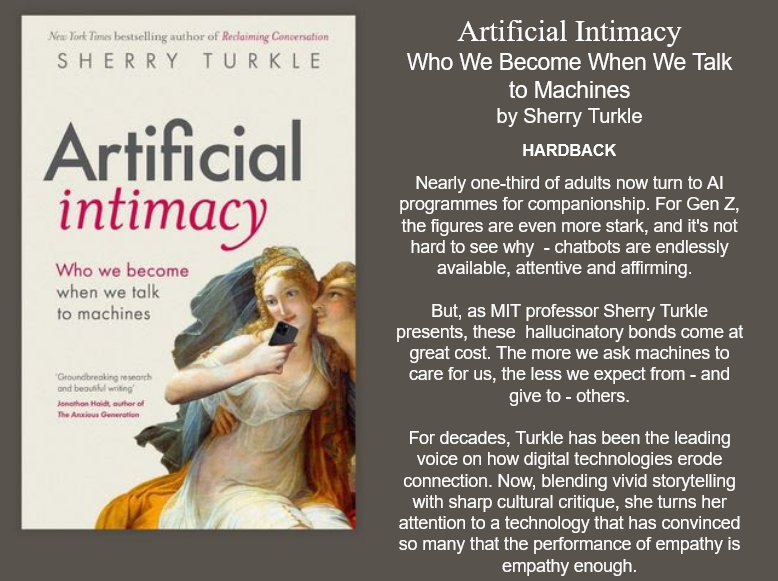
“The more we ask machines to care for us, the less we expect from – and give to – others.” The hydraulic model of human sociality. There is apparently a fixed quantity of caring in the system, and every unit directed toward a machine has been withdrawn from another human being. But there are non-zero-sum possibilities too: A person talks to a bot when no human conversation would otherwise have occurred. A bot helps someone think through something before talking to a spouse or friend. Someone who is lonely gets more conversational practice and becomes more willing to approach people. A person uses the bot for repetitive reassurance precisely so she doesn’t exhaust her friends with it. AI handles some low-value conversational labor and leaves humans with more time or patience for relationships they actually value.
Any of those could turn out to be common, rare, beneficial, harmful, or mixed. That’s an empirical question. But Turkle’s formulation has already answered it philosophically: attention given here must have been taken from there.
She is also proposing a kind of moral atrophy: being cared for cheaply will make us less caring. But there are equally plausible mechanisms in the opposite direction. Someone whose loneliness, anxiety, boredom, or need to vent has already been partially relieved may have more emotional surplus to offer other people. Parents understand this intuitively with almost every other kind of support: if Grandma watches the baby for two hours, we don’t say, “Terrible! Mom has outsourced maternal affection and will therefore love the child less.” We normally understand that burdens can be complementary.
The fixed-pie premise makes the argument almost unfalsifiable. If people use AI because they’re lonely, AI is exploiting their damaged relationships. If they enjoy AI, it is seducing them away from people. If they use it while maintaining good relationships, perhaps they are gradually lowering their expectations of humanity. If they say it has helped their human relationships, well, they’ve been convinced that “simulated empathy” is enough. There’s always a debit somewhere in the human column.
What would really upset this entire framework would be evidence that people can simply add another kind of relationship-like interaction to their lives without subtracting an equivalent quantity of human intimacy. Which, given everything we know about human beings accumulating books, pets, hobbies, parasocial attachments, correspondence, clubs, fictional characters, religious practices, diaries, therapists, online communities, and a thousand other supplementary forms of companionship, doesn’t strike me as an especially exotic possibility.
As soon as I feel or suspect someone or something wanting to take hold of me by acting on my sensibility — beggars, religion, politics, works, etc., trying to break my heart, convince me through fear or pity, through ways which bypass the mind — I rebel, I bristle and become merciless. These are not fair weapons.
A writer whose novels have been in print for generations, taught in schools and universities, adapted repeatedly for film, translated all over the world, and treated as a major twentieth-century English novelist. Somehow wandering the cultural wilderness awaiting discovery by Arjun Marigold on Substack.
There are a few things — some things — okay, many things — that make me want to reach through a laptop screen and punch someone in the throat. One of them is in this post. Can you guess what it is?
Let me put it this way. When my stepson was watching pro wrestling in the early 2000s, I was struck by how it had changed since my own childhood. The branding had become much more efficient. Wrestlers would have their obvious catchphrases followed by a whole line of merchandise built around it. Given that the spectacle wasn’t trying to impress anyone with being highbrow, and given that many of the performers were likely suffering from various degrees of traumatic brain injuries, there was minimal artifice in the promos. Everyone knew the catchphrase was coming, and the audience delighted in chanting it on cue.
Most significantly, the industry had responded to the internet age by becoming more ironic. The fig leaf of kayfabe, still present in the 1980s when I was watching Dusty Rhodes wrasslin’ with Ric Flair, had been taken away. The audience knew it was all a work, the performers knew the audience knew it was all a work, and everyone enjoyed the campy, self-referential spectacle regardless. Literary/humanities types would be aghast to be told that their level of self-awareness is somehow below that of the average wrestling fan, but it’s true, as evidenced here.
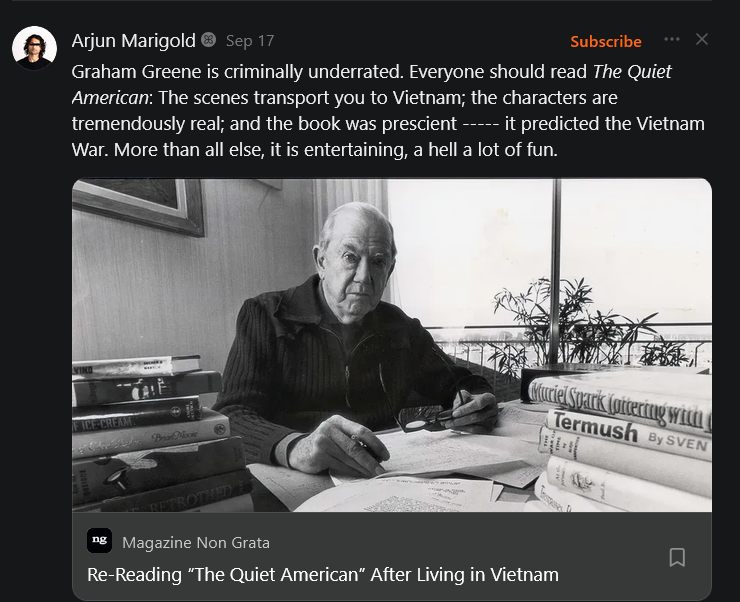
“Criminally underrated” is a cliché. A moronic meme-phrase. A catchphrase as fresh as four-day-old fish. No one should ever speak it in earnest. It is the thoughtless squawking of a mynah bird imitating all the other thoughtless mynah birds. Even worse, it compounds the inspidity with hyperbole — not just underrated, which would be a mere breach of decorum, possibly deserving of a civil suit, but criminally underrated. Charges should be brought against…whom, exactly? The literary establishment? Readers? Critics? Publishers? Hollywood? Posterity? All this, just to complain that “the object of my affection is not being praised at this exact moment in front of me.”
A wrestler at least knows he’s doing branding. The Rock wasn’t under the impression that “If you smell what The Rock is cooking” had spontaneously arisen from fresh contemplation on every occasion. The person telling you that Graham Greene is “criminally underrated,” however, may genuinely experience the phrase as his own observation. He is announcing refined taste while using the verbal equivalent of a foam finger. A wrestling crowd chanting “WHAT?” knows it is participating in a bit. A bookish crowd saying “criminally underrated,” “people aren’t ready for this conversation,” or “this lives rent-free in my head” often seems to imagine that it is independently producing fresh language. No wink, no acknowledgment that ten thousand other people have already deployed the identical prefab utterance that week alone.
I don’t just hate canned phrases, though. No, I also hate the stage management. The rest of Marigold’s post stands on its own. The scenes transport you to Vietnam, the characters feel real, the book was remarkably prescient about the coming war, and it was entertaining. Great! None of that needs to be prefaced by a pointless reference to what some imaginary group of other people may or may not think about it. If you want to discuss a book, then discuss it without throat-clearing and preamble. No one gives a wet, sputtering shit how you feel about how others feel about it. Online culture has made this reflexive because plain enthusiasm feels insufficiently consequential. “Here’s a book I love” sounds like one person liking something. “This masterpiece is criminally underrated” gives you a miniature drama: neglect, rediscovery, vindication, and, perhaps most importantly, the speaker as discerning rescuer.
And now what could have been an interesting conversation about something of substance has devolved once again into gossip and preening. Gossip is fundamentally about triangulation: not A, but what B thinks about A, and what C thinks about B’s opinion of A. Serious topics can be subjected to exactly the same flattening. Instead of “What is true here?” or “What is interesting about this?” you get: Who is talking about it? Who isn’t? Who is insufficiently alarmed? Who is insufficiently impressed? Who has failed to “center” the right thing? Who is “finally saying” what “nobody wants to admit”? The discussion turns from reality to the audience’s posture toward reality. The interesting object gets displaced almost immediately by an imaginary referendum, then everyone starts debating the referendum instead of the object itself.
This also owes to the fact that many people want to be involved in a conversation even when they have nothing to contribute. Talking directly about a poem, an argument, a technology, a war, a scientific finding requires knowledge and discrimination. Talking about how “people are reacting” requires much less. Any social media intern can do it. Mindless phrases like “no one is talking about,” “we need to normalize,” “the quiet part out loud,” “tell me you’re X without telling me you’re X,” and “louder for the people in the back” proliferate so easily because they let the speaker occupy the superior mezzanine above the conversation without contributing much to the conversation itself. Those are basically entrance music. You recognize the persona before any thought has even arrived.
I prefer the straightforward, unpretentious nature of wrestling promos. “Yes, this is my line. Yes, you know it’s coming. Yes, we are all going to shout it together.” The literary discourse would be improved by that level of candor:
“Graham Greene is criminally underrated!”
Crowd erupts.
“CRIM-IN-AL-LY UN-DER-RAT-ED!”
Then the T-shirts come out. Everyone has a cheesy fun time.
In the 28th letter to Lucilius, Seneca tells him that travel won’t solve anything because you take yourself with you: what you need is “a change of soul rather than a change of climate.” He further admonishes him that Socrates already noted this centuries earlier. Individuals may grow a little wiser over the course of a lifetime, but humanity in the aggregate never learns anything. I suppose a modern twist is that we’ve converted our perennial ignorance into a fuel to pour into our economic motor — there will always be someone there to sell you a new experience or location that will supposedly make you into a different person. But there is nowhere else to go. You are already here, in an eternal moment with Lucilius, facing the same choice that will wait forever for you to stop fidgeting and look it in the eye. You can be “enchanted” almost anywhere, given the basics — shelter, supplies, security. You can feel “completely alive sitting on an iron seat under an ugly lamp-post at a third-rate watering place.” Conversely, someone may discover that even the ancient stone church, misty field, beeswax candles, and handmade oak table have become the irritating background against which he checks his phone.
While it is true that the paragraph as an actual unit of thought has been replaced in much online writing with the paragraph as a display case for a sentence, the reprehensible tendency easily predates AI. Twitter threads, LinkedIn posts, Medium, BuzzFeed, newsletter copy, self-help writing, even certain kinds of late-2010s journalism were already full of it. Once a thought is spread across eight or twelve tweets, each individual unit has an incentive to work almost independently. You don’t get much syntactic subordination across tweets; you get serial declaration:
Here is the problem.
Here is what nobody understands.
Here is the part that matters.
And it gets worse.
Axios later turned the same tendencies into an explicit house philosophy, “Smart Brevity”: put the important thing first, use short sentences, simple structures, bullets, and design for readers who skim and scroll. If any single thing “caused” this style to predominate, it was the shift to mobile-first reading, thanks to the ubiquity of smartphones. A smartphone is a booster seat for people who can’t yet reach the table of adult conversation, a playpen for those whose minds cannot be safely trusted to wander unattended. The fact that you excerebrose mutants need your prose to be bite-sized and sugar-coated is why writers and publications have learned to deliver thoughts to you like Mommy steering the spoon-airplane into your open mouth. No wonder ostensible adults now speak in catchphrases like professional wrestlers, only with less self-awareness. But I’m going to say the quiet part out loud: you know what else has become a mindless reflex? Crying “AI” at every stylistic tic you dislike. You’re replacing one lazy shortcut with another: objecting to formulaic prose by using a formulaic explanation for it. Let that sink in.