Nevertheless, I knew many of my colleagues in the humanities would disagree. I could practically hear them arguing against me, as if they were seated all around me in those cramped fake-leather seats, yelling to be heard above the churning propellers. We have to use our privilege to advance the rights of the marginalized. We can’t let people like Bailey and Palmer say what is true about the world. We have to give voice and power to the oppressed and let them say what is true. Science is as biased as all human endeavors, and so we have to empower the disempowered, and speak always with them.
Involuntarily shaking my head, I argued back: “Justice cannot be determined merely by social position. Justice cannot be advanced by letting ‘truth’ be determined by political goals. Only people like us, with insane amounts of privilege, could ever think it was a good idea to decide what is right before we even know what is true. Only insanely privileged people like us, who never fear the knock of a corrupt police, could think guilt or innocence should be determined by identity rather than by facts.”
tribalism
And Plain to See the Facts Are Changing. No Meaning Left to Hold
The bad news is that today advocacy and scholarship both face serious threats. As for social activism, while the Internet has made it cheaper and easier than ever to organize and agitate, it also produces distraction and false senses of success. People tweet, blog, post messages on walls, and sign online petitions, thinking somehow that noise is change. Meanwhile, the people in power just wait it out, knowing that the attention deficit caused by Internet overload will mean the mob will move on to the next house in the morning. And the economic collapse of the investigative press caused by that noisy Internet means no one on the outside will follow through to sort it out, to tell us what is real and what is illusory.
…Perhaps most troubling is the tendency within some branches of the humanities to portray scholarly quests to understand reality as quaint or naive, even colonialist and dangerous. Sure, I know: Objectivity is easily desired and impossible to perfectly achieve, and some forms of scholarship will feed oppression, but to treat those who seek a more objective understanding of a problem as fools or de facto criminals is to betray the very idea of an academy of learners. When I run into such academics — people who will ignore and, if necessary, outright reject any fact that might challenge their ideology, who declare scientific methodologies “just another way of knowing” — I feel this crazy desire to institute a purge. It smells like fungal rot in the hoof of a plow horse we can’t afford to lose. Call me ideological for wanting us all to share a belief in the importance of seeking reliable, verifiable knowledge, but surely that is supposed to be the common value of the learned.
I Am a Human Being, Capable of Doing Terrible Things
Brian alerts me to a sucka M.C. bitin’ on one of my routines:
IRL, almost nothing is ever so simple. Almost no situations that ever exist have heroes and villains, victims and victimizers. Most stuff is just people doing their own things, and most of that consists of behaviors that are orthogonal to the entire paradigm of victims, heroes, and villains. Worldviews–and they are many–that attempt to break down all of history and human life to exploitation, war, and struggle are being disingenuous in an effort to use the injustice-hack for themselves.
It will win few friends and lose many to refuse the tribalism implicit in adopting one victim group or another, but if we are interested in stopping the damage caused by these sorts of conflicts, we must forgo the natural highs of responding to an injustice with more injustice. We must maintain that the same ethics apply to defense as offense, because as long as we let them differ in practice, we will just keep up the constant wars, cultural and physical, until that really is all we do…commit new injustices as get-backs for old injustices.
I kid. It’s a good post (despite the ever-so-slightly-annoying use of “hack“), and I agree. Consider this excellent strip by Zach Weinersmith:
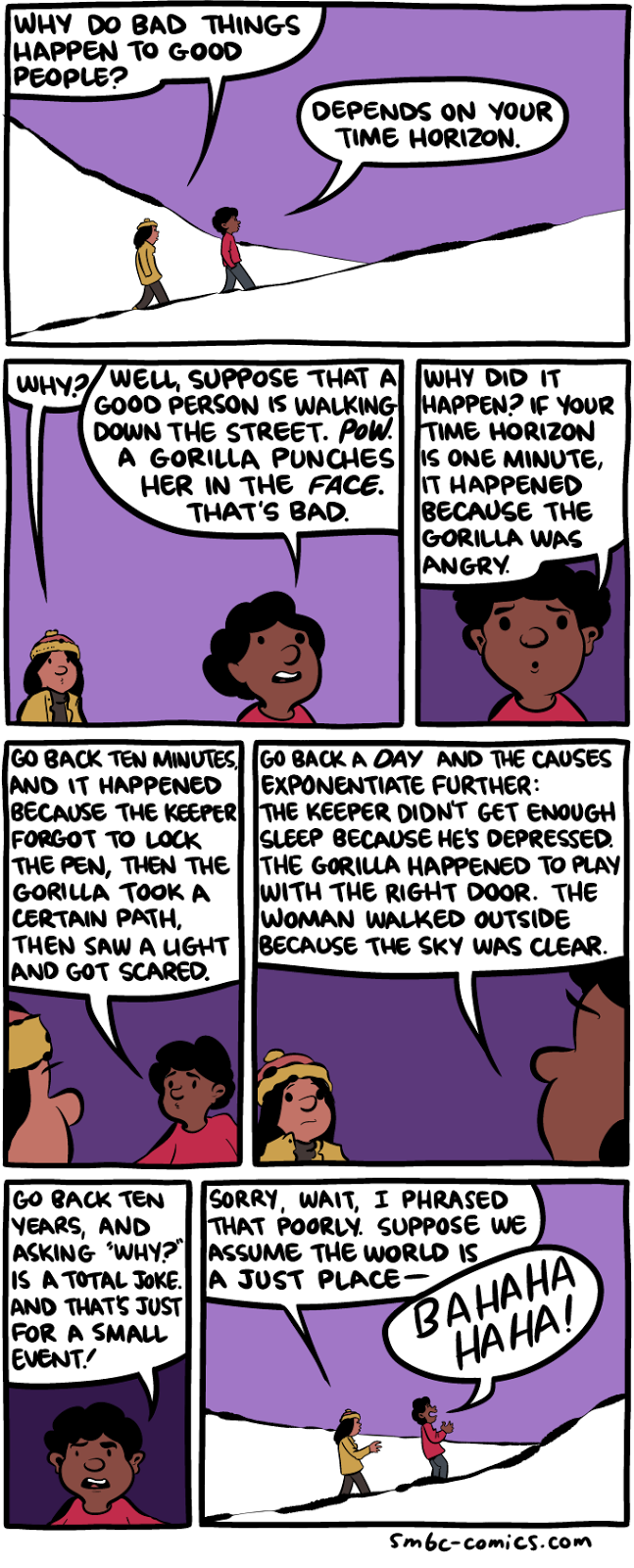
The same phenomenon occurs going forward in time as well. Self-proclaimed grandmasters of multi-dimensional chess will assure you that the ends will justify the means, that this action, despite appearing unethical and counterproductive by itself, will actually produce a beneficial result in the long run. The obvious problem is, trying to envision what “the long run” will look like is as fraught with error, bias and distortion as attempting to find causes in the past. The valence effect describes our tendency to imagine the best-case scenario resulting from our intended action, and then make the unwarranted logical leap to assuming that this is also the most likely result. Few people have the patience to make a serious effort to ponder all the alternative scenarios in which things don’t go so swimmingly.
Fix It with Your Tiny Fist There
FdB:

But where is the prescriptive element? I mean, I get that Ramsey wants white Americans to rise up and work to fix things. But how does he propose that we actually inspire them to do so? Sure, it should be enough to show them the reality to provoke them to fight for change. But should is a word of remarkably little relevance in the real world. 50 years after the most important Civil Rights legislation, it seems obvious that just pointing out that our society is unjust is not enough to provoke the white majority to create change.
In other words, the piece recounts in exacting detail a political problem but does nothing to establish a political solution. It begs for a next step– “here’s what I would do to convince white Americans to get on board with a political movement against racial inequality”– that it never takes. And in not taking that next step, it falls perfectly into line with the general, bizarre trend, the trend to say “it’s not the job of oppressed people to educate you.” Really? Then whose job, exactly, is it? I hear that all the time, and I find it such a bizarre attitude for self-described activists to take. To call yourself an activist is precisely to say “It is my job to educate you.” Change is active by its nature. The status quo doesn’t need activists. Change requires that you make it your job. So where’s the political strategy? I don’t pretend that it would be obvious or easy– in fact I think it’ll be incredibly hard– but, well, 200 years ago you could buy people, and the ability to do so was deeply embedded in the economy. Things can change, but you’ve got to make them happen and you have to motivate people who aren’t inherently predisposed to be motivated in order to do so.
Freddie is asking rhetorical questions, of course. He’s patiently trying to lead some incredibly stupid horses to water. I, on the other hand, don’t believe that these particular horses actually want to drink. That bumper sticker image up above (courtesy of Tom Tomorrow) perfectly encapsulates what they’re all about. The “political” twitosphere is nothing more than a bunch of people complaining that “somebody should do something about this, that and the other fucked-up thing!” Not them, of course. They’ve already done their part by writing a multi-part tweet that went viral, dintjasee? They’re the “ideas” crew. They just want to heave the ball of their righteous wisdom down the online lane and watch all the opponents of progress scatter like pins.
That’s why I put “political” in scare quotes. These people are not activists, they just play them online. They’re the political equivalent of Monday-morning quarterbacks. Real activists are far too busy with the never-ending, thankless hard work required to make actual political change happen in a world where, honest to God, believe it or don’t, three-quarters of the inhabitants don’t even use Twitter, let alone know that some celebrity totally won the Internet with their post about gun control in the wake of another mass shooting (which continue apace despite near-unanimous opposition on social media, strangely enough). They don’t have time to waste on social media posturing and performing for several hours a day.
Don’t get me wrong; I’m not condemning a tabloid site like Gawker for failing to draft intelligent policy proposals, as if they’re capable or willing. They’re only playing their role as the cool kids’ table in the social media cafeteria, just as they were designed. I’m merely underlining the point that the “political” web exists almost entirely for signaling and venting, nothing more. It’s a way for people to yell at their TV in public. As Freddie keeps saying, if you want to win enough support for unpopular ideas to turn them into policies and laws, it’s suicidal to act as if the truth and righteousness of your position is self-evident, and if your opponents can’t see that, well, it sucks to be as stupid as them. And yet, that’s the attitude you see displayed time and again. Even at a more intellectual site devoted to the history of ideas, where you might reasonably expect a post titled What Is The Left, Anyway? to offer up a more substantial vision of what it even means to be a leftist today, you get this kind of vapid rambling, where empty snark is about as close to a serious point as you come.
If you want to put your politics into action, put the computer to sleep and go find some activist groups in your area to get involved with. Spend your free time and weekends working with them. Or go find people who don’t already agree with you, but are at least reasonable enough to converse with, and try to sway them to your way of thinking. Any of those things would be more meaningful than sitting on your ass reading yet another post about how awful and stupid your opponents are. What are you going to do with that information? Vote for Democrats? You were doing that already! Vote even harder for Democrats? Please. The “political” web is just another form of entertainment for people who are too status-conscious to be seen keeping up with the Kardashians.
Searching, Seek and Destroy
The Huffington Post picked up on this and reported that the pizza place “publicly vow(ed)” to “reject gay weddings.” This entirely inaccurate description of what actually transpired was seized upon by countless folks all around the Interwebs. The pizza shop’s Yelp page was spammed with eight pages negative reviews, most of them quite obviously from people who had never been there. Their phone rang off the hook with fake orders. Someone on Twitter threatened to burn the shop down. The folks at Memories Pizza temporarily closed their restaurant.

“Punching up. Punching up! PUNCHING UP! PUNCHING UP…!“
Just ‘Cause You’re Right Doesn’t Mean I’m Wrong
In balancing a systematic critique on a single person’s story, Erdely essentially used a rightwing strategy to make a leftist point. The trouble is only that the right is skilled at this game, and correctly deduced that undoing Jackie’s story would go a long way to endangering Erdely’s larger structural point. It’s an opportunity they never should have been given, both for Jackie’s sake, and for the sake of the victims who really do find themselves struggling for protection within a hostile justice system.
In case you were wondering how the Rolling Stone rape story debacle was still somehow the right-wing’s fault, Stoker-Bruenig is here to bolster your faith. Amidst all the obfuscatory hand-waving, though, there’s a noticeable lack of two simple points. One, for deep-rooted psychological reasons, people will always grasp lessons better when they’re couched in compelling narratives as opposed to dry statistical analysis. (Progressives usually understand this, as evidenced by their almost-religious levels of faith in the dubious idea that reading novels makes you a better, more emotionally-intelligent person.) Rather than bemoaning that fact, perhaps you should simply make a stronger effort to tell the truth in your own narratives. Which leads us to the second point: fudging factual details in service to a “higher” truth is a bipartisan phenomenon, regardless of what partisan hacks will tell you to the contrary.
(Bonus third point: this post of Scott Alexander’s is a far more penetrating look at why partisans reliably choose the most sketchy stories to go to war over.)
…adding, speaking of Alexander, and speaking of lying for a higher truth, he links to this story, of which I had been completely unaware.
The Wrath Toward Khan
I’ve read Razib Khan’s blog for a few years. I find him insightful on a number of topics, including religion, history, and culture, and I found his perspective as a self-identified conservative very helpful as I attempted to make sense of the people now commonly known as social justice warriors (even there, it often seems like his conservatism is motivated largely by opposition to the politically correct left as much as anything; this particular spleen-venting doesn’t sound any different from the themes Freddie deBoer, an avowed socialist, specializes in, a fact noted by one of his commenters.)
I have no opinion on whether he’s racist or not. I’m not nearly educated enough to follow his posts about genetics. I certainly recognize that there’s enough circumstantial evidence to construct the sort of guilt-by-association hit piece that Gawker used to get the NYT to drop him like a hot potato, but I also note a distinct lack of any direct, damning quotes from the man himself. I certainly recognize that he has clearly signaled either his openness to taboo thoughts about race and biology, or his sheer refusal to play politics when it comes to science. The real point is, I don’t care. I have enough faith in my own thinking ability to not get tricked into believing in some kind of malevolent “race science”, even if he were trying to subtly indoctrinate his readers with it, and there’s too much good stuff on his blog to avoid it for the sake of appearances. More importantly, I’m just sick of the shrieking and the demands for collective shunning that dominate online discussions.
It almost surprises me to admit that. At this point, I would prefer a conversation with a mild reactionary to one with a self-righteous progressive who only knows enough to master the dynamics of high-school cafeteria politics. Too many people assume they already know everything they need to know, and the only thing left to do is make a big public display of which team you’re on. To hell with that.
In the midst of this otherwise disheartening fracas, I did snicker at this comment:
The left argues that while no governmental law is explicitly racist, governmental and societal institutions have racism built into them. So this is what enables leftists to decry racism even though there are no governmental laws explicitly permitting it. The left calls this “institutionalized racism.”
The same argument applies to free speech. While it’s true that there is no governmental law explicitly preventing Razib from expressing his views, governmental and societal institutions have built into them mechanisms that prevent Razib from expressing his views. Perhaps we should call this institutionalized censorship.
Cliques Nix Politics
Ancient quarreling aside, the overarching theme of the Bailey episode for Dreger was whether or not a scholar should be allowed to present evidence for a theory that some find profoundly threatening and deeply offensive. The critiques of Bailey often revolved around whether his book was “invalidating to transwomen” — which seemed like a separate question from whether the argument itself had any merit, a question that continues to be debated.
In her new book, Dreger also empathizes with Randy Thornhill and Craig Palmer, authors of A Natural History of Rape: Biological Bases of Sexual Coercion (2001). They argue that rape is motivated at least in part by sexual attraction, a view that diverges from the widely held notion that it is solely about violence and control. Palmer and Thornhill see their work as contributing to an understanding of why rapists rape and therefore, ultimately, of help to victims. Their many irate detractors see them as rape apologists. What started as science devolved into name-calling and death threats.
…”I very much identify as a liberal feminist,” she says. “That said, I get extremely impatient with liberals who want to rail about Republicans who won’t look at facts and then you get people who are making decisions based on identity and not on the facts. To me, that’s just a perversion of liberalism.” That stance wins her fans among a crowd she’s not sure she wants on her side. “Believe me, it makes me uncomfortable that my last 20 Twitter followers are right-wingers,” she says.
Yet she worries that partisan team-playing — making sure the progressive cool kids like you — is a hindrance to reasoned dialogue on tough topics. “I think we get lazy sometimes, and we let our politics rule what we’re doing, and as academics we can’t do that,” she says. “There’s this whole branch of academe in which simply telling your story is taken as some sort of data beyond just telling your story. To me it’s just telling your story.”
If I had the stature or the ability to write a Letters to a Young Foolosopher sort of book, I would center it around this simple advice: Be suspicious of narratives. Not reflexively contrarian — don’t argue just for the sake of it. Automatically taking the opposite side of any given argument is just another way of letting other people set the terms of your thinking for you. Not nihilistically paranoid, either — don’t assume that anyone speaking of “truth” and “objectivity” is just cynically concealing a lust for power and dominance. That sort of nihilism is a comforting meta-narrative itself, a way of shrugging off the burden of weighing, judging and measuring each new set of circumstances. Just be suspicious. For various reasons, from biological to social to individual, it’s very easy for us to notice patterns and submit to their internal logic. Like jogging through the woods, it’s natural to notice a clear trail and let that determine our direction. Narratives are both indispensable and unstable, and thus require constant vigilance.
When Michael Bérubé famously joked about people who “used to be a Democrat, but thanks to 9/11, (are) now outraged by Chappaquiddick”, he was basically talking about the power of narratives, the need to fit this particular experience into a preexisting story. Pace Bérubé, though, I don’t think you need Marxist theorists to make sense of the phenomenon; I think it can be explained by the cognitive phenomenon of chunking. It may seem paradoxical at first glance, but it’s actually easier, given the way our brains work, to substitute one grand narrative for another, like switching railroad tracks, than it is to rethink individual principles piece by piece, which can be frustrating and time-consuming. In other words, confronted with a traumatic shock like 9/11, many liberals might have felt disoriented and confused over principles that they had formerly taken for granted. But rather than think slowly and methodically about whether their personal pacifism had been too reflexive, or whether liberalism as a whole had let multicultural dogma blind itself to a serious threat, they responded by wiping the intellectual slate clean (simplicity!) and replacing their former worldview with another one, fully-formed (more simplicity!). Crisis averted, and at minimal cognitive cost. They might be wrong about a whole bunch of different things now, but at least they feel comfortable again.
But that, right there at the crisis point when you’re not sure what to think or who to believe, is where I would suggest you need to be suspicious and resist the urge to seek comfort among allies. Having emerged, blinking, into the sunlight, don’t be so eager to turn right back into the shadows. Take your sweet time, don’t be afraid to be left behind by those who have already made up their minds, and consider what makes this experience unique before deciding it’s merely a reflection of something else. Many of the people who would laugh knowingly at Bérubé’s witty formulation are the same ones who favor a different narrative, in which they are too sophisticated, rational and objective to ever fall prey to such groupthink, and the cycle begins again, to the delight of whichever trickster god gave us the gift of narrative to begin with.
There may not be any singular, objective truth about the world to be found. There may even be several, or many, irreducible truths, all in permanent conflict with each other. Still, using the general concept as a lodestar seems to be beneficial, especially when, as Dreger has experienced, up becomes down and ally becomes enemy. Concentrate on finding as much truth as you can, don’t be in any hurry to assemble it into an overarching narrative, and don’t be intimidated by those who use guilt, anger and shame to prevent you from inconveniencing their own narratives. Doing so may marginalize you in favor of those who are always ready to put politics ahead of truth-seeking, but I’d hope you find that a fair price to pay.
Can’t Unsee the Things I Saw; Fallen Devils, False Gods in the Violet Light
*Sniff* I have to say, reading about Heywood’s loss of innocence made me so nostalgic for those long-ago days — you know, three years ago — when I, too, was similarly, blissfully ignorant. My ears were so wet, my eyes were so wide, and the world was so full of promise then, back when Dennis Kucinich and Bernie Sanders were the fenceposts marking the edge of the political left from the unpopulated wasteland beyond. But now, oh, I have such wonderful, wonderful things to show you…!

Libera te tutemet ex inferis!
I kid. A little, at least. For a long time, I thought “political correctness” was a term that told you less about the target than the person using it, i.e., that it was a right-wing dog whistle. I recognized that in the big scheme of things, a bunch of overzealous hall monitors in academia were petty criminals compared to the organized crime rings who controlled the political and corporate worlds. But then the online atheist environment got contaminated by a strain of fanaticism, in which the fanatics insisted that atheism must be made synonymous with their particular brand of intersectional politics, or else be cast out into the outer darkness of sociopolitical irrelevance. Suddenly, I focused on the rabbit instead of the duck, the vase instead of the two kissing faces, the half-full glass instead of the half-empty one. The basic facts of the matter didn’t change; I just realized there was more than one valid perspective here.
For me, that perspectival shift meant that I started dividing people along lines of personality and psychology rather than politics and ideology. I realize it sounds glib and trite, but ♫ I’ve been around the world, and I’ve been in the Washington Zoo, and in all my travels, as the facts unraveled, I’ve found this to be true ♫: some people are just fucking assholes. SJWs are merely a different species of fucking asshole from the right-wing Republican assholes, or the religious fundamentalist assholes. Assholes go out of their way to cause and prolong conflict. They are natural-born petty tyrants and aspiring authoritarians who are never happy unless they’re taking charge and ordering other people around in accordance with their vision. Today’s SJWs, who are busy being the most inflamed, hemorrhoidal assholes they can be in the fight against transphobia, microaggressions and pixelated representations of misogyny, will still be gratuitously obnoxious assholes in ten years when they’ve left all those childish things behind and moved on to climbing the corporate ladder or making partner at a law firm. At this point in my life, I’m not interested in making excuses for assholish behavior just because, according to some tribal calculus I don’t even subscribe to, the assholes are on my “side”. Many assholes, I find, are under the delusion that they’re grandmasters at multi-dimensional chess. They believe that by acting like assholes at the right time for the right reasons, they’re somehow reducing the overall amount of assholery in the world in the long run.
And that brings us to a fascinating thing about assholism from the memetic perspective. Almost everybody would agree, in the abstract, that being an asshole is generally a bad thing. In order to reproduce itself, then, the asshole meme has to convince the host that acting like an asshole is necessary in this particular instance. The cause is too important! My opponent is too stubborn! I revealed the truth to him, but he refuses to recognize it! He started the argument anyway! Collectively, we all think that people should stop being assholes. Individually, we all think we have a uniquely good reason to act like an asshole occasionally. Thus does assholism remain a thriving, vibrant force in the world for all time. Quite a brilliant strategy, really.
So, yes, I took a crash course in all sorts of ostensibly left-wing ideologies that I had only dimly understood before, only to come out of it convinced of their utter uselessness. Countless lectures on privilege-checking didn’t teach me a thing that I hadn’t already grasped from the old folk wisdom about not judging a man until you’d walked a mile in his shoes. I concluded that attempting to practice the universally-recognized virtues will do more to improve the world than mastering sociological jargon to feign scholarly sophistication. I don’t even really frame this as a political argument anymore. There are easygoing, reasonable people on both sides of the political spectrum. If anything, I see myself as an heir to the honorable tradition of the Taoists, who thumbed their noses and blew raspberries at those ancient assholes, the Confucians, who likewise believed that society couldn’t function without their wise oversight and strictly-regimented organizational schemes.
Forget It, Scott. It’s ‘Ginatown.
Go back to the original Amanda Marcotte article. Check the title. “MIT Professor Explains The Real Oppression Is Having To Talk To Women”. That phrasing, “the real oppression is…”, carries a pretty loaded assumption. I’d say “hides a pretty loaded assumption”, but it doesn’t seem to be doing much work to hide it.
If you look through Marcotte’s work, you find this same phrasing quite often. “Some antifeminist guy is ranting at me about how men are the ones who are really oppressed because of the draft” (source). And she’s not the only one. If you Google the term “are the ones who are really oppressed”, you can find an nice collection of people using this exact phraseology, including a few examples from a charming site called “Nerds Fucking Suck”.
But Aaronson is admitting about a hundred times that he recognizes the importance of the ways women are oppressed. The “is really oppressed” isn’t taken from him, it’s assumed by Marcotte. Her obvious worldview is – since privilege and oppression are a completely one dimensional axis, for Aaronson to claim that there is anything whatsoever that has ever been bad for men must be interpreted as a claim that they are the ones who are really oppressed and therefore women are not the ones who are really oppressed and therefore nothing whatsoever has ever been bad for women. By Insane Moon Logic, it sort of makes sense.
As a result, Marcotte is incapable of acknowledging that Aaronson feels pain or has feelings more complicated than “all women exist solely to be my slaves”. She has to be a jerk to him, otherwise it would be a tacit admission that he has problems, which means only he has problems, which means no woman has ever had problems, which means all women are oppressors. Or whatever.
I read the comment by Aaronson which has inspired such a web-wide hullaballoo, and though I wouldn’t have been surprised to hear that it offended the perpetually ‘n’ predictably offended, even I was taken aback by the callous, willful misreading of it by the ever-execrable Marcotte. I swear, if she didn’t exist, Rush Limbaugh would have to invent her.
Anyway, it’s a very long post, so I’ve excerpted what I think is the main takeaway from it. As other people have basically said before, the Venn diagram of “Ass-slapping, catcalling, wolf-whistling dudebros” and “Guys who are willing to read and take to heart angry screeds by social media feminists” doesn’t really have any overlap. In practice, then, feminist vitriol is often aimed not at the right targets, but at the “right here, right now” targets — the guys who take these issues seriously enough to actually show up and talk about them, while the real sexists would only laugh at the thought of sitting through an impromptu women’s studies lecture. You read Aaronson’s comment and you see a guy who has put himself through immense emotional turmoil in trying to measure up to what he imagines is the male feminist ideal, a guy who, as Alexander says, “is now 97% on board with feminism, but wants people to understand that when done wrong it can be really scary”, and yet Marcotte and her Tumblr epigones are treating him with the same exact scorn and hostility they would use for an official enemy.
This is the inevitable result of the zero-sum logic people like her employ. Like a dragon jealously guarding its hoard, she can’t tolerate anyone else getting a piece of her oppression narrative, and she’s either incapable or unwilling to see how it makes her look in the eyes of anyone who’s not already in total, unquestioning agreement. I submit to you that most people who read what Aaronson has to say will come away feeling very sympathetic to him, and seeing a reaction like Marcotte’s will only reinforce the suspicion that nothing less than groveling submission will ever be good enough for the likes of her. I leave it to your understanding of basic human psychology to judge whether the average guy will find that acceptable.
I’ve noticed a few year-end retrospectives around the web with titles like “2014: The year women won” (or, if you prefer a more honest look at the toxic resentment underlying so much of this kind of feminism, “2014: The year women got even”). If this episode is any indication, I’m looking forward to seeing 2015 being designated the year of feminists scoring own goals.
Moloch Demands Fresh Blood to Maintain the Appetite of His Mechanical Heart
Which means that it’s not a coincidence that the worst possible flagship case for fighting police brutality and racism is the flagship case that we in fact got. It’s not a coincidence that the worst possible flagship cases for believing rape victims are the ones that end up going viral. It’s not a coincidence that the only time we ever hear about factory farming is when somebody’s doing something that makes us almost sympathetic to it. It’s not coincidence, it’s not even happenstance, it’s enemy action. Under Moloch, activists are irresistably incentivized to dig their own graves. And the media is irresistably incentivized to help them.
Lost is the ability to agree on simple things like fighting factory farming or rape. Lost is the ability to even talk about the things we all want. Ending corporate welfare. Ungerrymandering political districts. Defrocking pedophile priests. Stopping prison rape. Punishing government corruption and waste. Feeding starving children. Simplifying the tax code.
But also lost is our ability to treat each other with solidarity and respect.
Under Moloch, everyone is irresistably incentivized to ignore the things that unite us in favor of forever picking at the things that divide us in exactly the way that is most likely to make them more divisive. Race relations are at historic lows not because white people and black people disagree on very much, but because the media absolutely worked its tuchus off to find the single issue that white people and black people disagreed over the most and ensure that it was the only issue anybody would talk about. Men’s rights activists and feminists hate each other not because there’s a huge divide in how people of different genders think, but because only the most extreme examples of either side will ever gain traction, and those only when they are framed as attacks on the other side.
People talk about the shift from old print-based journalism to the new world of social media and the sites adapted to serve it. These are fast, responsive, and only just beginning to discover the power of controversy. They are memetic evolution shot into hyperdrive, and the omega point is a well-tuned machine optimized to search the world for the most controversial and counterproductive issues, then make sure no one can talk about anything else. An engine that creates money by burning the few remaining shreds of cooperation, bipartisanship and social trust.
SJWaterloo
Lex:
Rolling Stone published a mega trending article last month documenting the story of a horrific fraternity gang rape of a freshman student at the University of Virginia. The rape victim herself shared her story of the cold, calculated, and brutal events that took place upstairs at a UVA frat house and the almost more sickening callous fallout as friends, classmates, and the university seemed to gang up against the victim in the favor of not making waves. This story so perfectly fit into the current rape culture on rich kid college campus meme that it quickly went viral around the net, around the world, and smeared tons of people both named and given modest cover in the long form article. Except, yeah, the girl at the center of the story lied.
Rolling Stone just issued an apology. It’s not the kind of apology one traditionally makes after accusing the members of a specific fraternity and students and faculty at a specific university with gross charges of sexual assault and coverup. Like, my bad for calling you a rapist in an 8-page blowout article where we forgot to fact check the single most important underlying fact. It’s more like the, we tried our best but this chick just lied so good it’s not really our fault.
It’s just like the man said — as you go around the web, looking at what all the usual suspects have to say, you can’t help but notice that very few, if any, care about the specifics of what happened in this particular case. What they care about is how this specific case can be used to buttress whichever meta-issue they’re more concerned with, whether “Patriarchy and rape culture are real and they kill!”, or “Feminists are a bunch of obnoxious, whiny, man-hating bitches.” Whether she lied, or whether she just fudged some of the peripheral details (innocently or maliciously), having to admit that would feel like having to give ground on every major contentious feminist issue. It’s psychologically easier to try and rationalize this away instead. Thus people will continue arguing past each other, accomplishing nothing. Like the circus, they’ll just pack up the tents, travel to the next location, and put on the same show again. If, for you, the tragedy here isn’t that innocent people might have been publicly smeared as violent felons, but that your online enemies will be insufferable in their gloating, you are, as the saying goes, part of the problem.
As for this case, well, eternal optimist that I am, I’d like to think this might severely dampen the enthusiasm for all this faith-based “believe the victim” dogma (a perfect example of what “begging the question” means in its strict logical context, by the way) and the repulsive naming-and-shaming, trial-by-social-media phenomenon. (Even I, the eternal optimist, won’t go so far as to hope that “journalists” might learn a lesson about doing their job thoroughly.)
I Read All the Authors, I Knew the Right Slogans
I used to endorse a particular brand of politics that is prevalent at McGill and in Montreal more widely. It is a fusion of a certain kind of anti-oppressive politics and a certain kind of radical leftist politics. This particular brand of politics begins with good intentions and noble causes, but metastasizes into a nightmare. In general, the activists involved are the nicest, most conscientious people you could hope to know. But at some point, they took a wrong turn, and their devotion to social justice led them down a dark path. Having been on both sides of the glass, I think I can bring some painful but necessary truth to light.
Important disclaimer: I passionately support anti-oppressive politics in general and have only good things to say about it. My current political worldview falls under the umbrella of leftism, although not radical leftism. I’m basically a social democrat who likes co-ops and believes in universal basic income, the so-called ‘capitalist road to communism.’ I agree with a lot of what the radical left has to say, but I disagree with a lot of what it has to say. I’m deeply against Marxism-Leninism and social anarchism, but I’m sympathetic to market socialism and direct democracy. I don’t have any criticism for radical leftism in general, at least not here, not today. What I feel compelled to criticize is only one very specific political phenomenon, one particular incarnation of radical leftist, anti-oppressive politics.
There is something dark and vaguely cultish about this particular brand of politics. I’ve thought a lot about what exactly that is. I’ve pinned down four core features that make it so disturbing: dogmatism, groupthink, a crusader mentality, and anti-intellectualism. I’ll go into detail about each one of these. The following is as much a confession as it is an admonishment. I will not mention a single sin that I have not been fully and damnably guilty of in my time.
Things I Thought I Figured Out, I Have to Learn Again
Brian comments on the previous post:
Now, in attacking the illiberalness of the SJWs, one cannot forget that the far more numerous, far more powerful right wing equivalents are even nuttier-arguably far more insane. For every “video games are sexist” there are ten “Obama and his transgendered wife are plotting to take over the United States for ISIS and impost Shariah Law by 2020!”
So…we have to maintain perspective. Because the insane right elects Congresscritters!
(I started to respond there, but I soon realized I was going to exceed the comment box character limit, and since I can’t be bothered to post that often these days, I decided to go ahead and turn this into a post of its own.)
True, lunacy is a bipartisan phenomenon, though I question whether there is any meaningful way to quantify which side is “worse” or more numerous. That’s a value judgment which might only reflect your own filter bubble. Certainly, there’s no shortage of people on either side who deserve criticism. But a Fairness Doctrine-style approach (“I just wrote a post criticizing SJWs, so now I need to write one criticizing theocrats”) has its own downside, namely a vapid centrism that values equidistance over substance. Powerless outsiders, of which I am one, can afford to speak the truth as they see it without having to worry about where it will land on someone else’s multi-dimensional political chessboard. More on that in a moment.
I don’t think anyone would argue against the need to maintain perspective. The argument would hinge on whether a certain perspective was relevant or not. The fact that Republicans took control of the Senate has nothing to do with the question of whether SJWs are illiberal morons who deserve to be pelted with garbage and rotten fruit until they run home crying like the overgrown toddlers they are. Calling SJWs overgrown toddlers does not directly lead to more people abandoning the Democrats and voting Republican. A perspective which insists on understanding SJWs in relation to Christian Dominionists may be like trying to derive the square root of green. The framework is all wrong.
Here’s a basic truth: humans make sense of the world through narratives, not facts. Now, I don’t mean that facts are completely irrelevant and we’re all totally irrational. I mean that the number of facts pertaining to any given situation is, practically speaking, limitless. This is a banal truism. However, we tend to overlook it because evolution has equipped our brains with efficient pattern-seeking software that allows us to quickly and effortlessly recognize the facts which are relevant for our immediate purposes while filtering out and forgetting the rest of the irrelevant data, which never even rises to the level of our conscious attention. We could not function otherwise. We would spend so much time collecting data to make the simplest of decisions that the time to act would pass and the situation would change before we ever finished. We have no choice but to make imperfect decisions based on incomplete information. Thus, we already have an intuitive sense of what it is we’re looking for when we first start to pay attention to an issue. We notice which facts are relevant to us and connect them together. That process of connecting relevant facts is what we call a narrative, and the template for forming one is far more fundamental to the way our minds work than any objective striving after truth for its own sake.
Narratives are generally very useful (or, as a bumper sticker I saw once put it, “Stereotypes are a real time-saver”). You aren’t likely to go drastically wrong by sticking to one, as long as you remain flexible enough to modify it as needed. The perennial human problem, though, is that we tend to prune new facts to fit our preferred narrative, rather than the other way around. Eventually, this catches up to us, and we have to choose between the pain of looking like a complete fool by being stubbornly wrong, or the pain of having to let go of a useful framework and start making sense of the world in a different way. Judging by the evidence, a lot of people seem to find it easier to accept looking foolish.
The moral of the story in the previous post was about the inevitable failure of narratives, and how we react in the event. If you have long been favorably inclined to liberal/left perspectives on sociopolitical issues, only to be rudely shocked out of your complacency by the moral and intellectual bankruptcy of today’s SJWs, how do you respond? Do you hurry to construct a new narrative that rationalizes their excesses by comparison to someone “worse”? Or do you take the opportunity to cultivate an attitude of tentative humility, a determination to think things through slowly and deliberately, a refusal to be bullied or rushed into jumping to conclusions?
It’s fine to say, “These SJWs are largely a bunch of dumb postgrads with no real power. Most of them will probably settle down and outgrow their intersectionalist bullshit as they pursue careers and families. If you’re concerned about political issues at all, you should be far more concerned over how elected officials and their financial backers believe and behave.” That is a perfectly sensible and valid perspective to hold. However, it is not the only valid perspective, and not every issue can be coded in utilitarian terms of right vs. left politics. In the zero-sum environment of the voting booth, yes, you have no meaningful alternative to choosing the Democrat or the Republican. In the twitosphere, though, you are not being forced to choose between Anita Sarkeesian or Elliot Rodger, and anyone who tries to tell you otherwise is a lying demagogue. For example, if you approach Gamergate with a framework like, “Okay, who are the right-wingers and left-wingers here?”, you’re going to miss so many important nuances. Not every issue is a tributary feeding into the sea-level discourse of whether this ultimately benefits the left or the right. Personally, I’m not terribly invested in the fate of the political left. I agree with those who say that it is largely moribund, and I have no idea how to reinvigorate it. I only feel (provisionally) certain of the fact that no fruit worth keeping is going to grow from the roots and soil that comprise SJW-style politics, and thus I feel no obligation to tamp down my disgust for them. If the left can’t ultimately offer up anything better than them, it deserves its impotence and irrelevance.
Finally, different contexts allow for different emphases. If I were politically powerful and influential, then yes, it would be important to consider all the “optics” of how my words would be taken. But I am an absolute nobody writing on a blog that no one reads. I write for no reason but my own entertainment and satisfaction. I’m solely interested in making sense of the world, not declaring my allegiance to an agenda. I can’t imagine anything sadder than having that complete freedom, only to voluntarily don the chains of other people’s expectations. What consequences should I be concerned about? I don’t care if someone gets the wrong impression about me as a person because they can’t tell what my politics are by a quick glance here. In fact, I would resent any implication that I owe it to some hypothetical reader to spell out exactly what I stand for and why. Fuck you, hypothetical reader, you lazy bastard. Do the reading and thinking to figure it out yourself. Or don’t. Makes no difference to me. Bum-bum-bum-ba-bum-bum, I feel free…
All This Dog and Pony, Still Monkeys the Whole Time; We Could Not Help from Flinging Shit In Our Modern Suits and Ties
The Red Tribe and Blue Tribe have different narratives, which they use to tie together everything that happens into reasons why their tribe is good and the other tribe is bad. Sometimes this results in them seizing upon different sides of an apparently nonpolitical issue when these support their narrative; for example, Republicans generally supporting a quarantine against Ebola, Democrats generally opposing it. Other times it results in a side trying to gain publicity for stories that support their narrative while sinking their opponents’ preferred stories – Rotherham for some Reds; Ferguson for some Blues.
When an issue gets tied into a political narrative, it stops being about itself and starts being about the wider conflict between tribes until eventually it becomes viewed as a Referendum On Everything. At this point, people who are clued in start suspecting nobody cares about the issue itself – like victims of beheadings, or victims of sexual abuse – and everybody cares about the issue’s potential as a political weapon – like proving Muslims are “uncivilized”, or proving political correctness is dangerous. After that, even people who agree that the issue is a problem and who would otherwise want to take action have to stay quiet, because they know that their help would be used less to solve a problem than to push forward the war effort against them. If they feel especially threatened, they may even take an unexpected side on the issue, switching from what they would usually believe to whichever position seems less like a transparent cover for attempts to attack them and their friends.
And then you end up doing silly things like saying ISIS is not as bad as Fox News, or donating hundreds of thousands of dollars to the officer who shot Michael Brown.
This can sort of be prevented by not turning everything into a referendum on how great your tribe is and how stupid the opposing tribe is, or by trying to frame an issue in a way that respects or appeals to an out-group’s narrative.
Excellent article. I should start reading there more often.
Of course, there are numerous factors, some hardwired into our brains, some created by our social environments, which make this phenomenon extremely difficult to resist. That is, telling people to “stop being tribal” is about as doomed to failure as atheists telling religious believers to “stop being stupid and start being more rational!” One of my personal ambitions has been to attempt to use this space in a conscious attempt to resist the gravitational pull of tribal affiliation. I think many things about writing online make it ideally suited for that goal, even though we have plenty of disappointing evidence that it can just as easily be used to reinforce the worst elements of tribalism.
Jotun’s Law

If Godwin’s is any indication, I’m sure popular usage will eventually deform this as well, but still, it’s nice that someone sought to formulate it. Certainly speaks to a pressing need.