There was a time, not so long ago, that when people talked about changing society, they generally had Big Plans. These plans were big in the sense that, had any of them worked, the world we live in would have been changed almost beyond recognition. Things are different now. People may complain just as loudly, but they generally lack big ideas about how things should be redone. Or to speak more precisely: The big ideas that do remain are so obviously bad ideas (such as Islamic theocracy) that almost no psychologically well-balanced individual feels tempted by them. There is a stark difference between this ethos and a time when mild-mannered, middle-class people actually thought it might be helpful to tear down various pillars of Western civilization and rebuild everything from the ground up.
Nowadays, the disagreements that do remain tend to be over matters of detail. Political protest still carries the trappings of radicalism, but when you scratch the surface a bit, ask people what they really want, you typically end up with some fairly modest proposals. Antiglobalization protesters may still call for the overthrow of capitalism, but they’re usually willing to settle for an environmental protection rider or an amendment to the arbitration mechanism of the next free trade agreement. In France, activists have even insisted upon using the term altermondialisation to describe the movement, rather than antimondialisation, to emphasize the fact that they are not opposed to globalization—they would just like to see it done a bit differently.
May 2015
And Plain to See the Facts Are Changing. No Meaning Left to Hold
The bad news is that today advocacy and scholarship both face serious threats. As for social activism, while the Internet has made it cheaper and easier than ever to organize and agitate, it also produces distraction and false senses of success. People tweet, blog, post messages on walls, and sign online petitions, thinking somehow that noise is change. Meanwhile, the people in power just wait it out, knowing that the attention deficit caused by Internet overload will mean the mob will move on to the next house in the morning. And the economic collapse of the investigative press caused by that noisy Internet means no one on the outside will follow through to sort it out, to tell us what is real and what is illusory.
…Perhaps most troubling is the tendency within some branches of the humanities to portray scholarly quests to understand reality as quaint or naive, even colonialist and dangerous. Sure, I know: Objectivity is easily desired and impossible to perfectly achieve, and some forms of scholarship will feed oppression, but to treat those who seek a more objective understanding of a problem as fools or de facto criminals is to betray the very idea of an academy of learners. When I run into such academics — people who will ignore and, if necessary, outright reject any fact that might challenge their ideology, who declare scientific methodologies “just another way of knowing” — I feel this crazy desire to institute a purge. It smells like fungal rot in the hoof of a plow horse we can’t afford to lose. Call me ideological for wanting us all to share a belief in the importance of seeking reliable, verifiable knowledge, but surely that is supposed to be the common value of the learned.
Well, the Truth May Need Some Rearranging. Stories to Be Told
Nevertheless, I knew many of my colleagues in the humanities would disagree. I could practically hear them arguing against me, as if they were seated all around me in those cramped fake-leather seats, yelling to be heard above the churning propellers. We have to use our privilege to advance the rights of the marginalized. We can’t let people like Bailey and Palmer say what is true about the world. We have to give voice and power to the oppressed and let them say what is true. Science is as biased as all human endeavors, and so we have to empower the disempowered, and speak always with them.
Involuntarily shaking my head, I argued back: “Justice cannot be determined merely by social position. Justice cannot be advanced by letting ‘truth’ be determined by political goals. Only people like us, with insane amounts of privilege, could ever think it was a good idea to decide what is right before we even know what is true. Only insanely privileged people like us, who never fear the knock of a corrupt police, could think guilt or innocence should be determined by identity rather than by facts.”
Epistemic Machismo
Polanyi was one of the most prominent physical chemists of the middle of the twentieth century. In the second half of his life he took up philosophy in an effort to understand his own experience of scientific discovery. His elaboration of “tacit knowledge” entailed a criticism of the then-prevailing ideas of how science proceeds, tied to wider claims about the nature of reason. The logical positivists conceived reason to be rule-like, whereas according to Polanyi, a scientist relies on a lot of knowledge that can’t be rendered explicit, and an inherent feature of this kind of knowledge is that it is “personal.” He explained:
“The declared aim of modern science is to establish a strictly detached, objective knowledge. Any falling short of this ideal is accepted only as a temporary imperfection, which we must aim at eliminating. But suppose that tacit thought forms an indispensable part of all knowledge; then the ideal of eliminating all personal elements of knowledge would, in effect, aim at the destruction of all knowledge. The ideal of exact science would turn out to be fundamentally misleading and possibly a source of devastating fallacies.”
But the culture of scientific apprenticeship that developed in Europe, and then later in America, did so without warrant from the official self-understanding of modern science. As Polanyi writes, “To learn by example is to submit to authority. You follow your master because you trust his manner of doing things even when you cannot analyze and account in detail for its effectiveness.” This is intolerable if, like Descartes, you think that to be rational is to reject “example or custom” in order to “reform my own thoughts and to build upon a foundation which is completely my own.” The paradox of the Cartesian project is that from a beginning point that is radically self-enclosed, one is supposed to proceed by an impersonal method, as this will secure objective knowledge — the kind that carries no taint of the knower himself. Polanyi turns this whole procedure on its head: through submission to authority, in the social context of the lab, one develops certain skills, the exercise of which constitutes a form of inquiry in which the element of personal involvement is ineliminable.
Let’s dwell for a minute on the role that Polanyi assigns to trust: “You follow your master because you trust his manner of doing things.” This suggests that there is a moral relation between teacher and student that is at the heart of the educational process. Of course, the student must trust that the master is competent. But he also must trust that his intention is not manipulative. It is the absence of just this trust that we found at the origins of the Enlightenment epistemology in the previous chapter: a thorough rejection of the testimony and example of others. This rejection begins as a project for liberation — from kings and priests — and blossoms into an ideal of epistemic self-responsibility. But the original ethic of suspicion leaves a trace throughout. This stance of suspicion amounts to a kind of honor ethic, or epistemic machismo. To be subject to the sort of authority that asserts itself through a claim to knowledge is to risk being duped, and this is offensive not merely to one’s freedom but to one’s pride.
If Polanyi is right about how scientists are formed, then the actual practice of science proceeds in spite of its foundational Enlightenment doctrines: it requires trust. The idea that there is a method of scientific discovery, one that can be transmitted by mere prescription rather than by personal example, harmonizes with our political psychology, and this surely contributes to its appeal. The conceit latent in the term “method” is that one merely has to follow a procedure and voilà, here comes the discovery. No long immersion in a particular field of practice and inquiry is needed; no habituation to its peculiar aesthetic pleasures, no joining of affect to judgment. Just follow the rules. The idea of method promises to democratize inquiry by locating it in a generic self (one of Kant’s “rational beings”) that need not have any prerequisite experiences: a self that is not situated.
It’s a delightful coincidence that I just encountered this same theme of trust last week in a book about a completely different topic. In fact, I’m just going to merge that post into this one. Here’s Saul Frampton talking about Montaigne’s understanding of experiential knowledge as opposed to that of Descartes:
But Montaigne can be seen to offer an alternative philosophy to that of Descartes, a more human-centered conception that lays no claim to absolute certainty, but that is also free from what some have seen as the implications of such claims: the totalitarian political movements of the twentieth century, and the individualist anomie of modern Western life.
For at the heart of Descartes’ philosophy is the intellectual principle of division, an attempt to offer clarity in a world made uncertain by religious and political unrest. He thus states as part of his ‘method’ that intellectual problems should be ‘divided’ into ‘as many parts as possible’ and that we should accept as true only that which we can perceive ‘very clearly and distinctly‘ — i.e. separate from other things. And this principle provides the foundation for his division of mind and body: he sees the mind as all ‘one and the same’, whereas he ‘cannot think of any Corporeal or extended being which I cannot easily divide into Parts’. For Descartes, true knowledge thus amounts to a singular unambiguous vision: he uses the metaphor of a city designed by one ‘single master’, rather than evolving naturally and haphazardly through the work of ‘different hands’.
Montaigne, by contrast, operates with an older, less cutting-edge, yet perhaps more venerable intellectual instinct: that of proximity. Rather than defining and dividing things, Montaigne wants to bring them together, get near to them, close to them, not least to himself. And rather than searching for certainties that divide him from the commonality, Montaigne sees the principle of trust as of far greater importance; as he says at the start of his essays: ‘You have here a book of good faith.’ For Montaigne, human relations are the primal scene of knowledge: if trust is restored, agreement, tolerance and hence truth will follow; the search for constancy and certainty strikes him as merely obstinacy in another guise…For in the midst of these [French wars of religion] Montaigne begins to see such conflict as fueled by the search for political and religious certainty.
Whereas Descartes’ division of mind and body separates him from other bodies and other people, Montaigne sees his own relationship to his body as opening a gateway to ‘the universal pattern of the human’, and as a consequence society at large. Self-knowledge thus leads us into ourselves, but then out of ourselves into others: we need to get to know ourselves before we can understand our fellow man — a logical paradox from a modern perspective, but not for Montaigne.
I Am a Human Being, Capable of Doing Terrible Things
Brian alerts me to a sucka M.C. bitin’ on one of my routines:
IRL, almost nothing is ever so simple. Almost no situations that ever exist have heroes and villains, victims and victimizers. Most stuff is just people doing their own things, and most of that consists of behaviors that are orthogonal to the entire paradigm of victims, heroes, and villains. Worldviews–and they are many–that attempt to break down all of history and human life to exploitation, war, and struggle are being disingenuous in an effort to use the injustice-hack for themselves.
It will win few friends and lose many to refuse the tribalism implicit in adopting one victim group or another, but if we are interested in stopping the damage caused by these sorts of conflicts, we must forgo the natural highs of responding to an injustice with more injustice. We must maintain that the same ethics apply to defense as offense, because as long as we let them differ in practice, we will just keep up the constant wars, cultural and physical, until that really is all we do…commit new injustices as get-backs for old injustices.
I kid. It’s a good post (despite the ever-so-slightly-annoying use of “hack“), and I agree. Consider this excellent strip by Zach Weinersmith:
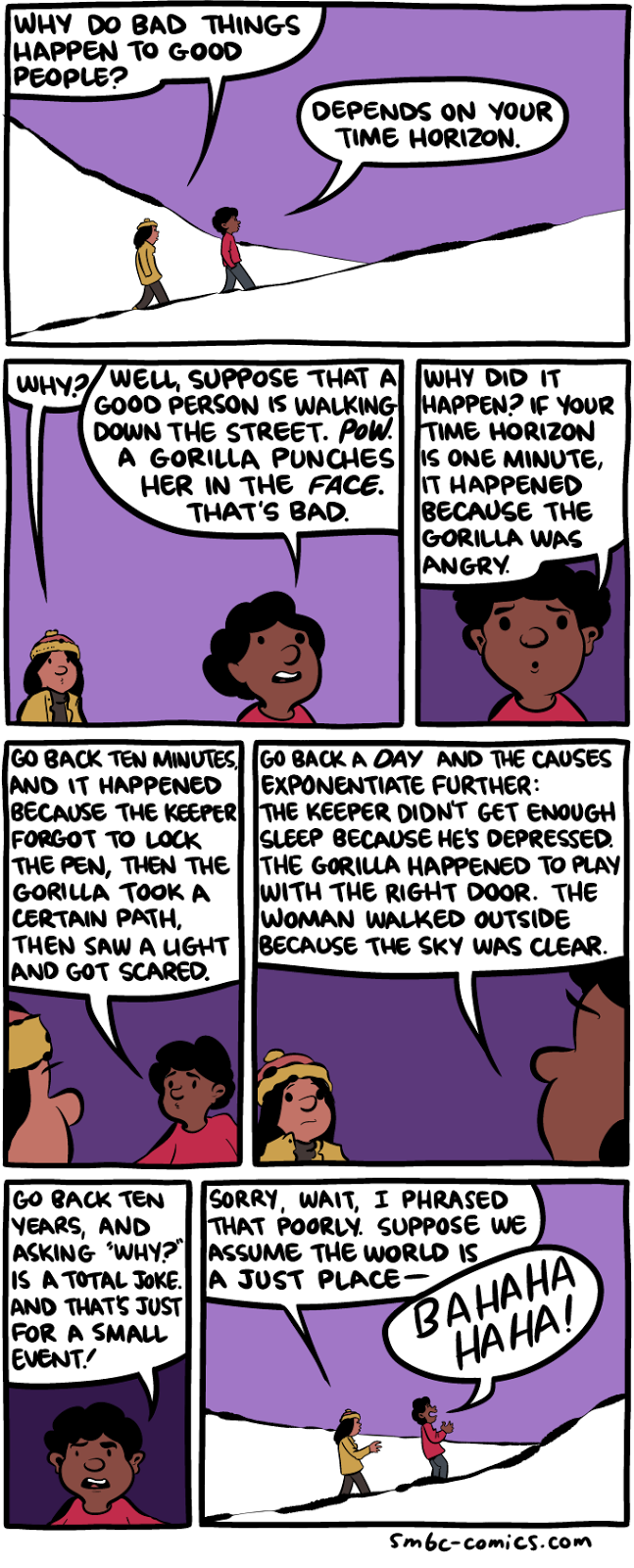
The same phenomenon occurs going forward in time as well. Self-proclaimed grandmasters of multi-dimensional chess will assure you that the ends will justify the means, that this action, despite appearing unethical and counterproductive by itself, will actually produce a beneficial result in the long run. The obvious problem is, trying to envision what “the long run” will look like is as fraught with error, bias and distortion as attempting to find causes in the past. The valence effect describes our tendency to imagine the best-case scenario resulting from our intended action, and then make the unwarranted logical leap to assuming that this is also the most likely result. Few people have the patience to make a serious effort to ponder all the alternative scenarios in which things don’t go so swimmingly.
When I Said I Understood, I Only Knew Where to Stand
Tocqueville was struck by the observation that as hyper-Protestants who reject anything that looks like clerical authority, Americans are expected to be self-sufficient in forming their own judgments about everything. This isn’t understood as a rare accomplishment, or a capacity that one grows into in the course of a life. It is a moral imperative from the get-go, taught in elementary school.
But of course we run into a problem: we are not competent to judge everything for ourselves. We know this; we feel it. We cannot look to custom or established authority, so we look around to see what everyone else thinks. The demand to be an individual makes us feel anxious, and the remedy for this, ironically enough, is conformity. We become more deferential to public opinion.
Here is an example that seems to fit Tocqueville’s insight. The Kinsey Reports on Americans’ sexual practices became objects of intense popular interest, maybe because they arrived (in 1948 and 1953) just as the received norms and mores were loosing their grip. Everyone was left to his or her own devices. People wanted to know if they were “normal”, where the only norms available, the only ones not discredited as “repression” by the pop-Freudianism that swept America after the war, were now quantitative. How often do other couples have sex? What’s the average? Is oral sex something that is done by most people? I like to be tied up — am I sick? The normative center of gravity now resides in the middle of a distribution, rather than coming from a religious interdiction or parental guidance, on the one hand, or from a cultivated, proudly antinomian sense of oneself as a pervert and sinner, on the other.
The web, for obvious reasons, is home to a lot of underemployed literary types with a lot of time on their hands. It’s also a playground for people who like to pretend that cultural consumption is a political act. Hence, without any special effort on your part, you can easily find an abundance of articles arguing about the supposed moral and political significance of reading certain books by certain authors. Typically, this involves a lot of empty signaling about race and gender. “This year, I’m aiming to have novels by African-American women account for 50% of the books I read.” Okay. And…?
What does it even mean anymore to call someone racist, say? Does it mean this person honestly believes in distinct races with deeply unequal divisions rooted in biology, which should therefore be reflected in politics and law? More cynically, does it merely describe a person who dissents, however mildly, from progressive piety about race? Or is it more of an existential accusation, reflecting a fanatical, almost-Protestant obsession with the purity of one’s soul, as reflected in the strange significance accorded to pseudo-scientific horseshit like the Implicit Association Test, with its supposed power to shine an objective light into the deepest crevices of one’s character and reveal the reactionary biases and stereotypes lurking there?
Lacking the ability to talk meaningfully (or calmly) about such questions of value, we retreat instead to the supposed pure, neutral objectivity of numbers. We let percentages stand in for values; we let ratios do our thinking for us. Our keys are blocks away, somewhere out there in the darkness, but like the drunk guy, we’re looking for them here, because the light is better. Will reading books by African-American women somehow render you immune to racist thoughts? Will it empower them in a politically meaningful way? How do we define who or what represents the quintessential African-American female experience anyway? (Through statistics!) Isn’t it rather, uh, problematic to assume that each identity grouping has an essentialist wisdom peculiar to itself, which can’t be attained by an outsider through imaginative empathy? Are white male authors a monolith, and does avoiding their books say anything deeply significant about you? Unsure of where we stand on such troubling questions, we settle for the poor substitute of knowing where we stand in relation to everyone else.
You Disappoint Me. I Had Such Fuckin’ Hopes for Us
The events of the last two weeks, however, have changed my view of The Wire in a very fundamental way. I have spent most of my time listening to people in Baltimore speak about how this uprising came to be and why the anger runs so deep. I’ve been primarily speaking to black Baltimoreans in grassroots organizations who have, in a state of MSM invisibility, been building movements for years to fight poverty, end street violence, and challenge police brutality. This is humbling to admit, but this experience has made me reassess my favorite show, as if a very dim light bulb was being switched on above my head.

The idea that David Simon, praised as someone with an ear to these Charm City streets like no one since H.L. Mencken, could look at what was happening in the Baltimore of 2015 and not see the social movements and organization beneath the anger, makes me wonder how much he truly “saw” when producing the show.

Now, I cannot help but recall all my favorite Wire moments through a lens that has me wondering if the show was both too soft on the police and incredibly dismissive of people’s ability to organize for real change. In the season that took place in the public schools, where were the student organizers, the urban debaters, and teacher activists I’ve met this past month? In the season about unions, where were the black trade unionists like the UNITE/HERE marchers who were—in utterly unpublicized fashion—at the heart of last Saturday’s march? In the season about the drug war and “Hamsterdam,” where were the people actually fighting for legalization? In the stories about the police, where were the people who died at their hands? It all reveals the audacity—and frankly the luxury—of David Simon’s pessimism.

I am not saying that art should conform to a utopian political vision of struggle like some dreck from the Stalinist culture mills. But I am asking a question that I wasn’t before: Why were those fighting for a better Baltimore invisible to David Simon? I don’t mean those fighting on behalf of Baltimore—the (often white) teachers, the social workers, and the good-natured cops who are at the heart of The Wire—but those fighting for their own liberation? Why was The Wire big on failed saviors and short on those trying to save themselves? And if these forces were invisible to David Simon, shouldn’t we dial down the praise of the show as this “Great American Novel of television” (Variety!) and instead see it for what it is: just a cop show?

In the wake of the Baltimore uprising, The Wire’s pessimism seems childish to me, and I’m going to put it away for a while. I could see myself revisiting it in the future, maybe amidst a more dreary political moment. But that moment isn’t now.

A Fact Without a Noisy Partisan
Liberal agnosticism about the good life has some compelling historical reasons behind it. It is a mind-set that was consciously cultivated as an antidote to the religious wars of centuries ago, when people slaughtered one another over ultimate differences. After World War II, revulsion with totalitarian regimes of the right and left made us redouble our liberal commitment to neutrality. But this stance is maladaptive in the context of twenty-first century capitalism because, if you live in the West and aren’t caught up in battles between Sunnis and Shiites, for example, and if we also put aside the risk of extraordinary lethal events like terrorist attacks in Western countries, then the everyday threats to your well-being no longer come from an ideological rival or a theological threat to the liberal secular order. They are native to that order.
…If we have no robust and demanding picture of what a good life would look like, then we are unable to articulate any detailed criticism of the particular sort of falling away from a good life that something like machine gambling represents. We are therefore unable to offer any rationale for regulation that would go beyond narrow economic considerations. We take the “preferences” of the individual to be sacred, the mysterious welling up of his authentic self, and therefore unavailable for rational scrutiny. The fact that these preferences are the object of billion-dollar, scientifically informed efforts of manipulation doesn’t square with the picture of the choosing self assumed in the idea of a “free market”. It is a fact without a noisy partisan, so our attention is easily diverted from it. Further, by keeping his gaze away from such facts, the liberal/libertarian keeps his own soul pure, lest he commit the sin of recommending to others some substantive ideal, one that will necessarily be controversial. But outside his garden wall there are wolves preying on the townspeople. In our current historical circumstances, his liberal purity amounts to a lack of public-spiritedness.
This excerpt, I feel it’s fair to say, sums up Crawford’s message in a nutshell. (There are many other thought-provoking parts in this book, some of which I’ll get to in the coming days.) I am on record as having raised a skeptical eyebrow at such assertions before, but in this case, I find myself more open to giving Crawford’s perspective as charitable a hearing as I can, partially because I sympathize with and trust his overall approach. I think he is honestly trying to envision what, if anything, can be done to protect fellow citizens from the predations of neoliberalism and its armies of highly-trained experts who utilize the most sophisticated psychological and advertising techniques to manipulate our wants and needs without our awareness. So, as a thought experiment, I find myself pretending I’m a bodhisattva, having attained comfort and security, and now I want to return to this fallen world and help as many others as I can. Or pretending I’m an ancient Greek, out for a stroll around the Agora, only to find myself accosted by some pug-faced man named Socrates wanting to know what my idea of the good life would entail. Barring some unreal Jacobin fantasy of total social re-engineering, what should people do to avoid living the isolated, directionless, debt-ridden lives that pervade so much of society today?
Saturday Shuffle
- Austra — Darken Her Horse
- Pale Sketcher — Supple Hope
- My Life With the Thrill Kill Kult — Diamonde Doll
- Chet Faker — Blush
- Lightning Dust — I Knew
- Orangutang — Bigger Chunk
- Author & Punisher — L_r
- Modest Mouse — Satellite Skin
- Datarock — I Used to Dance With My Daddy
- Black Rebel Motorcycle Club — Fault Line
- Serj Tankian — Praise the Lord and Pass the Ammunition
- Andy McKee — Drifting
- Isle of Q — Bag of Tricks
- Tombs — Deathtripper
- Corrections House — Run Through the Night
- Thao Nguyen — Bag of Hammers
- Spirit Caravan — Dreamwheel
- Aimee Mann — Nothing Is Good Enough
- The Wake — Control
- Bang Tango — Wrap My Wings
1 2