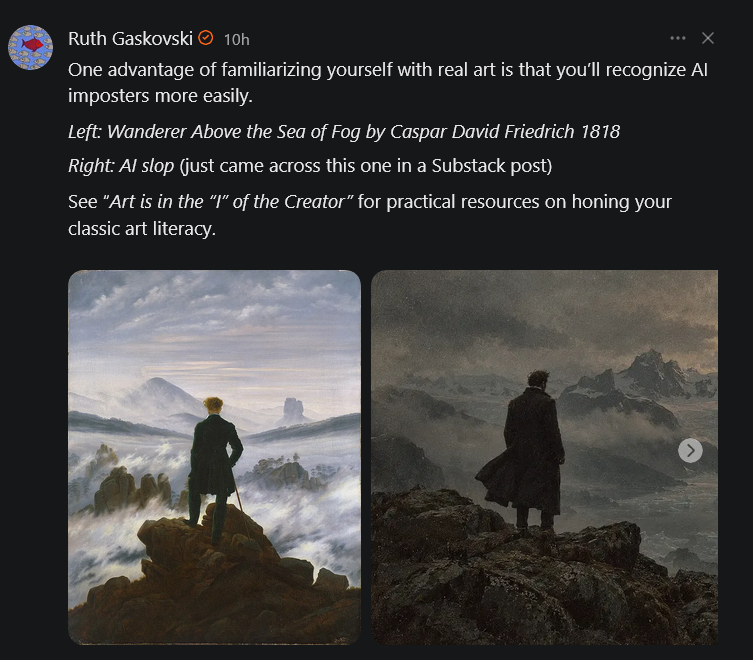
The surrounding context of this post isn’t important here. What I’m focusing on is how Rao articulates the inaptitude of the “fixed pie” mentality with regards to AI. Here’s a more-straightforward example:

There are a couple of obvious problems with this right away. First, maybe you should simply check in with your friends more often as a rule, not just when you need something from them. But also, there’s another possible, less heartwarming outcome to making that phone call: you may find yourself the subject of a passive-aggressive Facebook post about “friends” who feel entitled to someone’s “emotional labor” (and not only that, they call instead of texting, like we’re living in the freaking twentieth century or something). Before AI, the withering stock response to impromptu questions was, “Here, let me Google that for you.” Maybe the digital etiquette has changed now, but as a male feminist and good ally, I certainly wouldn’t want to be accused of violating boundaries or failing to respect my friend’s time.
But, to return to our main topic, the comparison here is rigged by pitting ordinary AI use against the jackpot outcome of human contact. But once you make that the standard, almost any efficient technology looks spiritually impoverished. Why use online banking when you might walk into the branch and discover that the teller is grieving her mother? Why order hardware online when a trip to the store could lead to an unexpectedly moving conversation with the guy in plumbing?
You ask ChatGPT to explain a technical paper, and the comparison becomes, “You could have asked an expert.” But very often you wouldn’t have asked an expert, even if you knew one. You would have skimmed it badly, misunderstood it, or never read it in the first place. You talk something through with an LLM, and the comparison becomes, “You should have called a friend.” But very often you wouldn’t have called a friend. You would have thought about it alone, written in a notebook, Googled around, or simply dropped the thought. You use ChatGPT to generate some silly image of Willis Carrier doing battle with the forces of summertime heat and humidity, and the comparison becomes, “A graphic artist could have been paid to do that.” Possibly, but a lot of generated imagery is stuff that previously would never have existed because it wasn’t worth the money, time, coordination, embarrassment, or social obligation required to get another person involved.
AI doesn’t merely redistribute a fixed amount of reading, writing, explaining, coding, advising, and conversation. It lowers the activation energy so dramatically that people do things they previously would not have done at all. In fact, Rao’s technical-paper example is a good example of how AI can increase demand for the underlying human product. He read a paper he otherwise wouldn’t have read. The paper was written by humans; the AI makes it accessible to another reader. The machine has not displaced the author. It has manufactured a reader.
The fixed-pie mindset is a very old folk-economic intuition that seems to emerge under stress and uncertainty. We’re familiar with it in its literal economic form, such as the bipartisan populist obsession with billionaires:

Most of us — some of us — a few of us, I hope? — understand that much “wealth” consists of ownership claims on enterprises whose value changes with expectations about future production. A billionaire becoming twenty billion richer because the market capitalization of his company rises is not analogous to somebody wheeling twenty billion dollars’ worth of coins out of everybody else’s houses. No corresponding twenty billion necessarily disappeared from everybody else’s possession. The valuation changed. But growth, capitalization, and counterfactual creation is abstract. “That greedy bastard has my share” is concrete. It identifies an agent, supplies a causal story, and gives resentment somewhere to fester.
The AI critic’s corresponding picture is: “There is only so much reading, writing, teaching, conversation, illustration, coding, etc. AI is doing some of it. Therefore humans have lost that amount.” Same imaginary conservation law. And in both cases the missing concept is creation at the margin. New wealth can be produced. New markets can appear. New reading can happen. New writing can become worth producing. New conversations can take place because the cost of initiating them has collapsed. This has certainly been my experience. But under stress and uncertainty, even educated humanities majors can revert back to a modern-medieval peasant understanding of the world. “There is only so much stuff. He has too much stuff. Therefore he has my stuff.”
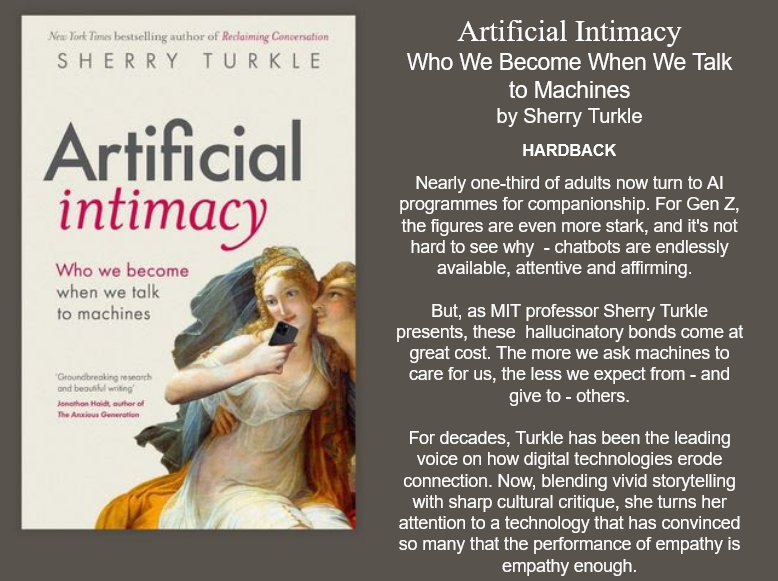
“The more we ask machines to care for us, the less we expect from – and give to – others.” The hydraulic model of human sociality. There is apparently a fixed quantity of caring in the system, and every unit directed toward a machine has been withdrawn from another human being. But there are non-zero-sum possibilities too: A person talks to a bot when no human conversation would otherwise have occurred. A bot helps someone think through something before talking to a spouse or friend. Someone who is lonely gets more conversational practice and becomes more willing to approach people. A person uses the bot for repetitive reassurance precisely so she doesn’t exhaust her friends with it. AI handles some low-value conversational labor and leaves humans with more time or patience for relationships they actually value.
Any of those could turn out to be common, rare, beneficial, harmful, or mixed. That’s an empirical question. But Turkle’s formulation has already answered it philosophically: attention given here must have been taken from there.
She is also proposing a kind of moral atrophy: being cared for cheaply will make us less caring. But there are equally plausible mechanisms in the opposite direction. Someone whose loneliness, anxiety, boredom, or need to vent has already been partially relieved may have more emotional surplus to offer other people. Parents understand this intuitively with almost every other kind of support: if Grandma watches the baby for two hours, we don’t say, “Terrible! Mom has outsourced maternal affection and will therefore love the child less.” We normally understand that burdens can be complementary.
The fixed-pie premise makes the argument almost unfalsifiable. If people use AI because they’re lonely, AI is exploiting their damaged relationships. If they enjoy AI, it is seducing them away from people. If they use it while maintaining good relationships, perhaps they are gradually lowering their expectations of humanity. If they say it has helped their human relationships, well, they’ve been convinced that “simulated empathy” is enough. There’s always a debit somewhere in the human column.
What would really upset this entire framework would be evidence that people can simply add another kind of relationship-like interaction to their lives without subtracting an equivalent quantity of human intimacy. Which, given everything we know about human beings accumulating books, pets, hobbies, parasocial attachments, correspondence, clubs, fictional characters, religious practices, diaries, therapists, online communities, and a thousand other supplementary forms of companionship, doesn’t strike me as an especially exotic possibility.