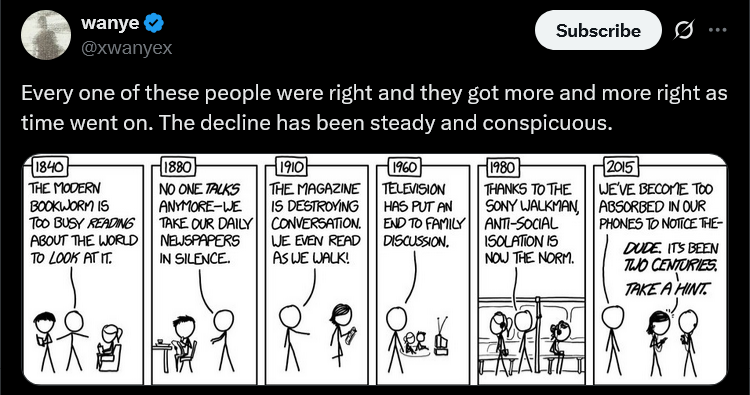
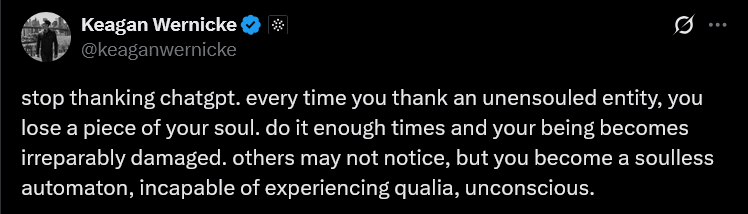
I think he’s overstating it. Even with strong life-extension, you don’t actually get rid of finitude. You get increased odds and longer runs, but there will still be accidents, resource limits, and eventual failure modes. The horizon moves out, but it doesn’t vanish. There will still be a market for philosophies that say, “You have to die sometime; here’s how to make that tolerable.” If anything, the more people fear death and cling to their extended lives, the more counter-arguments in favor of limits will develop: death as relief from exhaustion, as release from stasis, as the only way for new people and new cultures to arise. Not to mention that there’s no reason to suppose the human affinity for murder will fade away; if anything, it might become more widespread as people refuse to take nature’s hint.
How death is valued might change. I can easily imagine a scenario: a hyper-managed majority trying to defer death indefinitely, and a Romantic counter-culture that treats dying “on schedule” or even early as the last authentic gesture in a world obsessed with self-preservation. “Live forever” becomes the bourgeois norm; “die young” becomes the punk move. We already have micro-cultures that romanticize early death: the 27 Club, “live fast, die young,” the Romantic poet dying of consumption, the political martyr. In a world where the responsible default is “continuous optimization and health-span management,” checking out early becomes an even louder counter-signal. Voluntarily refusing life-extension (or just living recklessly in a world built for safety) would start to look like a kind of aristocratic gesture: throwing away what everyone else is desperate to buy.
But that Romantic status will be very selective, the way it always has been. When Keats dies young, it’s a legend; when some anonymous factory worker dies at 42, it’s a statistic. Any future cult of “beautiful early deaths” would probably attach itself to glamorous artists, influencers, or ideological die-hards, while the vast majority of premature deaths from poverty or addiction stay as unromantic and invisible as they are now. Life-extension tech would sharpen a class line: the long-lived, medically managed overclass; the involuntarily short-lived underclass; and a small self-conscious minority that chooses not to cash in the extra decades and makes a whole aesthetic out of that refusal.
Nietzsche worried that one immortal man would make the rest of us long for death out of sheer boredom with him. He didn’t live to see the prototype: tech billionaires livestreaming their biomarker readouts into eternity. The problem with immortality isn’t just that it’s arrogant to inflict yourself on the universe forever. It’s that most people already don’t know what to do with seventy years. Isaac Brock asks, “You wasted life, why wouldn’t you waste the afterlife?” and he’s right. If you’ve spent half your current allocation staring at your phone, why assume the next hundred years will be different? At that point, “life extension” risks becoming the metaphysical version of a gym membership: not something you seriously intend to use, just a comforting receipt you can wave around to prove you’re not really frivolous, you’re just getting ready. But time doesn’t care about your intentions. If you need an extra century before you can suck the marrow out of life, the odds are you’re going to spend the bonus years the same way you spent the base model: thinking you’ll start tomorrow. Many people don’t want more life; they want more wiggle room to avoid living.