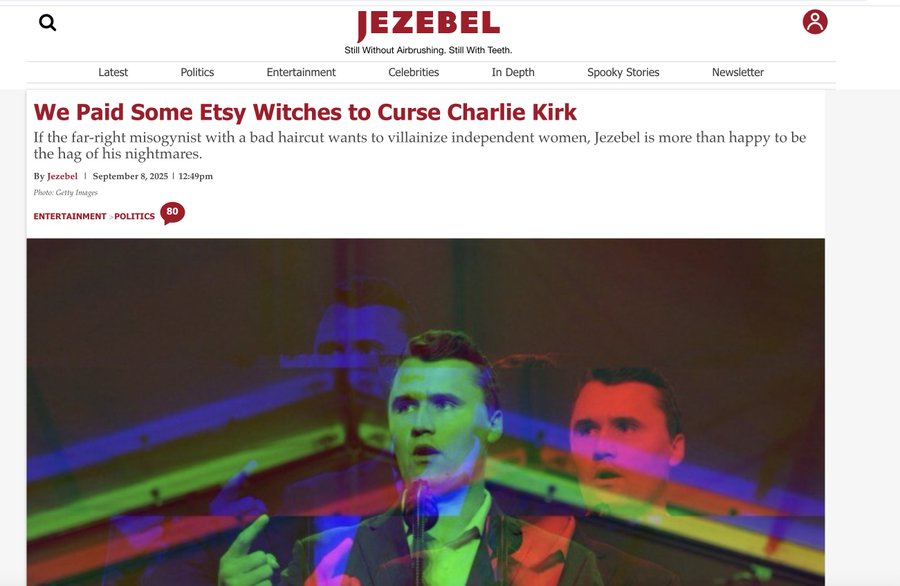
Ah, Jezebel, until now, it’s been a lovely several years forgetting you ever existed. To borrow from the philosopher Billy Butcher, I would call you all cunts, but you ain’t got the depth or the warmth.
On one level, everyone involved in this online theater knows the witchy stuff is make-believe. On another, a lot of people who would snicker at “spells” are doing the same thing with different props — trying to chant away moral responsibility with the language of inevitability. You can hear it in the chorus: He deserved it. Or, in a more cowardly passive register: What did you expect? If you anger enough people, someone’s going to snap. They talk as if they were describing gravity — step off a roof, you fall — when what they’re actually doing is casting a rationalist charm: a story that makes the chaos of political violence feel predictable, deserved, and therefore not their problem.
Human affairs aren’t gravity. They’re threshold and cascade systems. A small spark at the wrong moment, in the wrong network, can detonate far beyond “what anyone expected.” That’s not mysticism; it’s the boring math of contagion, thresholds, and network structure. Which is why “it was bound to happen” isn’t hardheaded realism; it’s a lullaby people sing to their consciences. One gunshot in Sarajevo did not “inevitably” produce the Somme and Verdun. In real time, many contemporaries didn’t foresee a continent aflame; the war emerged from a chain of miscalculations now called the July Crisis. Later, storytellers smoothed it into inevitability. But serious historians stress the chain reaction and the blindness, not fate.
Which brings me back to yesterday’s murder and the giddy “he had it coming / it was inevitable” talk. I’m echoing Orwell: “So much of left-wing thought is a kind of playing with fire by people who don’t even know that fire is hot.” The point isn’t that only the left is capable of this — human nature transcends even political divides — but that anyone who treats violence as a manageable tool is lying to himself first.
And this is where the Etsy witches become a useful, if ridiculous, mirror. The witches know they’re play-acting. The rationalist delusion is worse. It massages events into stories where the bad man “deserves” what happened, or where some impersonal law of political physics has already taken over, so no one has to dwell on agency or consequence. But post-hoc explanations don’t tame risk. They anesthetize judgment. It tells bright, credentialed people that narratives can domesticate chaos — that if they name an outcome “inevitable” or “justified,” they’ve defanged it. The world doesn’t care about your story. It only cares about what fuse you light. And once it’s lit, you don’t get to decide what burns next.
This is why you don’t flirt with ends-justify-the-means rhetoric. You don’t wink at “good” violence today because, in your imagination, it responds to the “bad” violence of yesterday, or prevents “worse” violence tomorrow. That’s a rationalist spell — a way of pretending you can channel chaos through your will. You can’t. You can only feed it or starve it. Starving it requires a discipline that feels small and unsatisfying when you’re angry: condemn political violence every time; stop laundering it with inevitability talk. We don’t know where the next spark lands, or which fuse it finds. We do know what happens when people start treating violence as predictable, deserved, or practically pre-authorized by their moral algebra: more ruins, more widows, more reasons for the other side to reach for the same fire. And then we all stand in the ashes, explaining very solemnly how it was “bound to happen.”
Even if it turns out the shooter was a schizophrenic with no coherent politics who picked a target at random, the reaction is the tell. The number of people who openly celebrated the killing — who treated it as righteous or inevitable — is the civic fact that matters. You don’t need a political motive in the assailant when you’ve got a political appetite in the audience. That appetite is how violence gets laundered into the moral economy: our dead are tragedies, their dead are punchlines, and above all, they started it. The ideologies come and go; the appetite remains. New slogans, old thrill. You can always come up with an ad-hoc reason for why this death was deserved, this humiliation cleansing, this cruelty inevitable. That’s not analysis; it’s ancient hunger in academic dress. Solzhenitsyn remains correct: the line dividing good and evil cuts through every heart — yours and mine included — which is why “cheering” violence corrodes the cheerer long before it changes the world.