I’m currently re-reading all of Alan Watts’ books, so it was especially interesting to discover that Bruce Lee was also a devotee of him. The only biography of Lee that I’ve read is Bruce Thomas’ Bruce Lee: Fighting Spirit, and a glance through the index reveals no mentions of Watts throughout the book. I suppose I’ll have to get a copy of John Little’s book as well.
books
Lucubrations, no. 22
To take an example related to animal intelligence, I can recall a moment around 15 years ago when I was sitting on a park bench in Tokyo eating my lunch. I was watching some crows strutting around the park looking for food. Suddenly I noticed that the very same intelligence that looked at the world through my eyes also looked at the world through the eyes of those crows.
It’s very difficult to write a good, watertight, rational kind of explanation for why I knew this to be true. It’s so unlike the way most human beings have been learning things about the world for the past few thousand years that it sounds kind of dopey. It even sounds dopey to me and I know it to be true.
…Intelligence isn’t a function of the brain. It isn’t contained there. The complexity of a creature’s brain doesn’t determine its intelligence.
Griffin was at least three decades my senior and had impressive knowledge, offering the Latin name of the birds and describing details of their incubation period. At the workshop, he presented his view on consciousness: that it has to be part and parcel of all cognitive processes, including those of animals. My own position is slightly different in that I prefer not to make any firm statements about something as poorly defined as consciousness. No one seems to know what it is. But for the same reason, I hasten to add, I’d never deny it to any species. For all I know, a frog may be conscious. Griffin took a more positive stance, saying that since intentional, intelligent actions are observable in many animals, and since in our own species they go together with awareness, it is reasonable to assume similar mental states in other species.
That such a highly respected and accomplished scientist made this claim had a hugely liberating effect. Even though Griffin was slammed for making statements that he could not back up with data, many critics missed the point, which was that the assumption that animals are “dumb,” in the sense that they lack conscious minds, is only that: an assumption. It is far more logical to assume continuity in every domain, Griffin said, echoing Charles Darwin’s well-known observation that the mental difference between humans and other animals is one of degree rather than kind.
Saint-Simon Says





The Wacky Morning D.J. Says Democracy’s a Joke
I’ve started re-reading Isaiah Berlin’s books, and they’re even better than my rose-tinted memory pictured them. By the way, for newer readers, it is a requirement that you, too, familiarize yourself with Sir Isaiah’s works, in order to be permitted to read here. An usher will be around shortly to check that you have your copies on hand, and there may even be a pop quiz to follow. Just so you know.


Anyway, that’s from Freedom and Its Betrayal, in the chapter on Claude Helvétius, a French philosopher from the mid-eighteenth century. Berlin describes him as the first utilitarian, a man to whom Bentham was deeply indebted, and one of the first to formulate the idea that politics could be turned into a science, with final answers to political questions existing a priori, waiting to be discovered by a sufficiently dedicated scientist with the proper tools and methods. For three hundred years, progressive minds have dreamed of the day when politics, with all its frustrations and compromises, could be brushed into the dustbin of history, and an elite ruling caste of enlightened technocrats could take power and give the people what they really want, as proven by the latest data and neuroimaging techniques, even if the poor, deluded cud-chewers don’t know it yet, and for those who still can’t adapt to the program, there’s always lobotomies, of either the pharmaceutical or old-fashioned kind.
This idea is still alive and well in our own age, as a glance through this morning’s news can tell you. I almost needed a lifejacket to surf the web today, what with all the crashing waves of progressive tears over the Brexit vote. Site after site featured the spleen-ventings of apoplectic proggies, furious that anything so outdated as a popular vote could have been allowed to interfere with their vision of a bureaucratic superstate. As you’d expect from uptight, moralistic prigs who spend every moment patrolling the police state of their minds, looking for any problematic words or ideas which could conceivably cause offense should they ever tunnel under the walls and wire and run amok among polite company, there has been a shuddering, gasping explosion of ecstatic release as they are finally allowed to vent their hatred of another group of people in the most positively un-enlightened language. Lower-class white Westerners? Racist white Westerners, you say? Oooooh, God, yes, okay, wait, wait, just let me slip my hand under here, and — ahhh, yes. Terminate with extreme prejudice! Scorch the earth and salt it so they can never grow back! Why did we ever let these subhumans vote in the first place?
I have no informed, meaningful opinion on Brexit, and my guiding assumption is that, as usual, the loudest, boldest predictions making the rounds right now are likely to be wrong, and the eventual results, once we’ve attained enough perspective to judge, will likely contain surprises no one anticipated, but which will seem obvious in hindsight. I realize that can’t compete with lurid prophecies of apocalypse and revolution, but I never said I was a pundit. No, what interests me is, one, as already mentioned, the way in which the ideas of a three hundred year-old philosopher are still entirely relevant today, and two, what this says about the political left in general.
Christopher Lasch, as I noted recently, wrote about how, a century ago, just before technocratic liberalism was about to reach its zenith, strangely enough, the mood among progressive thinkers was already shifting, becoming gloomier and self-pitying. As Lasch said, the Nation in 1922 was already developing the progressive aesthetic which loves to portray itself as a small, beleaguered outpost of impeccable taste and civilized values marooned in a wasteland of fundamentalists, rednecks and other savages. Even more recently, though, Peter Dornan, in the course of demolishing Naomi Klein’s latest screed, said it succinctly: the left has adapted to powerlessness. It has largely given up on seeing itself as the true vox populi, wanting nothing to do with those unwashed barbarians, and seems to be content with impotent fantasies about a society in which social scientists and academics have finally taken over the government. As he says, this is why a book like Klein’s, an incoherent grab-bag of sloganeering, wishful thinking and leftist bromides can find praise along the entire spectrum of left-wing media; it’s not like anything’s riding on it, after all. None of them expect it to be taken seriously or acted upon. It’s merely a way of signaling one’s membership among the elect, whether you wrote the book or whether you just wave it.
Jonathan Bronitsky said in a recent book review:
To this day, liberals and their other non-revolutionary siblings on the left might disagree with communists over the extent to which the state should engineer “fairness,” yet they still share with them a vision of what constitutes fairness and an image of a properly re-engineered people. For all ideologies of the left are tied to the Enlightenment, with its emphasis upon predetermined progress via reason and the accumulation of quantifiable knowledge.
“They still share with them a vision of what constitutes fairness and an image of a properly re-engineered people.” This, more than anything, is what strikes me about today’s left. They may have been forced to grudgingly admit that the state couldn’t remold society from the top down, but they have yet to admit that their ideal of what a just, equitable society would look like is incoherent. A chimera. A crackbrained fantasy. Like Wile E. Coyote, they’re running in place in midair, afraid to look down lest political gravity finally kick in. Thus the insular, self-congratulatory smugness. Thus the self-serving mythology about how only they can truly be opposed to all the insidious -isms which haunt the world like the imps and demons of a bygone age. Thus the need to make a virtue out of necessity — when confronted with their failure to persuade a majority of people to support their views, rather than adjust their tactics and redouble their efforts, they rationalize it as further proof that they’re just too pure for this fallen world.
Bear in mind, I’m not saying there aren’t perfectly valid-but-tediously-wonky arguments to be had over marginal tax rates and other specific policies. I’m talking about progressivism as an identity, as a surrogate religion, as the tiresome posturing that dominates social media. I’m talking about people who still, after three centuries, refuse to lose faith in a future Newton of politics who will finally reduce the maddening, complicated business of living and cooperating together in society into a few clear, inviolable rules that can be objectively applied by the credentialed experts. That vision appalls me, and furthermore, as Ben Cobley says, I don’t see any meaningful way to disentangle an essence of progressivism worth keeping from the insular, identity-obsessed cult it has become.
They Ain’t Heavy
He asked if the books were for class. I told him they weren’t. He asked if I was selling them. I told him I wasn’t. He asked why I had so many.
“Because I’m reading them.”
“All of them?”
“Yes.”
“Why carry them all? Why not just get a Nook or a Kindle?”
A trap, Yahdon! Don’t answer that!
His premise is flawed. The logic is pat.
Resist the urge to justify;
Instead, reply with Bartleby,
“I would prefer not to.”
Turn the tables, flip the script,
No, flip the tables, scatter wide
the coins of realm, and thus equipped
with self-respect, retort with pride,
“What sort of man are you?”
Why truckle like a serf to please
the monarchs of our modern age?
Convenience and Efficiency
still lock their subjects in a cage
with no aesthetic view.
Why trickle like a stream pursuing
least resistance to the sea?
One of us should be reviewing
options, but it isn’t me.
Mistaking Mythmaking for Social Remaking
No doubt the centrality of moral judgment goes a long way toward explaining the popularity of This Changes Everything. Movements need an ethical compass, and this book is never shy about who to blame for our problems and who to turn to for solutions. It captures the zeitgeist superbly, striking all the right political notes: anti-oppression, decentralization, spiritual attunement, equality. Readers are likely to love this book if they already share the values it’s built on. Whether moral positioning is a sufficient basis for a successful social movement is less clear, however.
Wow. What an absolute runaway steamroller of a book review. That’s one of the best things I’ve read online this year. Yet, as Dorman says in the conclusion, however flimsy and incoherent Klein’s book is, the biggest problem is the warm, uncritical reception it received from the left-wing choir, the same people who have quickly adopted Thomas Piketty’s Capital in the 21st Century as the New Testament update on Karl Marx’s wrathful, thundering Old Testament. And don’t even get me started on the undying progressive faith in a What’s the Matter with Kansas? framework that condescendingly attributes false consciousness to all opposition…
The Birth of the Asylum
Another pertinent excerpt from The Authenticity Hoax:

Arthur and I have an inside joke where, when commiserating over all the madness of society, we periodically shake our fists at the heavens while growling, “Jean-Jacques!” This developed out of our discovery that quite a few things that we consider unfortunate about our culture can be fairly traced back to the demented scribblings of that deranged lunatic. Like I said recently, it’s interesting to note how so many of the intellectual contests in our day and age are taking place on a playing field whose boundaries were painted by Burke and Rousseau almost two and a half centuries ago. Here, we can clearly see the philosophical origins of today’s postmodern insanity, where passionate feelings count as irrefutable evidence.
What Is This That Stands Before Me?
 When I first set about trying to make sense of the ongoing Great Awakening of social justice fanaticism, I found that the most helpful sources of information were books written in the mid-to-late-’90s, shortly after the last wave of political correctness had attracted mainstream attention. I’d been wondering how long it would be until we started to see book-length analyses of today’s SJWs, and now Kim Holmes has produced one of the first examples:
Progressive liberalism in America today is not at all like what has come before. It is not merely a logical extension of the old progressivism popular at the turn of the 20th century, or the New Deal liberalism of Franklin Roosevelt and its outgrowth, the “Great Society” liberalism of Lyndon Johnson. It is not even the same as the 1960s New Left. It is something entirely new. It has roots in these old movements, but it has acquired a new ideology all its own.
The historical roots are twofold: 1) the tradition of radical egalitarianism that first surfaced over two centuries ago in the radical Enlightenment; and 2) various intellectual movements that arose as a negative reaction to the Enlightenment’s rationalism, often lumped together in a movement called the Counter-Enlightenment. The first tradition is normally associated with the left, while the second is a phenomenon normally of the right, at least in Europe. The fusion of these two opposing intellectual traditions is a major reason why the postmodern left is so philosophically elusive. It is also a factor in why it has been so politically successful.
The historical inspirations for the New Left were typically leftist. But the postmodern left was also fed by another set of ideas associated with the right-leaning Counter-Enlightenment. Partly a romantic rebellion against the rationalism of the Enlightenment, but also a continuation of some of its more radical egalitarian ideas, the Counter-Enlightenment was characterized by distrust of rational discourse, a disdain for empiricism, contempt for Western liberalism, a hatred of modernity, and a tendency to glorify human passion as the mark of authentic individualism.
Hegel’s dialectic in action! The old windbag is probably smiling in his grave. Holmes goes on to distinguish postmodern leftism from traditional liberalism (the postmodern left favors epistemic relativism over liberalism’s affinity for natural law, it has no qualms about using state power to coerce opposition to accept its radical egalitarian claims, and it is strongly opposed to open inquiry and debate) and from early-20th-century progressivism (progressives, he stresses, were interested above all in building a new collective society, not in creating a balkanized zone of warring identity tribes, and they approved of the basic cultural and moral frameworks of Western civilization).
Taxonomy aside, he notes one especially interesting thing about their style of argument:
The deconstructionist method used by the postmodernists, albeit ostensibly theoretical in intent, is a powerful political weapon. It is a way to critique society without exposing oneself to easy counterattacks. By promising, for example, to tear away the veil of myth that supposedly props up capitalism and Western culture, it offers an all-purpose method of criticism that is political without appearing to be political. Postmodernists present themselves as relativists, not dogmatists, and thus they can sling arrows at the system from every possible angle. Since they are not held responsible for defending anything that actually exists, they wear their theoretical slipperiness as a badge of honor, as proof of a profound authenticity that is exceedingly difficult to disprove. They are intellectual guerrilla fighters in an asymmetrical war against Western culture, only they often pretend not to be fighters at all, but simply disinterested academics. They attack from the cultural flanks and then slip back into the cloistered protection of the academy, professing an interest only in literary theory or the nature of perception, language, and knowledge.
This actually made me laugh. Those of you who used to read the blog Who Is IOZ? (it’s now private, as the author, Jacob Bacharach, has gone on to become a novelist) back in the day should recognize this description. He espoused an intensely moralistic, non-denominational radicalism while sarcastically, ironically deflecting all challenges to him to defend a practical stance (and, perhaps true to his generation’s stereotype, he still likes to style himself as too special to fit within anyone else’s categorizations). IOZ managed to keep the shtick alive for several years due to his exceptional and entertaining writing ability, but in the hands of an ordinary practitioner, its sanctimony is merely tiresome.
At any rate, the salient point is that, unlike the fellow-traveling left of the early 20th century and the Third-World-liberationist sympathies of the New Left, today’s radicals are too jaded/afraid to be caught committing to a positive vision; theirs is entirely negative, relentlessly critical. Everything that actually exists is to be condemned for its imperfection (or, as a wiseacre likes to say, everything’s a problem). But how long can you occupy a morally pure “view from nowhere” while still expecting the targets of your attacks to continue taking you seriously? Hopefully, if the appearance of books like this is any indication, not much longer.
To the Ten Thousand Things
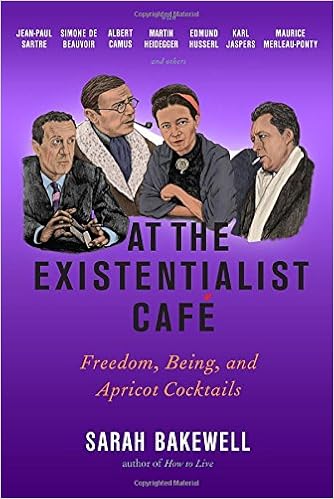 Linji Yixuan, founder of a school of Ch’an Buddhism in 9th-century China, was said to have scornfully dismissed Buddhist terms such as “Bodhi” and “Nirvana” as stakes for tethering donkeys. In reading Sarah Bakewell’s At the Existentialist Café, I found myself wishing that the prominent figures in phenomenology and existentialism, Edmund Husserl, Martin Heidegger, and Jean-Paul Sartre, had studied under a similar instructor who might have imparted a sense of skepticism toward the possibility of capturing the essence of experience in words like “Being” and “Authenticity”, or, as in the case of Heidegger, torturous compound German phrases.
Bakewell’s previous book, an unconventional biography of Montaigne, was a treasure. I was eagerly anticipating this one as a result, especially given that I have become increasingly convinced that I am the victim of a hypnotist’s lingering prank, one in which I was rendered incapable of remembering the slightest interesting thing about Heidegger’s philosophy within mere minutes of having finished reading about him. If anyone could help me understand why this man is worth my time and attention, Bakewell could.
As it happens, I can’t say I’m any closer to a desire to read Being and Time, though that’s no fault of Bakewell’s. As a character-driven summary, rather than a dense philosophical history, the story of this group of thinkers is indeed absorbing. It begins with Husserl’s slogan, “To the things themselves!” As Bakewell explains:
It meant: don’t waste time on the interpretations that accrue upon things, and especially don’t waste time wondering whether the things are real. Just look at this that’s presenting itself to you, whatever this may be, and describe it as precisely as possible.
There is at least a superficial similarity to Zen philosophy here, but in practice, the phenomenologist project appears more like an attempt to greedily attend to the quotidian details of experience in a possessive manner. I once heard a metaphorical description of conscious awareness as a thin penlight being used to search within a darkened warehouse. Bakewell’s paraphrases of the original material, however lucid, seem to me to describe an attempt to shove as much experience as possible out of the shadows, into that narrow beam of light.
At this point, it becomes curious to note that Charles Darwin is mentioned only once in passing. Not that he should have played a role in Bakewell’s story, of course, but his absence in the thought of her subjects, nearly a century after his discoveries, seems significant (for that matter, one might think Kant’s criticisms of empiricism, a half-century before Darwin, should have likewise tempered the urge to wallow in the deluge of sensory stimuli). Evolution did not mold the human brain as a truth-seeking machine. Like all other evolved beings, we adapted to our environments at a cultural snail’s pace, according to our most pressing needs. The fact that we ruthlessly filter our experience along established patterns and ignore most things which seem irrelevant to our needs and interests is evidence of our minds working in the most efficient manner possible within their enforced constraints, rather than evidence of a moral or intellectual failing. Subjecting our experiences to hyper-focused scrutiny is something that can only be done in short bursts — the cognitive burden is too taxing. Is the effort worth it, though? Will sustained attention to this, whatever this may be, burn a hole through the layers of illusion to the authentic truth beneath? I’m skeptical, to say the least.
In his book Fools, Frauds and Firebrands, Roger Scruton referred a few times to Sartre’s “Satanic” pride (Satanic in the sense of Milton’s anti-hero). We see evidence of this here as well, with both Sartre and his partner Beauvoir struggling to accept the necessity of death. As Bakewell says about Sartre, “everything in his personality revolted against being hemmed in by anything at all, least of all by death.” Phenomena, of course, will go on after our individual deaths; countless living beings will partake of the same experiences that we have had. What offends Sartre’s immense pride is the fact that death means “I” can no longer hoard one particular collection of memories as “mine”. I found it unexpectedly poignant to consider this particular tragic flaw, especially as there were so many others of his that failed to inspire much sympathy.
That said, I consider it a notable accomplishment that I found myself in near-agreement with Bakewell when she confesses coming to respect and even like Sartre, despite disagreeing with much of his philosophy and acknowledging his “monstrous” nature. For me, it was more a feeling of grudging acceptance for someone attempting to think his way through one of the darkest, most turbulent times in history, when it was very easy to make wrong choices. My general revulsion for Sartre as a man was tempered by being reminded of his concept of bad faith, one which has become increasingly central to my own thinking. Passages like this —
All these devices work because they allow us to pretend that we are not free. We know very well that we can always reset the alarm clock or disable the software, but we arrange things so that this option does not seem readily available. If we didn’t resort to such tricks, we would have to deal with the whole vast scope of our freedom at every instant, and that would make life extremely difficult. Most of us therefore keep ourselves entangled in all kinds of subtle ways throughout the day.
Or this —
For Sartre, we show bad faith whenever we portray ourselves as passive creations of our race, class, job, history, nation, family, heredity, childhood influences, events, or even hidden drives in our subconscious which we claim are out of our control.
— stir my blood and quicken my pulse, just like when I first discovered existentialism in philosophy class many years ago. We could do with a lot more emphasis on “radical freedom” in our own time, when the urge to shrug off the burden of our own agency is as tempting as ever, especially when encouraged by the latest theories in sociology and neuroscience. All in all, a satisfying read, even if Heidegger is destined to remain opaque to me.
Such a Grand Departure from Basic Human Nature
No one’s expecting a world that runs on justice
No one is waiting for such a grand departure
From basic human nature
Alongside the internationalists and the pro-Americans, a third group in postwar Western Europe favored putting their hope in the Soviet Union. This was, after all, the one major nation on earth that had actually tried to put into effect the great Communist ideal for humanity — the prospect that (at some far-off point when all the cleaning up work was done) human beings would banish poverty, hunger, inequality, war, exploitation, fascism and other evils from existence forever, simply by an act of rational management. It was the most ambitious attempt to change the human condition ever attempted. If it failed the first time, it might never be tried again, so it seemed worth defending at all costs.
We are here talking about the events of just seven decades ago — a modest human lifespan — yet it has already become difficult to think ourselves sufficiently into that time to understand how this ideal swayed so many intelligent, sophisticated people in the West. Now, the conventional wisdom has become that Communism would never have worked in any possible world, and therefore that those who failed to see it as futile from the start were fools. Yet, to people who had been through the hardships of the 1930s and the Second World War, it could seem an idea worth believing in despite its acknowledged unlikeliness. People did not see it as a mere dream, of the kind you wake from with a vague impression that you’ve seen something marvelous but impossible. They thought it a practical goal, albeit one to which the path would be long and difficult, with many pitfalls along the way.
Yuval Levin, in his excellent Tyranny of Reason, made a similar generous point. Given the astounding successes of the natural sciences in the wake of Newton, it was perfectly reasonable to hope, or even assume, that a similar science of man and society could be developed and implemented. What’s unforgivable is that there are still so many people today who have a historical record to reflect upon, yet still refuse to learn from it.
Plight Makes Right
If a lot of people with incompatible interests all claim that right is on their side, how do you decide between them? In a paragraph of the final part of The Communists and Peace, Sartre had sketched the outline of a bold solution: why not decide every situation by asking how it looks to “the eyes of the least favored”, or to “those treated the most unjustly”? You just need to work out who was most oppressed and disadvantaged in the situation, and then adopt their version of events as the right one. Their view can be considered the criterion for truth itself: the way of establishing “man and society as they truly are”. If something is not true in the eyes of the least favored, says Sartre, then it is not true.
…This is similar to what might one might call the Genet Principle: that the underdog is always right. From now on, like Jean Genet, Sartre submits himself joyfully to the alienated, downtrodden, thwarted and excluded. He tries to adopt the gaze of the outsider, turned against the privileged caste — even when that caste includes himself.
No one could say that this is easy to do, and not only because (as Beauvoir had pointed out in The Second Sex) borrowing someone else’s perspective puts a strain on the psyche. Anyone who tries to do it also runs into a mass of logical and conceptual problems. Disagreements inevitably ensue about who exactly is least favored at any moment. Each time an underdog becomes an overdog, everything has to be recalculated. Constant monitoring of roles is required — and who is to do the monitoring?
I’m surprised I’ve never heard this idea cited approvingly and credited to him. Sartre, the unheralded father of intersectionality? Well, that would certainly explain why the baby is so fucking ugly.
Literature Lost
 The New Left was a heavy boulder heaved into the pond of American society, and the ripples are still disturbing the surface. We currently find our little boat rolling in the turmoil of the second big wave of political correctness to follow that initial splash. Regular readers know my story — I didn’t go to college, and thus was not exposed firsthand to the original PC outburst that was taking place at that time. My shallow liberalish identity, forged largely in response to the aggressive, mean-spirited right-wing environment I grew up in, didn’t survive exposure to the millennial generation’s PC resurgence, which was spread wider than ever before by social media, rather than remaining quarantined on college campuses. For the last few years, I’ve been reading as much as I can to give me a better philosophical understanding of who these lunatics are and which crack in the roof of hell they crawled out from.
John M. Ellis’s 1997 book Literature Lost is one of the better sources I’ve found for my purposes, engagingly written and refreshingly free of polemical excess. He starts with context, showing that cultural history has been a long series of footnotes to Ecclesiastes, in which everything we thought was new is just another remake. Today’s radicals reflexively oppose anything to do with straight, white, Western men, but Tacitus was the first to use a romanticized image of barbarian outsiders as a selectively polished mirror in order to shock his own society with its ugly reflection. We may stare in utter disbelief as campus leftists insist that races and genders need to be effectively segregated, not for the benefit of white society this time, but rather to prevent those white devils from appropriating and microaggressing against cultures of color, and yet Johann Herder, as Isaiah Berlin has elsewhere explained in depth, had already laid the intellectual foundations for tribal group identity and cultural relativism long ago. And then, of course, haunting the whole sorry spectacle is the malignant shade of Rousseau, the original social justice warrior. Rather than rehash his many intellectual crimes, I’ll just step outside to hawk and spit on the ground at the mention of his accursed name.
From there, we read about feminists complaining that “easy dismissal of feminist writers, journals and presses” and “malicious humor directed against feminists” are common examples of “harassment”, which exists on the same continuum as actual, literal rape. This, by the way, is from a Modern Language Association newsletter from 1991, not from a post last week on Tumblr. (Peggy McIntosh, the mother of intersectionality, who is uniquely responsible for the fact that no one currently between the ages of 20-50 will ever want to hear the word “privilege” again no matter what the context, makes several appearances in this book.) We take a look back at the primitive precursor to Twitter show trials, multisignature letters, in which dissident scholars find themselves being publicly attacked by mobs of enraged academics, ad hominem-style, in prominent publications, for their apostasy. And we are reminded that intellectual philistines have been insisting, for decades now, that politics is the most important content of literature (or art in general), and that opposing oppression by straight, white, Western men is the primary concern of all politics.
In making the persuasive case that the uniqueness of Western culture lies not in its crimes, but in the moral/intellectual framework it developed and practical action it took to atone for those crimes, Ellis does oversimplify the Enlightenment and its consequences, in my view. You wince, for example, as Ellis writes, “Torture now occurs for the most part only in those areas of the globe where Enlightenment values have not fully penetrated,” knowing as you do that Abu Ghraib would be news less than a decade later, and that waterboarding would be something that Republican presidential candidates happily espouse as a campaign promise today. He rightly argues that “stumbling” toward moral progress is forgivable for a Western culture that codified the very ideals by which it is being harshly judged, but seems to consider it a foregone conclusion that the rest of the world will eventually adopt “Enlightenment” values. Well, as critics of this sort of “it gets better” school of historical thought, such as John Gray and Timothy Snyder, have pointed out, the Jacobins, Bolsheviks, and Maoists were all attempting to use science and reason to rationally improve human society, however inconvenient that is for P.R. purposes. Noting this is not to claim, a la Slavoj Zizek, that there is no meaningful difference between Jefferson and Stalin, so we might as well choose the “honesty” of the latter; it is merely to suggest that this is an unnecessary weak link in an otherwise strong argument. The ideals could be defended without hitching them to a tendentious, vague equation of “the Enlightenment” to “anything we consider good, happy, positive, and beneficial in our society.”
Still, that’s a minor quibble. I highly recommend it for anyone interested in gaining perspective on the left side of the culture wars.
Verily, Verily, I Say Unto Thee (9)
I read Thomas Chatterton Williams’s memoir, Losing My Cool, last summer and found it engrossing. I recommend checking it out, but until you do, here’s a couple more recent articles from him worth reading. One, on everybody’s least favorite buzzword, privilege:
What is more harmful — and pervasive in these disillusioned last days of the first black presidency — are the ways in which left-leaning discussions now share assumptions with the worst conservative and even white supremacist ideology. Whether put forth by racists or anti-racists, the insistence that, as James Baldwin noted, it is a person’s “categorization alone which is real and which cannot be transcended,” is oppressive. When genuinely anti-racist views lead us to the same practical conclusions an open bigot would embrace — that black life is miserable compared with white life — we give white people too much credit and strengthen the status quo.
The false choice between acknowledging the repugnant history of racism that informs the present, and the wish to accept the reality that a growing number of black people may nonetheless experience the freedom to define ourselves, is infantilizing. What this current moment of protest and awakening must lead us to, if it is to lead us anywhere, is a dignified means of fully inhabiting our ever more complicated identities.
And two, on everybody’s second-least favorite buzzword(s), safe spaces:
It’s a strange and ironic double diminishment: first to feel oneself aggrieved, and then to conclude that the best response is to bask in fragility and retreat into an artificially indulgent social context. There is something utterly dehumanizing about being fit to a demographic profile, reduced to the sex or color of a body. While I may not be able to control how I look or how others perceive me, I control absolutely the ways I perceive myself. The idea that minorities need bubbles betrays an internalized sense of inferiority. When we concede public space as inherently hostile instead of deliberately claiming it as our own — as Martin Luther King Jr. and so many others did in the Sixties, as the gay-rights movement did more recently — we perpetuate and reinforce some of the very biases we seek to counteract.
Just as troubling, the growing power and influence of the appeal to vulnerability transforms it from a strictly defensive (if ineffective) tool into an increasingly potent method of intimidation that can silence even meaningful disagreement.
Don’t Cross the Streams
For the therapeutic society, such a goal continually recedes beyond the horizon. These therapies share many of the new assumptions about race: racism continues unabated; all slights are equal; anyone who endures racial slights of any kind or degree is a victim or a survivor who needs help; racism is an illness shared by all oppressors, who also need therapy; and small-group interactions and emotional catharsis are the primary ways in which the racial problems of the country should be faced. That there is never an end in sight — racism remains completely unchanged — handily gives the new therapies the rationale not just for persevering but for proselytizing through pamphlets, books, journals, classes, workshops and retreats.
…The therapeutic movement, with this ethos of empowerment, has trumped the civil rights movement, with its vision of the just society and the good life. The culture of therapy’s view that the problem for everyone — bigots, oppressors and leaders alike — is a lack of nurture, validation and support has inspired numerous best-selling books and talk shows. The spirit of the movement is that we are all owed unconditional acceptance at all times, and that any weaknesses we have are not our own responsibility.
…The notion of incorrect attitudes — stereotypes — both expands and diminishes the extent of the problem. No one is truly guilty here — no one is actually at fault — because it is society that breeds the wrong attitudes. Yet everyone must be subjected to self-examination, because everyone harbors these attitudes. Thus any distinction between a racially motivated act — like refusing to hire or promote someone or chasing someone out of one’s neighborhood on account of race, or worse — and a passive misconception one might have about a group one has never known intimately gets lost. This focus on attitudes of nebulous origin, and the misleading assumption that they are universal and as lethal as racist acts, comes from a loss of judgment and proportion. This loss of proportion and inability to distinguish among wrong acts rests on the idea that stereotypes are responsible for racism, not individuals.
I became interested in reading this book after seeing an intriguing reference to it in a Spiked article a few months ago. Shortly afterward, I fortuitously came across a copy in a secondhand bookstore. Having now read it, I have to amend my thinking a bit. You’ve heard me say many times that the trendy emphasis on intersectional social justice is merely the millennial generation’s twist on the tired old fashion of left-wing identity politics. I still think this is true, but slightly incomplete. Lasch-Quinn’s book does a very good job of illustrating the overlooked fact that both the vocabulary and the rhetorical framework favored by social justice warriors owe as much to the maudlin, emotionally-incontinent therapeutic culture as to the New Left. Truly, a grim example of the worst of both worlds combining as one.
This Land Was Made for You and Me
Tony Judt, Ill Fares the Land:
The kind of society where trust is widespread is likely to be fairly compact and quite homogenous. The most developed and successful welfare states of Europe are Finland, Sweden, Norway, Denmark, the Netherlands and Austria with Germany as an interesting outlier. Most of these countries have very small populations: of the Scandinavian lands only Sweden tops 6 million inhabitants and between them all they comprise less people than Tokyo.
…But it is not just a question of size. Like New Zealand, another small country (pop. 4.2. million, even smaller than Norway) that has succeeded in maintaining a high level of civic trust, the successful welfare states of northern Europe were remarkably homogenous.
…Size and homogeneity are of course not transferable. There is no way for India or the USA to become Austria or Norway, and in their purest form the social democratic welfare states of Europe are simply non-exportable.
It was strange, I thought, that Judt brought this up in the middle of his book and then just…went back to nostalgically lamenting the loss of mid-twentieth-century American civic spirit without attempting to suggest how, indeed, a renewed vision for social democracy might surmount this formidable obstacle. I don’t mean to imply a necessity for the sort of cheap “call to action” that books like this typically end with, of course. American society will continue to evolve and redefine itself while paying no heed to the manifestos, blueprints or theories of intellectuals, which exist primarily to give other intellectuals something to chatter about. But assuming that most readers are coming to this book already sympathetic to Judt’s perspective, perhaps it would have been more useful for them to be confronted with harder questions about their own complicity — for instance, what does it say that those on the left who would love to see the United States transform into a social democracy are the same people who, through their dogmatic adherence to multiculturalism and the ethnic balkanization of identity politics, have done the most to undermine the possibility of a civic ethos capable of transcending the heterogeneity of over three hundred million people? If religion is a superstitious relic of a benighted age, and earnest talk about the civic creed of the American Dream only brings a cynical sneer in return, where are we to find the resources to develop the sort of cosmopolitan neighbor-love that Judt pined for? The question is never raised in these pages, and so we can only continue to wonder.
Verily, Verily, I Say Unto Thee (8)
Though there are individual exceptions, the absence of Beard is usually a sign of physical and moral weakness; and in degenerate tribes wholly without, or very deficient, there is a conscious want of manly dignity, and contentedness with a low physical, moral, and intellectual condition. Such tribes have to be sought for by the physiologist and ethnologist; the historian is never called upon to do honor to their deeds.
— Thomas S. Gowing, The Philosophy of Beards