I’ve said before, with only the tip of my tongue in my cheek, that Oprah Winfrey is “no more a person now, but a whole climate of opinion under which we conduct our differing lives.” (Yes, technically, Auden first said that about Freud, but Sigmund has nothing on Oprah when it comes to the reach of their respective pernicious influence. I’m confident that W.H., were he around today, would agree with me.) Now, with the news that Oprah is going to bring the risible 1619 Project to film and TV, it looks like she’s going to add pseudo-history to her legacy, in addition to the pseudo-spirituality and maudlin therapeutic sensibility she’s already known for. As if we weren’t already close enough to living in Idiocracy.
history
Clio Shrugged
Literary historian Robert Darnton points out that as private reading bloomed, some feared that the act would have physical consequences. He cites the German writer J.G. Heinzmann, who in a 1795 tract warned that excessive reading would increase “susceptibility to colds, headaches, weakening of the eyes, heat rashes, gout, arthritis, hemorrhoids, asthma, apoplexy, pulmonary disease, indigestion, blocking of the bowels, nervous disorder, migraines, epilepsy, hypochondria, and melancholy.”
There’s something so time-specific to this list of maladies, isn’t there? I mean, you read it, smile, and say, “That’s such an eighteenth-century image, like powdered wigs, quills and horse-drawn carriages.” I read this last week, but I thought of it again while reading a review of not one, but two new books about walking. Specifically, “questions of how and why we walk — what walking means.” (Apparently this hasn’t been settled by the previous umpteen books about the meaning of walking. I will never stop being amazed that people can produce so much verbiage from such a humble topic.)
We know that walking is good for us, that “if undertaken in regular doses,” as Shane O’Mara writes in “In Praise of Walking: A New Scientific Exploration,” “it provides the small, cumulative and significant positive changes for lung, heart and especially brain health.”
…For O’Mara, the answers are practical. “The emerging science,” he insists, “is giving us a clear picture: Regular walking confers enduring and substantial benefits on individuals, and on society at large.” It improves our “moods, clarity of thought, our creativity,” as well as “our connectedness to our social, urban and natural worlds.”
And yet, when we lived in a world built around the length of the human stride, when architecture was oriented toward pedestrians, and when towns were designed to be walkable, people still found ways to be unhappy and unhealthy. He’s not wrong, but it’s such a shallow, myopic way to look at it. It strikes me that this type of optimal-health-and-efficiency neurobabble will one day be seen as a stereotypical marker of our own time. “Hahaha, isn’t it weird that people back then were so obsessed with brain chemistry and the malign effects of smartphones?”
Another review, this time of a book about the history of Progressivism, suggests that the combination of Darwinian theories, philosophical pragmatism, and the disillusionment following the carnage of the Civil War was what set the stage for Progressive ideas to flourish. Of course, it has long been argued, convincingly in my opinion, that World War One was “the blow that hurled the modern world on its course of self-destruction,” as Jacques Barzun said. How many other wars have likewise served as punctuation marks at the end of an epoch? The cynical thought occurred to me that perhaps “history” is a record of the silly trends that preoccupy us while we wait for the next massive war to come along and wipe the slate clean. Will our contemporary plague serve as a similar cultural palate-cleanser? Or will we pick right up where we left off until the next big war alters our assumptions and priorities again?
Nor Awkward Claim Picked From the Wormholes of Long-Vanished Days
Of course I knew what to expect when I picked up a copy of Stephen Greenblatt’s Tyrant: Shakespeare on Politics. Still, though, there are times when I feel like turning around to tell Greenblatt that it’s hard to enjoy the book with him leaning over my shoulder, breathing on my neck, trying to make sure that I don’t miss any of the unsubtle parallels he draws. I mean, really — Jack Cade, in capturing Lord Saye, “has in his hands the realm’s highest fiscal officer, the emblem of the swamp that he has pledged to drain”? “He promises to make England great again”? Countless other examples, without being quite so on-the-nose, are still framed in unambiguous ways, as if we can’t be left to draw our own conclusions. Much of the book, simply by virtue of centering on Shakespeare’s plays, is enjoyable enough to read — that is, when the reader is allowed to forget for a moment that THERE’S A RELEVANT LESSON TO LEARN HERE.
As it happens, I’ve added Shakespeare to my book-juggling routine these last few months, trying to read a scene here, a scene there, a sonnet before bed, etc. One of the many enjoyable things about doing so is that it’s a break from the incessant cicada-drone of omnipresent, up-to-the-millisecond media and its infatuation with the Eternal Now. At the risk of making it sound like just another utilitarian, productivity-enhancing “hack,” it’s good to spend some time considering the differences between, say, Elizabethan England and our own time. Granted, there are constant themes in human nature and history which we can’t help but notice. But we have to be careful not to force history onto the Procrustean bed of our fleeting obsessions, lest we end up finding social media in ancient civilizations, or Silicon Valley start-ups in colonial America.
Mr. Full, Mr. Have Kills Mr. Empty Hand
The Right is now having a new version of an old fight. Is a person’s success or failure mainly dependent on his personal choices or on the operation of larger, impersonal forces over which he has no control? The key word here is “mainly.” No reasonable person believes that economics, culture, and history have no influence over human choices. At the same time, no reasonable person believes that individuals — especially in contemporary America — are entirely imprisoned by circumstance.
…The populist wave built, and with it a tale that sounded very strange to conservative ears. The struggling white working class had been victimized. It needed primarily a political rescue. The notion that the government can help at the margins but that self-improvement is mainly up to the individual was replaced by an angry victim narrative. And the victimizers? The “elites,” of course.
History isn’t just “one damn thing after another,” of course; it seems more like “the same few damn things over and over again in recurrent cycles.” In his book The True and Only Heaven, Christopher Lasch complained about the trendy mindset that saw the decade (or perhaps the generation) as the basic unit of historical time. Analyzing history in bite-sized ten-year chunks, he argued, encouraged a shallow perspective better suited to observing fashion trends and consumer goods. And yet, the longer I live, the harder it is to avoid the impression that every “new” idea is just one that’s been out of fashion long enough for an increasingly attention-deficient culture to have forgotten why it was discarded in the first place. The “rational” alternative to the revitalized socialism of both the national and international varieties is a STEM-mongering liberalism in thrall to the technocratic delusions of Auguste Comte. History seems like just as much of an absurd joke viewed through the wide-angle lens.
Schopenhauer, with his usual perkiness, said that human existence was primarily an oscillation between boredom and despair. A less-morbid perspective might say that there is a virtuous mean worth aiming for, however difficult it is to attain it, but most people occupy themselves rushing back and forth between the stupid ideas on either side of it.
Sic Transit Gloria
The Lady of the House spent the holidays visiting relatives in the homeland. She mentioned to me that her family apparently eats off of paper plates now due to the tedium of arguing over whose turn it is to do the dishes.
This gave me a new way to think about the fall of the Roman Empire. From our perspective, we look back and wonder how shepherds and peasants could have lived among the ruins of Roman infrastructure without being motivated to replicate those technological achievements. Perhaps in addition to the usual answers given, we should consider the possibility of an entire culture essentially sitting back-to-back, arms folded, glaring straight ahead in silence. Oh, you think I’m going to be responsible for the maintenance on those giant stone buildings and paved roads? I guess we’ll just share this dirt-floor wooden hut with our livestock instead!
We moderns have inherited the Renaissance perspective that contemplation of the lost glories of antiquity was always tinged with melancholy and nostalgia, but the British historian Chris Wickham claims that the Roman ruins were seen in the early medieval period as emblematic of the righteous and inevitable triumph of Christianity over paganism. Likewise, perhaps the use of paper plates in lieu of perfectly good ceramic and china will be seen by future scholars as a symbol of the equally righteous and inevitable triumph of domestic egalitarianism over the gendered division of household drudgery.
The Birth of the Asylum
Another pertinent excerpt from The Authenticity Hoax:

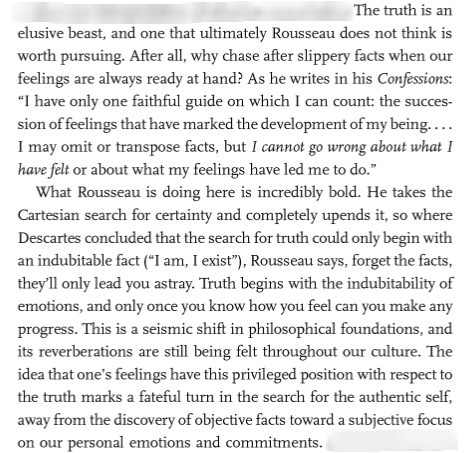
Arthur and I have an inside joke where, when commiserating over all the madness of society, we periodically shake our fists at the heavens while growling, “Jean-Jacques!” This developed out of our discovery that quite a few things that we consider unfortunate about our culture can be fairly traced back to the demented scribblings of that deranged lunatic. Like I said recently, it’s interesting to note how so many of the intellectual contests in our day and age are taking place on a playing field whose boundaries were painted by Burke and Rousseau almost two and a half centuries ago. Here, we can clearly see the philosophical origins of today’s postmodern insanity, where passionate feelings count as irrefutable evidence.
On the Blight Side of History
One of the depressing things about getting older is the realization that there is no such thing as an idea too stupid to come back into fashion.
No True Marxman
Way back in the day, I knew this singer of a slightly-famous goth band and his younger girlfriend. At some point, I heard through the rumor mill that she only allowed him to have anal sex with her so that she could technically still claim to be a virgin for whatever reason. (Hey, I don’t know; it wasn’t like I was asking to be kept apprised of this stuff.)
I wonder what made me think of that after all these years…
Zimmer begins by insisting that self-described Marxist regimes such as the Soviet Union, Maoist China, Cuba, North Korea, etc., all of whose leaders were immersed in Marxist thought, were not real Marxists at all. (Zimmer: “[T]hese authoritarian monstrosities had virtually nothing to do with [what] Marx himself said or did.”)
Ohhh, yeah. It’s amazing the rationalizations people come up with to claim that Marx’s moral virginity remains pure. Entire nations may have gotten brutally reamed, but true Marxism was never officially consummated.
A Head-Tailed Cat
Don’t be so gloomy. After all it’s not that awful. Like the fella says, in Italy for 30 years under the Borgias they had warfare, terror, murder, and bloodshed, but they produced Michelangelo, Leonardo da Vinci, and the Renaissance. In Switzerland they had brotherly love – they had 500 years of democracy and peace, and what did that produce? The cuckoo clock.
Slavery, universal and unquestioning religious faith, aristocratic government, disregard for the suffering of others: these are the very miserable grounds on which some of the major achievements of civilization in the past were built. Hence the thought: we cannot have those desirable things now, because we have got democracy, freedom of conscience, various kinds of equality (nearly), kindness and hygiene instead. If these really are the only options, then we do not have much choice.
The organic conception of civilization reinforces this view. It stresses the interconnectedness of everything that occurs in a particular society in a particular epoch. Therefore the achievements of a time and place are thought of as inescapably bound up with, and often produced by, the defects of the era. If the passage of time sees the removal of those defects it must also remove the possibility of parallel achievements.
According to this view the great public monuments of post-war Britain had to look like Milton Keynes and the Millennium Dome — because of democracy and a National Health Service and universal education and freedom of opinion. The seventeenth century could have as its greatest public monuments St Paul’s Cathedral and the other churches of Sir Christopher Wren because it has oligarchic aristocratic government, poor sanitation, short life expectancy, little freedom of opinion and little public education.
He doesn’t mention him by name, but this is obviously one of Nietzsche’s central themes. In fact, it’s one of the themes that most effectively resist appropriation by those who would turn him into some kind of bombastic life coach. Given his conscious defiance of “systematic” thinking, it’s always risky to identify what he “really” meant, but if you ask me — and even if you don’t, I’ll tell you anyway — I would say that Nietzsche was most concerned with culture, not individuals. Western liberal individualism was just more decadence as far as he was concerned. All his famous exhortations about the Übermensch were centered on the assumption that strong, healthy cultures would occasionally produce heroic individuals like a Beethoven or Goethe, whose artistic genius would redeem life for the rest of us, who are just here taking up space and doing the grunt work. This tendency didn’t go in reverse — heroic individuals did not regenerate weak, sickly cultures. Needless to say, he would have looked at our culture, seen a crass obsession with commerce, unhealthy individualism taken to the extremes of narcissism and solipsism, and a weak, neurotic concern with avoiding pain and injustice at all cost, and dismissed any further thoughts of cultural greatness with a disgusted wave of his hand. And yet, he might have said, for all your pride in your civilized harmlessness, you still have slave labor constructing your sports stadiums, and something very much like it building the technological gadgets which give your petty lives a semblance of meaning. You have no problem consigning countless millions of other sentient creatures to miserable lives and assembly-line deaths for the sake of your convenience. You can simply afford the luxury of removing cruelty from your immediate vicinity. Rationalist sleight-of-hand takes care of any uncomfortable remainders. Blood, you’re soaking in it. Always have been, always will be. The only question is whether you’re going to use it to produce transcendent greatness or self-loathing mediocrity.
However, we could employ the idea of civilization in a more hopeful way. We could see civilization as seeking to equal the best achievements of the past while disentangling them from the misfortunes upon which they once depended. The idea is that we could aim for the same level of civility, grandeur, grace and beauty, but without building on those obviously intolerable foundations.
Hopeful, indeed. Alan Watts used an odd-but-striking example that relates to this idea:
Here is someone who has never seen a cat. He is looking through a narrow slit in a fence, and, on the other side, a cat walks by. He sees first the head, then the less distinctly shaped furry trunk, and then the tail. Extraordinary! The cat turns round and walks back, and again he sees the head, and a little later the tail. This sequence begins to look like something regular and reliable. Yet again, the cat turns round, and he witnesses the same regular sequence: first the head, and later the tail. Thereupon he reasons that the event head is the invariable and necessary cause of the event tail, which is the head’s effect. This absurd and confusing gobbledygook comes from his failure to see that head and tail go together: they are all one cat.
The cat wasn’t born as a head which, sometime later, caused a tail; it was born all of a piece, a head-tailed cat. Our observer’s trouble was that he was watching it through a narrow slit, and couldn’t see the whole cat at once.
This, in turn, was one of Watts’s central themes — the idea that “good” and “bad”, “desirable” and “undesirable” are like the head and tail of the cat: inseparable. We simply aren’t able to stand up and look over the fence to see the entire cat at once, so to speak. We can’t attain the god’s-eye perspective from which we could see that no matter how hard we try to eliminate bad, unpleasant things from the world and preserve only the good things, it can never happen. It is based on a fundamental misunderstanding, like trying to figure out how the cat’s head “causes” the tail. To strain the metaphor further, our attempts to scrub the world clean of undesirable things would be like trying to separate the head and tail of a cat, only to have each head generate a new tail, and each tail develop a new head.
Somehow it appears that the cat mutated into a hydra. Well, no matter. The point is, the idea of “desirable” and “undesirable” as integers which can be increased or subtracted is one of the foundational myths of post-Enlightenment Western culture. You may say, “Well, I greatly prefer the ‘problems’ of a middle-class Westerner to those of a medieval peasant.” I wouldn’t disagree. But that’s still a value statement, not an objective fact. Likewise, it’s a value statement to say, “Well, I’m perfectly content with the way things are right now. They’re good enough. No need to risk unintended consequences by messing around with further attempts at optimization.” The point isn’t that we can’t ever agree on a way to live and coexist. The point is that any such consensus will likely have to leave our cherished rationality and objectivity behind.
The Tragic Dimension of Life
Erasmus calls his book a ‘praise’ of folly; this is meant ironically. He does not like folly. But as he multiplies the examples of human stupidity, greed, corruption and confusion, something else begins to emerge: the sheer normality of messing things up. Erasmus is no longer castigating an aberration, which — with a bit of coaxing and prodding — could be put right. He seems to be describing our fate.
If we take this seriously, the pursuit of civilization cannot be cast as the project of removing folly from the world. It has to aim lower: at coping and trying to flourish, given the crooked timbers of humanity.
…In an intimate way, tragedy is founded on the fact that not all good things are compatible: it may be (for most people) impossible to have a happy marriage and a raucous erotic life; or to have a well-paid job and follow your own vocation; it may be that you cannot live in the place where you most want to live; responsibility is tedious and frightening; yet taking responsibility is important. The longing to live an interesting and enjoyable life is always confronted by poverty, fragility, bad luck, death. Things we want to control are often beyond our control. We do not choose the political, moral or economic world in which we have to live; you can wear yourself out seeking genuine progress and end up making none.
So the ambition of civilization, in the face of this, is to strengthen us to face disappointment and suffering. The tragic dimension of life cannot be removed by planning and legislation. Instead we have to cultivate what are called ‘stoic’ virtues: the capacity to do without, to postpone pleasure, to make ourselves do things we do not want to do (when there is good reason to do them); to put up with minor irritations, to avoid complaint and useless criticism.
In a civilized society, these virtues are communicated and inculcated from generation to generation. There is a species of ‘take control of your life’ rhetoric that is superficially connected to this, but is in fact radically different. The message of ‘take control’ is that you will have to suffer a little now (go on a diet, be assertive, work hard), but soon, as a result, you will be successful, rich, famous and beautiful. The reality, however, is that we have to practice the stoic virtues not as a means to securing happy celebrity, but as a way of coping with tragedy. We have to be controlled, effortful, patient and uncomplaining without the expectation of any special reward.
Increasingly, I feel that the lesson most people took away from the failed utopian political experiments of the recent past was merely that such changes can’t be made all at once, in a top-down manner. The idea that we can still achieve a near-perfect world by improving one thing at a time, while refreshingly sane by comparison, still acts as if utopia is achievable. I say “acts” because I don’t know if anyone has really thought about it to that extent. Do we honestly believe that we can progressively eliminate undesirable things from the world through enlightened management and technique, or have we simply accepted it as our Sisyphean task to forever attempt to improve the world even if we’re destined to fail?
The question is not based an a false dichotomy between a “static” world, as in the popular caricature of the Middle Ages, and our current one. People have always used reasoning and problem-solving skills to make changes to the world, going back to the first stone tools at Olduvai. But it is only recently in history that we have come to feel that there is never any good reason to stop trying to optimize things. Settling for “good enough”, especially in a political context, is seen as a moral deficiency. I’m proceeding from the assumption that since the Enlightenment, it has become reflexive to see there being no inherent limits in our ability to shape the world in accordance with our desires. If our rational, technological schemes bring disaster, it’s only because we overlooked something in the planning or application. This is a technical problem which can be fixed. And even if the problem proves a lot more intractable than it initially appeared, attempting to fix it is an existential imperative for us. The stoic virtues can be tolerated on the individual level, but for society as a whole? I find it difficult (though interesting) to imagine what that would even look like.
Nothin’ Ever Doesn’t Change but Nothin’ Changes Much
But, overall, knowledge does give us power?
That is true. It doesn’t, by itself, free us. It is a two-edged sword. You can use certain technologies to promote freedom but also to spy on people. One of the core thoughts of the book where I descend from a strong philosophical and religious tradition, in philosophical terms from Socrates, is that I hold that the advancement of knowledge is not in itself liberating.
The general view today is, I think, that the growth of knowledge leads to a growth of human freedom. But the human world isn’t accretive in that way as the sciences. In human history what often happens is the destruction of whole civilizations.
There seems to be a certain monoculture in our thinking today, in our view of the world. Whatever side you’re on, most people would believe in inevitable ethical progress that is attached to the sciences.
There’d be different content, but still the general assumption is that we are moving to a better state. Now, my view is that politics and ethics aren’t like that. I take that ethics and politics are more erratic and discontinuous. There are serious advances, but then they are regularly lost.
And, unfortunately, good things are lost. For example, in the ancient world, pre-Christian Europe, there wasn’t a persecution of gay people! That was then lost for 2,000 years. That’s quite a long regression. People who believe in progress must allow the question, “But what about those 2,000 years?”
There are good events in history—there are genuine advances—but they are inherently fragile. That’s my key message.
As Below, So Above
“In most of our versions of paradise, sacred or secular, heaven is a place where dreams come true,” Garrett writes. True enough, yet what he omits to note is that human dreams of perfection are essentially contradictory. We may dream of a cosmos governed by moral laws but we also want one in which our cherished personal attachments can sometimes be exempted from these laws. We would like ourselves and those we love to be spared ageing and death; but if our wishes were granted, whether by divine decree or by means of the new technologies that futurists in Silicon Valley are coming up with, we would cease to be the creatures we are and become unrecognisable to one another. Our inability to form any coherent view of the afterlife results from it being a projection of needs and impulses that are irreconcilably at odds.
Now, as in the past, there are many who look to another life to resolve these conflicts, but the anarchy from which they seek to escape is inside themselves.
In Jesus’s world, the Son of Man would arrive in his kingdom, the last would be made first, and each person would be repaid according to their deeds. In Marx’s world, the communist society would regulate the general production and allow each person to try their hand at being a hunter, fisherman, herdsman or critic, according to their whims. In Nicholas Carr’s world, looking backward rather than forward this time, personal technology has distracted us from our authentic selves, and if we can just plug our ears with wax and ignore its siren song, we can get back to whatever deep, meaningful things we were assuredly doing with our lives before the mid-’90s. In these sorts of narratives, imagination fails at the crucial moment and leaves us with a vague “happily ever after” denouement, where we have healed and become whole. Once we reach this state, then what? No one ever says. It seems to be assumed that we’ll know an ideal state when we reach it, and having done so, we’ll be content to bask in it indefinitely.
I, on the other hand, suggest to you that most people don’t actually know themselves well enough to know what would make them content, and even if they were to luck into contentment somehow, boredom and mischief would soon drive them back to dissatisfaction again. More money in the checking account? A prettier appearance? More time to read good books? The dictatorship of the proletariat? The Second Coming? It doesn’t matter what you give them; people will always find new ways to make themselves unhappy again. However beautiful a design you manage to weave from your circumstances, the threads will immediately begin unraveling. You may even start picking at them yourself.
Kenan Malik credits Hegel with the insight, overlooked by previous philosophers, that humanity was above all else a work in progress. Human nature did not burst onto the scene fully formed as if winking into existence from a vacuum; individually, it was shaped through interactions with others, and socially, it was shaped through the evolving stages of history’s dialectic. Having grasped that humanity’s story was born in motion and conflict, though, Hegel gave in to the temptation to envision it eventually coming to rest on a static plateau, deciding, conveniently enough, that the historical dialectic was destined to reach its final resolution in the Prussian state. Many others since then have likewise found themselves unable to conceive of human existence outside the self-serving conventions of narrative structure. Whether they see the ideal human subject as needing to be discovered in the past or created in the future, they all still assume that the meaning of existence reveals itself in the conclusion. But a chord ringing out interminably would be the death of music. A pose held indefinitely would turn even the most graceful dancer into a statue. The motion is the meaning.
The human spirit is a shark with just enough awareness to turn one eye up toward the light shimmering down and dream of a world without constant motion, the scent of blood, and mindlessly gnashing teeth. The denizens of the world above know better, though. In our world, we are required to swim forever — in currents of our own making, if need be — or else die.
An Age of Superstition
What the French thinkers (and Habermas) produced was essentially a postmodern form of Marxism. Some of the authors seem reluctant to abandon Marx, others are keen to update him, but no one seems willing to jettison him entirely. It is not so much his economic determinism or his class-based motivations that are retained as his idea of ‘false consciousness’, expressed through the idea that knowledge, and reason, must always be forged or mediated by the power relations of any society — that knowledge, hermeneutics, and understanding all serve a purpose. Just as Kant said there is no pure reason, so, we are told from the Continent, there is no pure knowledge, and understanding this is emancipatory. While it would not be true to say that these writers are anti-scientific (Piaget, Foucault and Habermas are too well-informed to be so crude), there is among them a feeling that science is by no means the only form of knowledge worth having, that it is seriously inadequate to explain much, if not most, of what we know. These authors do not exactly ignore evolution, but they show little awareness of how their theories fit — or do not fit — into the proliferation of genetic and ethological studies. It is also noticeable that almost all of them accept, and enlist as support, evidence from psychoanalysis. There is, for anglophone readers, something rather unreal about this late continental focus on Freud, as many critics have pointed out. Finally, there is also a feeling that Foucault, Lacan and Derrida have done little more than elevate small-scale observations, the undoubted misuses of criminals or the insane in the past, or in Lacan’s case vagaries in the use of language, into entire edifices of philosophy. Ultimately, the answer here must lie in how convincing others find their arguments. None has found universal acceptance. At the same time, the ways in which they have subverted the idea that there is a general canon, or one way of looking at man, and telling his story, has undoubtedly had an effect.
This is from a chapter on the French intellectuals of the late twentieth century. Most of the time, when you hear someone disparaging postmodernists, these are the people whom they have in mind. (Lacan’s most famous disciple, of course, is the grotesque caricature-wrapped-in-a-parody-inside-a-bullshit-farce, Slavoj Žižek.) Anyway, banalities elevated into profundities aside, false consciousness has indeed proved to be one of Marx’s most enduring ideas. You hear its echoes when people are said to be “voting against their own interests”, as if the speaker knows better than them what they really want or need, or when, say, minorities and women feel that their individual perspective trumps the imperatives of their race or gender (as dictated to them by the self-appointed intelligentsia). The truism that there is no such thing as knowledge outside of perspective becomes, in practice, Foucault’s “genealogical method“, where the aim of an argument is not to rebut specific assertions, but to identify the supposed wellspring of your opponent’s thought and declare it hopelessly polluted, thus implying, without needing to openly assert, that everything downstream is likewise poisoned.
It wasn’t just the French, though; the Frankfurt School is noted earlier in the book for being preoccupied with “the attempted marriage of Freudianism and Marxism.” Watson also quoted Friedrich Hayek: “I believe men will look back on our age as an age of superstition, chiefly connected with the names of Karl Marx and Sigmund Freud.” It’s funny because it’s true! In an age in which science was quickly colonizing all forms of human experience, almost the entire intellectual class of Europe and America was captivated by two systems of thought which look increasingly ridiculous the further they appear in hindsight. And so I still wonder: what will our descendants think about the water in which we’re swimming now? Why should we assume that we aren’t living under the spell of superstitious nonsense while priding ourselves on our cutting-edge scientific awareness just as much as people in the last century were?
Verily, Verily, I Say Unto Thee (4)
Isaiah Berlin was one of my most formative intellectual influences. He single-handedly engendered my enduring fascination with the history of ideas. I plan on re-reading all of his books soon, right after I get caught up on all the new books I’ve accumulated recently. Which brings me to my point: the NYRB has republished a short acceptance speech of his from twenty years ago which elegantly encapsulates a couple of his most fundamental, recurring themes. I do implore you to go read it, as it would be bad form for me to copy and paste the entire thing, a powerful temptation indeed.
It’s Just Like the West to Think It Knows Best When Answers Are Subject to Change
In the 21st century that old spell of universal progress through western ideologies – socialism and capitalism – has been decisively broken. If we are appalled and dumbfounded by a world in flames it is because we have been living – in the east and south as well as west and north – with vanities and illusions: that Asian and African societies would become, like Europe, more secular and instrumentally rational as economic growth accelerated; that with socialism dead and buried, free markets would guarantee rapid economic growth and worldwide prosperity. What these fantasies of inverted Hegelianism always disguised was a sobering fact: that the dynamics and specific features of western “progress” were not and could not be replicated or correctly sequenced in the non-west.
While I’m Still Standing You Just Fade Away
To gain an understanding of this phenomenon, we can look at a strange aspect of liberalism’s “victory”: the constant appearance of counter-ideologies that have arisen in reaction against it. Despite its overall success, liberalism has for two centuries been dogged by a series of counter-ideologies. So far, they have all been defeated, but sometimes only at great cost. Fascism and the various forms of communism and leftist extremism were the major counter-ideologies during the 20th century; varieties of extreme nationalism played a similar role during the 19th and early 20th centuries. Various other intellectual trends, including some without comparable but still not trivial political significance, such as the Romanticism of the early 19th century and related forms of bohemianism and avant-gardism, might also be considered in this context.
However varied they are, these counter-ideologies generally share a sense that liberalism’s protection and privileging of individual self-interest as opposed to the common good (however defined) makes it ignoble; potentially or actually unjust; and chaotic or anarchic and hence ultimately weak. This sensibility is evident in the pejorative meaning of the term “bourgeois”: someone who is so immersed in the pursuit of petty material concerns that he is blind to both nobility of soul and the claims of social justice.
Roughly speaking, there are two ideal types of counter-ideologies: those holding that liberalism is too disorganized to work well and hence cannot survive, and those fearing that liberalism will succeed (or has already succeeded) and will diminish human life as a result. These sound like mutually contradictory objections, but by calling them ideal types we recognize that in practice most counter-ideologies have elements of both: Liberalism is bad because it is successful in forcing or seducing people to adopt a “bad” way of life, but its faults mean that it will fail eventually.
…In general, critics saw liberalism as too disorganized and anarchic to survive because it left individuals too free to pursue individual interests at the expense of a concern for the common good. As we have seen repeatedly over the years, it is easy for liberalism’s enemies to underestimate a democracy’s geopolitical (including military) strength as a result. The advantages of a less centralized political and economic system reside in the fact that, once galvanized by a common threat, such a system can make better use of the various talents of all members of society. This truth is easily overlooked by those who adhere to this critique of liberalism.
I clicked on this article with no particular expectation, only to find it very interesting, dare I say fun to read. Perhaps your experience might be similar should you care to give it a look-see.