Many “why” questions are really “how” questions in disguise. For instance, if you ask: “Why does water boil at 100C?” what you are really asking is: “What are the processes that explain it has this boiling point?” – which is a question of how.Critically, however, scientific “why” questions do not imply any agency – deliberate action – and hence no intention. We can ask why the dinosaurs died out, why smoking causes cancer and so on without implying any intentions. In the theistic context, however, “why” is usually what I call “agency-why”: it’s an explanation involving causation with intention.So not only do the hows and whys get mixed up, religion can end up smuggling in a non-scientific agency-why where it doesn’t belong.This means that if someone asks why things are as they are, what their meaning and purpose is, and puts God in the answer, they are almost inevitably going to make an at least implicit claim about the how: God has set things up in some way, or intervened in some way, to make sure that purpose is achieved or meaning realised. The neat division between scientific “how” and religious “why” questions therefore turns out to be unsustainable.…But for the moment, we can say that any religious belief that involves an activist, really-existing God and claims that religion has something to say about why things happen, must also be encroaching on questions of how they happen, too. And if that’s true, the easy peace which many claim should exist between science and religion just isn’t possible.
religion
He’s Mean, He’s Mean, You Know What I Mean
Dennett says that I am concerned that Dawkins is “too darned clear, too brutally frank when he articulates his case” against religion. It is not Dawkin’s clarity that concerns me. It is his condescension towards believers and his labeling of this large group of people as non-thinkers.
…Dennett reminds me that Richard Dawkins is deeply appreciative of the art, music, and poetry that religion has engendered, but it is just that Dawkins believes that religion, on balance, has accomplished more harm than good.
I would find it difficult to attempt such a tally. Whatever the results of such a balance, does that mean we, like Dawkins, should throw out religion wholesale, take a condescending attitude toward people of religious beliefs, label people of religious beliefs as non-thinkers imperious to scientific evidence? No. It means that we should continue to oppose those practices of religion that do damage, we should continue to oppose irrational thinking on issues that require rational thinking and evidence. But, at the same time, I would argue that we should allow our existence to encompass some things that we cannot explain by rational argument and proof.
If you read Dennett’s earlier essay, you’ll notice that in the second sentence, he says:
…Alan Lightman joins a long line of atheist apologists who feel compelled to respond negatively to Richard Dawkins’ campaign but find it hard to put forward a crisp, fact-based objection.
So Lightman responds by once again complaining that Dawkins is condescending and rude without ever providing a specific example, such as, say, a quotation where Dawkins attacks believers themselves, as opposed to faith or belief in the abstract, in such personal, denigrating terms. Brilliant.
I like that last sentence too. “We should allow our existence to encompass some things that we cannot explain by rational argument and proof.” Again, who fails to do this, aside from people with burlap bags for heads and straw sticking out from their collars and shirtsleeves? Who demands rationality and proof in art, poetry and music? Ironically enough, it’s people like Lightman who seem inclined toward a strict dichotomy rather than a continuum when it comes to questions of faith; as he says earlier, he thinks that if the existence of an intelligent creator or an objective meaning of life can’t be disproved by science, they are just as valid as any other belief and are required to be taken seriously. But lumping faith in a personal God in with faith in what we understand of scientific laws is disingenuous in the extreme; there are massive degrees of difference between them when it comes to evidence and likelihood.
Lucubrations, no. 7
Sittin’ here in the wee hours, just contemplating the usual middle-of-the-night issues: the nature of self, the nonexistence of God, other lighthearted fare. Daniel Dennett keeps popping up in my readings tonight:
Yes, many unanswered questions persist. But these are early days, and neuroscience remains immature, says Churchland, a professor emerita of philosophy at University of California at San Diego and author of the subfield-spawning 1986 book Neurophilosophy. In the 19th century, she points out, people thought we’d never understand light. “Well, by gosh,” she says, “by the time the 20th century rolls around, it turns out that light is electromagnetic radiation. … So the fact that at a certain point in time something seems like a smooth-walled mystery that we can’t get a grip on, doesn’t tell us anything about whether some real smart graduate student is going to sort it out in the next 10 years or not.”
Dennett claims he’s got much of it sorted out already. He wrote a landmark book on the topic in 1991, Consciousness Explained. (The title “should have landed him in court, charged with breach of the Trade Descriptions Act,” writes Tallis.) Dennett uses the vocabulary of computer science to explain how consciousness emerges from the huge volume of things happening in the brain all at once. We’re not aware of everything, he tells me, only a “limited window.” He describes that stream of consciousness as “the activities of a virtual machine which is running on the parallel hardware of the brain.”
“You—the fruits of all your experience, not just your genetic background, but everything you’ve learned and done and all your memories—what ties those all together? What makes a self?” Dennett asks. “The answer is, and has to be, the self is like a software program that organizes the activities of the brain.”
And here he responds to Alan Lightman’s faith-based twaddle from last week:
Is there any rational grounding for a belief in a miracle-making interventionist God? (No.) Do we need God to account for the brilliant design of living things? (No.) Do we need God to somehow underwrite or ground our confidence that our ethical convictions are not just parochial prejudices? (No.) There is nothing gloriously, ineffably, tantalizingly imponderable about these questions, carefully crafted and vetted by philosophers and scientists over the centuries.
Lightman fails to consider the possibility, moreover, that the reason many theological questions continue to evade the bright light of rational inquiry is that they have been ingeniously crafted by theologians to do just that. As the traditional concepts of God, heaven and hell crumble in the collision with science, the theologians invent new, more “sophisticated” concepts to take their place. They are improvements only in the sense that they are more immune to falsification by any imaginable discovery.
…Like many atheists, Dawkins — as Lightman surely knows — is deeply appreciative of all the glorious art and music and poetry that religion has engendered. But still he trots out the canonical list of glories to float the implication that we atheists are a philistine lot. Shame on him. That is what I call faith-fibbing. Not so much a bald-faced lie as a carefully indirect misrepresentation. He can’t actually claim that Dawkins doesn’t weigh the many contributions of religion to the arts against the damage it has wrought. Dawkins does just that, and arrives at a judgment with which Lightman apparently disagrees: All things considered, religion’s blessings are outweighed by the harm they do. The problem is that Lightman doesn’t tackle that difficult issue; he prefers to sing the praises of faith without holding it to account.
When All You Have Is a Bible, Everything Looks Like a Crucifixion Nail
There is a lot of speculation as to who the “Occupiers” are and what they might accomplish. There is much I still don’t know about the movement, but undeniably it has caught the imagination of a generation — and that matters.Here are a few things I do know about the Occupy Wall Street protesters:When they stand with the poor, they stand with Jesus.When they stand with the hungry, they stand with Jesus.When they stand for those without a job or a home, they stand with Jesus.When they are peaceful, non-violent, and love their neighbors (even the ones they don’t agree with and who don’t agree with them), they are walking as Jesus walked.When they talk about holding banks and corporations accountable, they sound like Jesus and the biblical prophets before him who all spoke about holding the wealthy and powerful accountable.
Oh, please. Jesus wouldn’t be protesting on Wall Street; he’d be grabbing people by the lapels and yammering about Mayan prophecies! 2012! End of the world! Aieee!
Also, I couldn’t help but be reminded of this.
Tickle Me Emo
I shall start with this proposition, which, to me, seems entirely self-evident: if there is no God, then human life is absurd. That is, if one believes that God does not exist, then one must accept this consequence: human existence has no purpose, no value, no meaning – at bottom, human existence is empty.
…A universe without God, then, contains no purpose, no value, no meaning. Human existence is rendered absurd: I emerge from a state of non-being, I encounter myself as an emptiness in the world, I act for myself, commit myself to various forms of life, all the time striving towards a completed mode of being. But of course, I never manage to arrive at this goal, I was doomed to failure from the very start – emptiness cannot provide for itself objective meaning! So I continue to act, but in full awareness of the very futility of acting. And in the end I disappear, vanish once again into a state of non-being. Nothing is left but the memories of my existence in the minds of other people. And even those memories and those people are sure to grow frail and pass away with the passing of time. Nothing will be left of me. My pointless life will reach its pointless conclusion.
…I think about such an existence, a life without God, without the ground of existence itself, and I find myself saying, ‘What an absurd, meaningless, dismal thing!’ This, I believe, can be the only comprehensible reaction from an atheist who has seriously reflected upon his or her life. But still, this reaction is extremely rare. Why? Because the vast majority of people refuse to think, they refuse to follow a belief to its natural conclusion. Instead, they distract themselves and occupy their minds with trivial matters. No one asks, ‘Why am I here? Who am I?’ No one considers the most fundamental question, ‘Why is there something rather than nothing?’
People do not reflect; they are afraid to reflect. Without God – it is true! – human life is utterly absurd and meaningless. “If there were no eternal consciousness in a human being,” wrote Kierkegaard, “if underlying everything there were only a wild, fermenting force writhing in dark passions that produced everything great and insignificant, if a bottomless, insatiable emptiness lurked beneath everything, what would life be then but despair?” If every atheist were a thinking atheist, there would be significantly less joy in the world.
I myself am not an atheist, however. I believe in God – a God who gives purpose, value and meaning to every human life, who himself became a human life, and who therefore understands and participates in our suffering, our grief, our humiliation, our joy; a God who has overcome the power of death, who has freed us from the fear that death instills in us; a God who embodies goodness and love; a God to whom I cannot help but want to offer my praise.
Oh, man. I swear I have tears of joyous laughter in my eyes right now. Dude. Dude. I promise you, a bajillion other people have pondered who they are and why they are here. Only slightly fewer of them have mulled over the burning question of why there is something rather than nothing; in fact, I daresay it’s quite a stale philosophical cliché at this point. Yes, I know, you think you’re the only person in history to ever feel these intense emotions and face these harrowing concepts, but — it is true! — there is life after Platonic absolutes.
They Call Me the Genre Spanner
The space for this particular articulation of Buddhism is created by specific cultural currents in the modern West: Romantics, Idealists, Transcendentalists, and their mid-twentieth-century counter-cultural successors, all of whom emphasize exploration of the deep interior of the mind, God as an all-encompassing spirit in nature, spontaneity, creativity, and suspicion of mechanized reproduction; Protestant Christianity, which eschews idolatry, privileges texts, looks askance at priesthoods and hierarchies; Enlightenment rationalism, which promises insight into the nature of things through careful observation and thought; psychology, which encourages introspection and exploration of the mind; and global capitalism, which allows for the flow of commodities newly valued in the West, like our Buddha image, by those who can afford them.
Thus Buddhism takes on yet another incarnation, blending with the indigenous cultures of the West, the United States, the Midwest, and Clifton. Even here, though, it turns out to be one incarnation among many.
This is a much better way of saying what I said here. I particularly liked the part about the guy who felt disappointed that Tibetans didn’t measure up to the idealized image that he had projected onto them.
As I said, one of the strengths of Buddhism is that its pragmatic aspect allows people to make use of it to suit their own context without being accused of deviating from orthodoxy. But for all that, many people who identify as Buddhists do so for all the usual religious reasons, even Westerners who aren’t shackled by Asian cultural conditioning. I’m alternately amused and bemused by the way people are so desperate to believe that all the answers are “out there” already in finalized form, and all they need to do is find the right leader to follow behind.
Not Even Shallow
Mystical explanations are thought to be deep. The truth is, they are not even shallow.
— Nietzsche
Somebody spilled a big jug of jabberwocky all over the Internet today. Let’s begin with Alan Lightman:
In my opinion, Dawkins has a narrow view of faith. I would be the first to challenge any belief that contradicts the findings of science. But, as I have said earlier, there are things we believe in that do not submit to the methods and reductions of science. Furthermore, faith, and the passion for the transcendent that often goes with it, have been the impulse for so many exquisite creations of humankind. Consider the verses of the Gitanjali, the Messiah, the mosque of the Alhambra, the paintings on the ceiling of the Sistine Chapel. Should we take to task Tagore and Handel and Sultan Yusuf and Michelangelo for not thinking? Faith, in its broadest sense, is about far more than belief in the existence of God or the disregard of scientific evidence. Faith is the willingness to give ourselves over, at times, to things we do not fully understand. Faith is the belief in things larger than ourselves. Faith is the ability to honor stillness at some moments and at others to ride the passion and exuberance that is the artistic impulse, the flight of the imagination, the full engagement with this strange and shimmering world.
That final sentence sure is purty, but, you know, what the fuck? Faith means being able to feel quietly contemplative and passionately exuberant? And aside from literal solipsists, who doesn’t believe in “things larger than ourselves”?
As Lightman surely knows, there are varying degrees of faith, and it’s disingenuous of him to conflate them. Having faith that my family will still love me tomorrow, or that gravity will still be in effect, is not the same thing as having faith in the narrow religious sense that Dawkins is attacking — a specifically anti-intellectual form of religious faith that treats reason and evidence as snares and obstacles.
But all of this presumes an awful lot about the nature of a God we know really very little about. By killing all preconceptions we have about who or what God is, we do indeed free God simply to be, as stated in Exodus and by great theologians and philosophers ever since. Arguments about theodicy dissolve, claims that God punishes certain people selectively for whatever reason we deem valid lose their teeth.
Well, I have gone one step further, and killed my conception of God’s very is-ness! For is it not presumptuous of us to insist that God must conform to our limited conception of being? Yes, I have liberated God from the burden of existence itself, the freest freedom of all! I call this innovative maneuver the “reverse-Anselm.”
Overthrown by Your Children; God Willing, Shut You Down
The US is increasingly portrayed as a hotbed of religious fervour. Yet in the homeland of ostentatiously religious politicians such as Michele Bachmann and Rick Perry, agnostics and atheists are actually part of one of the fastest-growing demographics in the US: the godless. Far from being in thrall to its religious leaders, the US is in fact becoming a more secular country, some experts say. “It has never been better to be a free-thinker or an agnostic in America,” says Annie Laurie Gaylor, co-president of the FFRF.
The exact number of faithless is unclear. One study by the Pew Research Centre puts them at about 12% of the population, but another by the Institute for the Study of Secularism in Society and Culture at Trinity College in Hartford puts that figure at around 20%.
Most experts agree that the number of secular Americans has probably doubled in the past three decades – growing especially fast among the young. It is thought to be the fastest-growing major “religious” demographic in the country.
Professor Barry Kosmin of Trinity College, who conducts the national Religious Identification Survey, believes up to a quarter of young people in the US now have no specific faith, and scoffs at the idea, prevalent in so much US media and culture, that the country is highly religious or becoming more so. “The trending in American history is towards secularisation,” Kosmin said.
Anything that reduces the power and visibility of the religious right is fine with me, but I find it impossible to get excited about anything linear and teleological; I’m a cyclical sort of fellow. Orwell called it “a major mental disease” to always predict “a continuation of the thing that is happening.” Stern words indeed, but I wouldn’t be surprised at all to see these same godless youths engineer another Great Awakening when they get to middle age. If there’s one thing I think you can confidently say about Americans of all ages, it’s that they are congenitally incapable of staying put for long. Belief may be in a process of nebulizing right now, but boredom, hyperactivity, and a ceaseless search for novelty will probably lead to it solidifying again at some point.
Lucubrations, no. 6
More from The New Buddhism:
The Beats emulated the cool reserve of the African American jazz musicians they idealized, favored dark-colored clothes, and displayed a good deal of existential angst. The hippies, on the other hand, wore every color of the rainbow and valued above all the openness and emotional expression reflected in their famous slogan “Peace and Love.” While the Beats saw themselves as a collection of individual artists and bohemians struggling for survival in conformist America, the hippies believed they were on the cutting edge of a new ethos of sharing and communal living that would remake the world. The Beats preferred poetry and the introverted sounds of cool jazz, while the Haight-Ashbury counterculture centered on the celebration and rebellion expressed in its flamboyant rock music.
In many ways, the Beat subculture provided a more sympathetic environment for the spread of Buddhism. Unlike the Beats, the hippies had few intellectual pretensions, and as we have seen Buddhism has often had its strongest appeal among the intelligentsia. Moreover, the reserved style of the Beats certainly fit far better with the traditions of Japanese Zen (which was the only form of Buddhism with which Americans had any familiarity) than the more emotional and expressive hippies.
This reminded me of the recent essay that’s been making the rounds about the time Jack Kerouac met Ken Kesey:
Jack was 12 years older than Ken, and there was a marked difference in their energies and interests. Jack had been living in a house with his mother in Northport, although he still had to deal from time to time with the public adulation inspired by the 1957 publication of On the Road. His was a relatively passive life.
Kesey and the Pranksters, on the other hand, were on an extended high that peaked in New York. According to one of the Pranksters, Ken Babbs, every place they had stopped on the bus trip, they had gotten out their musical instruments, donned their regalia, turned on the cameras and tape recorders, and broken into “spontaneous combustion musical and verbal make-believe shenanigans.” The Pranksters were still doing a version of this in the New York City apartment.
This was the atmosphere into which Kerouac walked. Unlike the intrepid Pranksters, Jack sat quietly on the side, “slightly aloof,” as Babbs told me. They draped a small American flag over Jack’s shoulders, but he took it off, folded it neatly, and placed it on the arm of the couch.
There was absolutely no serious or colorful discussion between Kesey and Kerouac. Jack was never loud, or critical, or indignant. He seemed tired, but he was patient with the Pranksters’ antics. Still, an hour after he came, he left. In the end, he was uncomfortable with Kesey’s overwhelming display of exuberance.
…The Beats and the Pranksters showed us different ways of opting out of society. They were both countercultural movements. The Beats were trying to change literature, and the Pranksters were trying to change the people and the country.
I Was an Iron Age Anarchist, Lookin’ for a Sex Solution
In light of this I wanted to open up a conversation on the topic: How do sex and anarchical thought intersect in light of Jesus? How and when does one’s sexual life and practices truly reflect the anarchical teachings of Jesus?For those of us who clearly recognize that Jesus is a deeply political figure (bringing the reign of God to earth), we have no choice but to face up to this reality: sex is a deeply political act. In fact, if “politics” is nothing more than the dynamic of how we relate and connect to one another as people, then sex may be one the most politically charged acts in this world. You and I owe our very existence to this political act, to the communal interactions of our parents that brought us forth into this world.
In my own readings of anarchical thought the only author who has addressed the political implications of Jesus’ teachings on sex was Leo Tolstoy. In his My Religion: What I Believe he wrote,Jesus declares that debauchery arises from the disposition of men and women to regard one another as instruments of voluptuousness, and, this being so we ought to guard against every idea that excites to sensual desire, and, once united to a woman, never to abandon her on any pretext, for women thus abandoned are sought by other men, and so debauchery is introduced into the world.
Tolstoy was a rationalist who clung to the teachings of Jesus with the utmost literal interpretation. Though there are deep holes in his rationalism, there is much to learn from his simplistic adherence to the words of Jesus. In Tolstoy’s eyes Jesus is teaching us that sex is nonviolent and domination-free only when found in lifelong commitments of love, for in every other instance the partners ultimately “regard one another as instruments of voluptuousness.” Is Tolstoy’s analysis right? If so, what does this mean exactly for those of us attempting to conform our lives to the politics of Jesus?
Be Lamps Unto Yourselves
From The New Buddhism:
It is never possible to be sure if the statements attributed to the Buddha in the Pali Canon and other early scriptures are really his, since they were not set down in writing until centuries after his death. On the matter of sex, however, there is little doubt about his attitude.
…In one of his most famous statements on the subject, the Buddha is said to have told a monk who was seduced by the wife he had left behind when he joined the sangha: “Oh, misguided man, it is better for you to put your penis in the mouth of a hideous poisonous snake than into the body of a woman.”
…The Buddha warned his monks: “The one thing that enslaves a man above all else is a woman. Her form, her voice, her scent, her attractiveness, and her touch all beguile a man’s heart. Stay away from them at all costs.” When a monk asked the Buddha how members of the order should act toward women, he replied, “Do not look at them.” “But what if we must look at them?” the monk asked. The Buddha replied, “Don’t speak to them.” “But what if we must speak to them?” he persisted. “Keep wide awake,” was the Buddha’s final response.
I’m sure that, just as with Christian apologists, there are people who will stubbornly insist that notable quotables like this are either the result of mistranslations, or inaccurate transcriptions of stories that had been passed around orally for hundreds of years, or whatever it takes to preserve the image they need their idol to have. Personally, I wouldn’t be at all surprised to find that even a wise man living more than two millennia ago harbored some attitudes that we today would find repugnant. But it really doesn’t matter to me one way or the other.
The book is fascinating for the way it sheds light on the way Western concepts of Buddhism are, in many ways, Western concepts of Buddhism. I’ve been aware myself that the sort of writers whose explanations of Buddhist thought have influenced me the most, like Alan Watts, Steve Hagen, Stephen Batchelor, and Sam Hamill are filtering their understanding and valuing of certain aspects of Buddhism through a Western consciousness that values things like individualism, rational scientific thought and political liberty. The thing is, there’s nothing wrong with that. The most valuable thing about Buddhism as a tradition is that it’s an ever-evolving work in progress. It adapts to change, as it should. Take what’s useful to you and leave the rest. The Buddha doesn’t need to be the most perfect human who ever existed for many of his ideas to still have value.
In the Hushed Moments When the Nameless Draws Near
And in any case, religion for James was more a matter of subconscious experience than explicit doctrine. “Feeling is the deeper source of religion,” he wrote, and “philosophic and theological formulas are secondary products, like translations of a text into another tongue.” Philosophical theologians who tried to “construct religious objects out of the resources of logical reason” were missing the point, and chest-thumping atheists who tried to refute these intellectual constructions only compounded the error. James liked to define religion by contrast: it was the opposite, he suggested, of the smug facetiousness and cackling je m’en fichisme cultivated by 18th-century philosophes like Voltaire, who treated any display of tenderness or solemnity as a sign of weakness or folly. But most of us have a capacity for respectful attentiveness, and we can, on occasion, “close our mouths and be as nothing.” Anyone with the courage to say “hush” to “vain chatter and smart wit” – anyone who could prefer “gravity” to “pertness” – was, James thought, ready for religious experience. Becoming religious was like falling in love, he said: not a process of intellectual persuasion, but not a delusion either, and it lent new aspects to the world, “an enchantment which is not logically deducible from anything else.”
Sigh. Okay, let’s try a different approach. What if we agree to think of religion as a poetic experience? For example, and perhaps surprisingly to you, one of my most favorite books of all time is Rainer Maria Rilke’s The Book of Hours: Love Poems to God. Here’s a passage I love:
But when I lean over the chasm of myself—it seemsmy God is darkand like a web: a hundred rootssilently drinking.This is the ferment I grow out of.More I don’t know, because my branchesrest in deep silence, stirred only by the wind.
I love you, gentlest of Ways,who ripened us as we wrestled with you.You, the great homesickness we could never shakeoff,you, the forest that always surrounded us,you, the song we sang in every silence,you dark net threading through us,on the day you made us you created yourself,and we grew sturdy in your sunlight….Let your hand rest on the rim of Heaven nowand mutely bear the darkness we bring over you.
You are the future,the red sky before sunriseover the fields of time.You are the cock’s crow when night is done,you are the dew and the bells of matins,maiden, stranger, mother, death.You create yourself in ever-changing shapesthat rise from the stuff of our days—unsung, unmourned, undescribed,like a forest we never knew.You are the deep innerness of all things,the last word that can never be spoken.To each of us you reveal yourself differently:to the ship as a coastline, to the shore as a ship.
If this is all people mean when they speak of God – a surging sense of joy, a desire for a feeling of balance and harmony in one’s life, an ability to still be impressed by the odd twists and turns our lives take, despite our attempts to plan them out in detail – then even obstreperous atheists like me can smile and nod along. But that’s just the thing, isn’t it? To the ship as a coastline, to the shore as a ship — as much as the William Jameses of the world might wish it to be otherwise, for many people, religion, especially the monotheistic varieties, is very much about truth claims upon the world, not feelings about it. Even many of the more liberal kinds of believers who would agree that a poetic sensibility is an integral part of the religious experience would still likely find my suggestion demeaning that religion could be “reduced” to poetry.
An inexpressible experience of beauty and harmony isn’t threatened or nullified by scientific knowledge or rational thought. People who have a problem with vocal atheists should take the time to consider why they seem to think otherwise. I have an idea why that might be, but I’ll leave you to draw your own conclusions.
With Ourselves at the Center
Any heaven we think it decent to enterMust be Ptolemaic with ourselves at the center.– W.H. Auden
My understanding is that Carl Sagan wasn’t an atheist. I’m not either. But this is about the most effective argument for atheism that I’ve ever seen. It’s actually deeply spiritual. Perhaps it’s just me, but many of my encounters with atheist remind me of my encounters with the born-again. Indeed I often suspect that the latter was once the former, and is really angry about it.

But I do find it interesting how people really seem to need a sense of psychological balance like that; there always seems to be this urge to ideologically position oneself squarely in between two polar opposites. Always splitting the difference. You say 2+2=4? And you say 2+2=12? Then clearly the answer must actually be eight, and why can’t you two be more flexible and understanding?
If you actually have principles, and aren’t simply attracted to compromise for the sake of compromise regardless of where your arbitrarily designated midpoint lies, sometimes you find yourself agreeing with the world, and sometimes you find yourself standing alone in opposition to it. Neither one has anything to do with the truth or validity of your stance. And self-righteousness can take many forms, such as in the barely-disguised condescension of those who place themselves above the fray, levitating on a lotus blossom, tut-tutting at those of us down in the muck and the mire.
God Thinks I Don’t Exist
However, I came across an interesting new (to me) perspective on this. The American magician Penn Jillette argues that there are two questions here:1. Is there a God?2. Do you believe in God?The first question is the one I would answer with agnosticism. I don’t know. However, if I consider the second question, Jillette argues there are only two answers. Belief is ‘active’ – you either do or do not believe. He then argues that if you say you ‘don’t know if there is a God’ then you cannot actively believe in God, thus you do not believe in God. Making you an atheist.
Clever, but I do think there’s a bit more nuance in the way most people use the word “believe”. It can often mean “I think so, to the best of my knowledge,” but there’s also a sense of wishful thinking involved too, an “I hope so.” Sometimes when you say that you believe in someone, you mean that you not only think they’ll act in accordance with your expectations, but that you’re placing some trust in them to do so. Saying it to a loved one can be meant precisely to that effect, your profession of belief acting as a hopeful gesture to inspire them, a way to prod them to be worthy of your faith in them.
And in a more typical religious sense, people can think of belief like an arrow aimed at a target — it’s another word for the effort they make to attain whatever they think a perfect state of bliss or grace or understanding would be, expecting they’ll fall short in the meantime. In both cases, you might even profess belief precisely to mollify any doubts you have.
But either way, an atheist version of tricky wordplay equivalent to Anselm’s ontological argument isn’t likely to have much effect on the murky soup of desire and fear that constitute most people’s religious beliefs.
Fuckem’s Razor
Occam’s Razor, in Newton’s formulation, says that ”We are to admit no more causes of natural things than such as are both true and sufficient to explain their appearances.” Put more directly, this means that when trying to understand things, the simplest explanation is usually the right one. Occam’s Razor is credited to 14th century logician and Franciscan friar William of Ockham.
Fuckem’s Razor, on the other hand, derives from the teachings of another Medieval monk, Robert of Fuckham, and it posits roughly the opposite of Occam’s Razor. To wit, when confronted with a problem, the most complicated and obscure explanation is probably correct. At the very least, all conceivable factors must be debated, on an equal footing, regardless of their plausibility or how much evidence supports them.
I’m sure this is all fairly confusing, so let me illustrate with a couple of examples. Say you’re in your house, it’s hot as hell and the place is collapsing around your head as you try and make out what’s going on. Occam’s Razor would note the flames leaping into the sky, the clouds of choking smoke and distant scream of approaching sirens in suggesting that your house is on fire. Fuckem’s Razor, on the other hand, obliges the objective observer to consider all the possibilities. Since scientists have not been able to conclusively rule out the possibility of either alien life or the existence of parallel dimensions, we must, in the interests of intellectual rigor, admit to the extreme likelihood that your house is under attack by bug people from the 18th Dimension.
Brilliant. From now on, when presented with yet more evasive hairsplitting from agnostics (especially those who get overcome with the vapors due to the impudence of those New Atheists), I’m just going to mutter “Fuckem’s Razor” to myself and crack up giggling.
This World of Dew
This world of dew
is only the world of dew
And yet… oh, and yet…— Issa
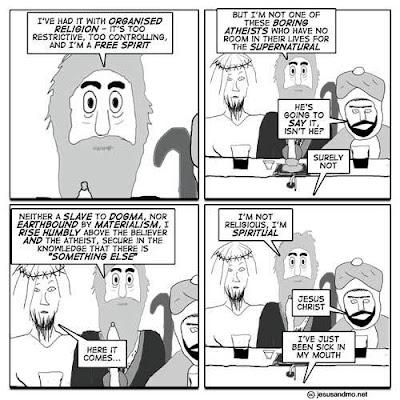
The propensity for reflection also goes deeper still. Insofar as we reflect on our lives, we need to be able to make sense of them in the context of some wider framework of beliefs. This is a role which has traditionally been played in most societies by systems of religious belief, but these have over time become increasingly implausible, and the need remains. Most people are not intellectuals, and their alternative to religious belief often turns out to be an exceedingly vague and inarticulate thought that “There must be something”.
But there are questions which cannot be evaded, even if our answers to them are, like our life-narratives, implicit in the ways we live our lives. We need some way of understanding the place of human beings in the natural world, as a part of it or as set apart. We have either to see ourselves as subject to some higher purpose or as responsible for our own lives and our world. We have either to see our lives as a prelude to some future mode of conscious existence, or as ending with death and the merging of our bodies with the rest of the natural world.
…In conclusion, though, I want to switch perspective and say that as a humanist I find it annoying when people claim, as they frequently do, that none of this is enough, that a life of creative activity and supportive relationships, taking on a determinate shape over time, is not enough, because it lacks the essential element. It leaves out “spirituality”, people say, and has no room for God. What basis do they have for the claim that it’s not enough?
Regardless of what name they give it, what people seem to be saying is that it’s not enough because it’s not permanent. If the things that matter most to us don’t have some sort of everlasting, unchanging significance, they’re pretty much worthless. But this is a problem that comes from viewing time as an abstraction, something to want more of. It diminishes our sense of importance to think of the world moving on as always once we’re gone, erasing us from its collective memory. But the things that matter most to us can’t be justified by recourse to longevity or unchanging essence. They are their own explanation. They exist, at least for a brief period of time. That’s enough.