In any case, solitude and privacy are not just privileges. They are also compensations. People didn’t have modern selves in traditional society, but they didn’t need them, because they had family and community: extended families, face-to-face communities. They had an intricate structure of relationships, traditions, roles, and expectations to give content to their lives and direction to their efforts, to orient themselves in space and time. They didn’t need to go it alone or make up the world for themselves, so they didn’t need the equipment that enables modern individuals (if they’re lucky) to do so.
Now all we have is ourselves. The modern self is a consolation prize; it’s what we have to cling to—that and friendship, modernity’s central relationship. Intimacy is also a modern phenomenon, because it rests on privacy. When E. M. Forster said “Only connect,” he didn’t mean that’s all we need to do; he meant that’s all we could do: forge our horizontal bonds, because the roots are gone.
solitude
Pierce the Veil
Spirituality: the last refuge of a failed human. Just another way of distracting yourself from who you really are.
— George Carlin
If solitude does not lead us back to society, it can become a spiritual dead end, an act of self-indulgence or escapism, as Merton, Emerson, Thoreau, and the Taoist masters all knew. We might admire the freedom of the wild boar, we might even envy it, but as long as others are enslaved, or hungry, or held captive by social conventions, it is our duty to return and do what we can for their liberation. For the old cliché is true: no matter what I do, I cannot be free while others are enslaved, I cannot be truly happy while others suffer. And, no matter how sublime or close to the divine my solitary hut in the wilderness might be, it is a sterile paradise of emptiness and rage unless I am prepared to return and participate actively in the social world.
Damn. Do I at least get a “regrets only” option on this R.S.V.P.? I’d hate to be rude, but…
He doesn’t name it as such, but this is obviously the bodhisattva ideal. The problem with it for me, as well as with other soteriological beliefs, both religious and secular, is the reification of abstractions such as a mystical, species-wide bond called “humanity”, or the strange belief that suffering is an unnecessary and optional aspect of existence. You can’t talk about the fundamental interconnectedness of all things without considering the vertiginous effects:
The power of moral prejudices has penetrated deeply into the most spiritual world, which would seem to be the coldest and most devoid of presuppositions, and has obviously operated in an injurious, inhibiting, blinding, and distorting manner… If, however, a person should regard even the affects of hatred, envy, covetousness, and the lust to rule as conditions of life, as factors which, fundamentally and essentially must be present in the general economy of life (and must, there, be further enhanced if life is to be further enhanced)—he will suffer from such a view of things as from seasickness.
Born Against (Slight Return)
“A man’s religion”—but also a man’s irreligion, James might have said. For the varieties of irreligion reflect the same once-born/twice-born dichotomy as the varieties of religion. The “New Atheists” easily fall into the category of the once-born, being as monolithic in their devotion to science as religious fundamentalists are in their monotheism. “Neo-Atheists,” on the other hand, are aware of the psychological and spiritual deficiencies of atheism and eager to import into secular society some of the enduring “goods” of traditional religions. Thus, they exhibit more of the character of the twice-born. So too, current varieties of will-to-believers are of both types. “New Age” disciples, rejecting traditional religion and aspiring to personal fulfillment and universal harmony, belong to the once-born. “Born-again” Christians, though, are of a mixed variety—twice-born in their acute recognition of sin, which prompts some to return to traditional churches with their rituals and dogmas, while others, like the once-born New-Agers, seek refuge in transitory non-dogmatic, non-ritualistic churches or mega-churches.
She’s repurposing William James’ famous psychological distinction between the once- and twice-born to illuminate the sociopolitical battle between religion and atheism, which is why I’m inclined to quibble with it. I mean, obviously, I would not want fundamentalist Christians crafting policy, but that’s as far as it goes. Beyond the bare minimum effort required to maintain a secular state, social and political proselytizing doesn’t interest me in the slightest. My favorite influences taught me better than that:
The surest way of ruining a youth is to teach him to respect those who think as he does more highly than those who think differently from him.
Ah! How reluctant I am to force my own ideas upon another! How I rejoice in any mood and secret transformation within myself which means that the ideas of another have prevailed over my own!
Even if we were mad enough to consider all our opinions true, we should still not want them alone to exist: I cannot see why it should be desirable that truth alone should rule and be omnipotent; it is enough for me that it should possess great power. But it must be able to struggle and have great opponents, and one must be able to find relief from it from time to time in untruth – otherwise, it will become boring, powerless and tasteless to us, and make us the same.
Whatever kind of bizarre ideal one may follow, one should not demand that it be the ideal, for one therewith takes from it its privileged character. One should have it in order to distinguish oneself, not in order to level oneself.
True believers of all types, regardless of the character of their particular pet cause, would stare in dumbfounded disbelief at someone uttering such notions. Once-born, twice-born, they all derive comfort from bonding with their in-group and seeking to convert or overrun the out-group. I, on the other hand, aim to widen chasms between myself and others as much as possible and create them where they don’t already exist.
I Hate You All and Somehow You Find Me Incredibly Charming
But our online gadgets have arguably enhanced the social lives of one large swath of the population: the introvert.
Introverts are often brimming with thoughts and care deeply for their friends, family and colleagues. But even the most socially skilled introverts (of whom there are many) sometimes long for a free pass from socializing en masse or talking on the phone. This is what the Internet offers: the chance to connect — but in measured doses and from behind a screen.
When I was researching my book, QUIET, I noticed that many of the introverted academics I corresponded with were much warmer via e-mail than when we finally met in real life. The keyboard and screen allowed them to express their caring and friendly natures.
Similarly, when you’re blogging or tweeting, you don’t have to wade through small talk before you get to main point. You have time to think before you speak. You can connect, one mind with another, freed from the distractions of social cues and pleasantries — just the way readers and writers have done for centuries.
It’s all true. The Internet was a godsend for freaks and geeks and autism-spectrum types who enjoy communication in its most abstract, Platonic ideal form. If you made my acquaintance in everyday life, you would probably assume, as many have, that I am either rude, mute, mentally retarded, or incredibly boring; nothing at all like the gregarious, delightful, life-of-the-party motherfucker I am here. Let idiots like Nicholas Carr flap their hands and squawk about what the Internet is doing to their brains; for those of us in question, it’s been a social flowering and an intellectual renaissance, and we resent being pulled away from it to endure the quotidian idiocies of life among our neighbors. Which makes this sort of interesting:
JH: Obama is an unusual politician. There are very few people in American politics who achieve something — not to mention the Presidency —in which the following two conditions are true: one, they don’t like people. And two, they don’t like politics.
KC: Obama doesn’t like people?
JH: I don’t think he doesn’t like people. I know he doesn’t like people. He’s not an extrovert; he’s an introvert. I’ve known the guy since 1988. He’s not someone who has a wide circle of friends. He’s not a backslapper and he’s not an arm-twister. He’s a more or less solitary figure who has extraordinary communicative capacities.…I’m not a psychologist, so I don’t know what the root of that is. People have theories about it. But I know in practice he is a guy who likes to operate with a very tight circle around him, trusts very few people easily or entirely. He ran his campaign that way in 2008, he runs his White House that way, and he’s running his campaign that way in 2012. President Obama just doesn’t talk to too many people.
My default assumption is that you have to be at least a borderline sociopath to actively seek power over hundreds of millions of people to begin with, but to do it when you don’t actually enjoy the job or the people you ostensibly serve? Maybe he’s a masochistic sociopath.
Your Culture Will Adapt to Service Us. Resistance Is Futile.
We all know them: the conscientious objectors of the digital age. Social media refusers and rejecters—the folks who take a principled stance against joining particular social media sites and the folks who, with a triumphant air, announce that they have abandoned social media and deactivated their accounts. Given the increasing ubiquity social media and mobile communications technologies, voluntary social media non-users are made increasingly apparent (though, of course, not all non-users are voluntarily disconnected—surely some non-use comes from a lack of skill or resources).
The question of why certain people (let’s call them “Turkle-ites”) are so adverse to new forms of technologically-mediated communication—what Zeynep Tufekci termed “cyberasociality”—still hasn’t been sufficiently addressed by researchers. This is important because abstaining from social media has significant social costs, including not being invited to or being to access to events, loss of cultural capital gained by performing in high-visibility environments, and a sense of feeling disconnected from peers because one is not experiencing the world in the same way. Here, however, what I want to address here isn’t so much what motivates certain people to avoid smartphones, social media, and other new forms of communication; rather, I want to consider the more fundamental question of whether it is actually possible to live separate from these technologies any longer. Is it really possible to opt out of social media? I conclude that social media is a non-optional system that shapes and is shaped by non-users.
Technically, Social media is optional. No laws or formal rules require that we participate. As seen in the example above, however, there is a strong social cost to abstention. As an integral aspect of everyday life, social media is increasingly difficult to opt out of. P.J. Rey points this out in his recent discussion of Facebook exploitation. Here, I want to explore why and how this is the case.
Contemporary social interaction takes place in both physical and digital spaces. The social media abstainer therefore necessarily “misses out” on some of this interaction. From the example above, we see that abstainers miss more than just the latest gossip. Indeed, they seem to “miss out” on full social integration. This latter kind of missing out threatens a deeply ingrained human need for sociality, making the costs of social media abstention quite steep. To abstain from social media is to largely and (sometimes) voluntarily dis-integrate the self from the social collective.
You know, there are still substantial numbers of people who manage to find life worth living without a strong social media presence; it’s just that tech-savvy media junkies tend to only recognize the existence of other tech-savvy media junkies. The rest of us are essentially flyover country on two legs as far as they’re concerned. Still, I’ve been dreading the day when they look up from their toy phones long enough to wonder about us. It won’t be long before amazed curiosity turns into something more sinis—oh, yeah? That was fast.
It’s not just love seekers who worry about what the lack of a Facebook account means. Anecdotally, I’ve heard both job seekers and employers wonder aloud about what it means if a job candidate doesn’t have a Facebook account. Does it mean they deactivated it because it was full of red flags? Are they hiding something?
The idea that a Facebook resister is a potential mass murderer, flaky employee, and/or person who struggles with fidelity is obviously flawed. There are people who choose not to be Facebookers for myriad non-psychopathic reasons: because they find it too addictive, or because they hold their privacy dear, or because they don’t actually want to know what their old high school buddies are up to. My own boyfriend isn’t on Facebook and I don’t hold it against him (too much).
But it does seem that increasingly, it’s expected that everyone is on Facebook in some capacity, and that a negative assumption is starting to arise about those who reject the Big Blue Giant’s siren call. Continuing to navigate life without having this digital form of identification may be like trying to get into a bar without a driver’s license.
I’m so old, I remember when the Internet was the escapist alternative to the herd mentality of small-town busybodies. Plus ça change, plus c’est la même chose.
The Man Who Wasn’t There
“We engage in all sorts of behavior to avoid others, pretending to be busy, checking phones, rummaging through bags, looking past people or falling asleep. Sometimes we even don a ‘don’t bother me face’ or what’s known as the ‘hate stare’.”
- Avoid eye contact with other people
- Sit on the aisle seat and turn on your iPod so you can pretend you can’t hear people asking for the window seat
- Look out the window with a blank stare to look crazy
- Pretend to be asleep
“Ultimately this nonsocial behavior is due to the many frustrations of sharing a small public space together for a lengthy amount of time,” concluded Kim. “Yet this deliberate disengagement is a calculated social action, which is part of a wider culture of social isolation in public spaces.”
Apparently this is common behavior on a bus. Oh, but I’m the weirdo for doing those things everywhere I go?
He Don’t Lie, He Don’t Lie, He Don’t Lie — Montaigne
Dear Michel de Montaigne: I sometimes feel despondent over what I see as the Internet’s tendency to broaden one’s intellectual horizons while simultaneously, and ironically, facilitating the most rigid groupthink. It’s almost as if the sheer oceanic volume of information available to anyone with a broadband connection causes people to band together even more tightly around shared interests and beliefs for fear of completely losing their identities. Even some of the most interesting, thought-provoking writers attract a large number of puerile, sycophantic commenters and allow the echo chamber of praise to reinforce their prejudices and weaken their mental rigor. Am I wrong to think that an earnest truthseeker should strive after contrary voices in order to avoid being lulled into complacency by the flattery and easy companionship of the like-minded?
Montaigne Responds: I enter into conversation and argument with great freedom and facility, since opinions find in me a soil into which they cannot easily penetrate or strike deep roots. No proposition astounds me, no belief offends me, however much opposed it may be to my own. There is no fantasy so frivolous or extravagant that it does not seem to me a natural product of the human mind. Those of us who deny our judgement the right of making final decisions look mildly on ideas that differ from our own; if we do not give them credence, we can at least offer them a ready hearing.
Contradictions of opinion, therefore, neither offend nor estrange me; they only arouse and exercise my mind. We run away from correction; we ought to court it and expose ourselves to it, especially when it comes in the shape of discussion, not of a school lesson. Each time we meet with opposition, we consider not whether it is just, but how, wrongly or rightly, we can rebut it. Instead of opening our arms to it, we greet it with our claws. I could stand a rough shaking from my friends: ‘You are a fool, you’re talking nonsense.’
In good company, I like expression to be bold, and men to say what they think. We must strengthen our ears and harden them against any weakness for the ceremonious use of words. I like strong and manly acquaintanceships and society, a friendship that prides itself on the sharpness and vigour of its dealings. I like love that bites and scratches till the blood comes. It is not vigorous and free enough if it is not quarrelsome, if it is polite and artificial, if it is afraid of shocks, and is constrained in its ways: ‘for there can be no discussion without contradiction’ (Cicero, De Finibus, I, viii).
When I am opposed, my attention is roused, not my anger. I go out to meet the man who contradicts me and corrects me. The cause of truth ought to be a cause common to us both. How will he reply? The passion of anger has already struck down his judgement; confusion has usurped the place of reason. It would be useful if a wager were to hang on the result of our disputes, if there could be some material mark of our losses, so that we might keep a record of them. My man could then say to me: ‘Your ignorance and stubbornness on some twenty occasions last year cost you a hundred crowns.’
I welcome and embrace the truth in whosoever hands I find it. I cheerfully surrender to it, and offer it my vanquished arms as soon as I see it approaching in the distance. And provided that I am not treated with too imperious and magisterial a frown, I am glad of any criticisms upon my writings. Indeed I have often made changes in them, more out of politeness than because they were improved by it. For I like, by yielding easily, to gratify and foster the freedom to find fault with me, even at some cost to myself.
It is, however, difficult to induce men of my time to do this; they have not the courage to correct because they have not the courage to stand correction; and they never speak frankly in one another’s presence. I take so much pleasure in being judged and known that it is almost indifferent to me whether I am admired or criticized. My mind so frequently contradicts and condemns itself that it is all one to me if someone else does so, especially as I only give his criticism such authority as I choose.
Dear Michel de Montaigne: I agree with Maria Popova’s ideas about the combinatorial nature of creativity. But then I wonder if I’m only justifying my own lack of talent and original insight. In your esteemed opinion, is originality a prerequisite of valuable thought, or does it have more to do with fashion and a petty desire for distinction?
Montaigne Responds: Truth and reason are common to all men, and no more belong to the man who first uttered them than to him that repeated them after him. It is no more a matter of Plato’s opinion than of mine, when he and I understand and see things alike. The bees steal from this flower and that, but afterwards turn their pilferings into honey, which is their own; it is thyme and marjoram no longer. So the pupil will transform and fuse together the passages that he borrows from others, to make of them something entirely his own; that is to say, his own judgement. His education, his labour, and his study have no other aim but to form this.
Let him conceal all that has helped him, and show only what he has made of it. Plunderers and borrowers make a display of their buildings and their purchases, not of what they have taken from others. You do not see a high-court judge’s perquisites; you see the alliances he has made and the honours he has won for his children. Nobody renders a public account of his receipts; everyone displays his profits. The profit from our studies is to become better and wiser men.
Dear Michel de Montaigne: People say I’m crazy doing what I’m doing. They give me all kinds of warnings to save me from ruin. When I say that I’m O.K., well, they look at me kind of strange. “Surely you’re not happy now you no longer play the game?”
People say I’m lazy, dreaming my life away. They give me all kinds of advice designed to enlighten me. When I tell them that I’m doing fine watching shadows on the wall, “Don’t you miss the big time boy, you’re no longer on the ball?”
I’m just sitting here watching the wheels go round and round. I really love to watch them roll. No longer riding on the merry-go-round, I just had to let it go. Should I be more ambitious, more concerned with my reputation, or is it enough for me to be content with tending to the bonsai tree of my life, happy to be forgotten by the world and left alone?
Montaigne Responds: Our life, said Pythagoras, is like the great and crowded assembly at the Olympic games. Some exercise the body in order to win glory in the contests; others bring merchandise there to sell for profit. There are some – and these are not the worst – whose only aim is to observe how and why everything is done, and to be spectators of other men’s lives, in order to judge and regulate their own.
Dear Michel de Montaigne: I don’t know if I can believe any longer in the hope of salvation within linear time, whether of the religious sort or the scientific/technological alternative. But how can I possibly live in a world that holds forth no promise of evil’s eventual vanquishment? Why, then, resist the embrace of nihilistic oblivion?
Montaigne Responds: One must learn to endure what one cannot avoid. Our life, like the harmony of the world, is composed of contrarieties, also of varying tones, sweet and harsh, sharp and flat, soft and loud. If a musician liked one sort only, what effect would he make? He must be able to employ them together and blend them. And we too must accept the good and evil that are consubstantial with our life. Our existence is impossible without this mixture, and one side is no less necessary to us than the other. Any attempt to kick against natural necessity will be to copy the foolishness of Ctesiphon, who tried a kicking-match with his mule.
Soliloquy
Time:
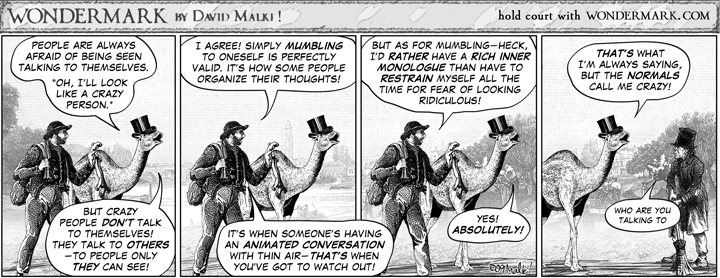
Let’s all stop judging people who talk to themselves. New research says that those who can’t seem to keep their inner monologues in — raving bus station denizens, for the most part, excluded — are actually more likely to stay on task, remain focused better and show improved perception capabilities. Not bad, really, for some extra jabbering.
Pfft, I could have told you that. I was a very quiet, withdrawn kid who would probably be placed on the shallow end of the autism spectrum these days, and the only time I felt comfortable talking above a murmur was in my own company. Sometimes it was in the course of playing with toys, inventing dialogues between my G.I. Joes, and sometimes it was just singing impromptu nonsense songs, but especially as I got older, I found that talking out loud, in more or less complete sentences, was invaluable for gathering my thoughts and streamlining them.
During the years in which I spent hours on the road between midnight and morning, it was a way of keeping my brain awake and active. I would talk my way through a subject that was preoccupying me, and the verbalization seemed to make it easier to keep my thoughts grounded and focused. Or I would compose poems (and later, posts) in my head and recite them over and over to see if they had what I considered a certain musicality.
I don’t mind being considered crazy for that; I probably didn’t want to talk to you anyway.
Got to be a Joker, He Just Do What He Please (Slight Return)
This week, Slate’s tech columnist Farhad Manjoo and Dear Prudence advice columnist Emily Yoffe debate the question: Does opting out of any and all social networks make you seem “suspicious”?
I Do Not Like Many People, Love; They Bore Me, or Attack Me, or Talk Too Much When There is Nothing to Say
As Facebook reaches further into every corner of our lives, it also engenders confusion, annoyance and concern. The litany of complaints is familiar. “People are going to be so busy writing about their lives that they forget to live them,” as a friend complains to me, is perhaps the most typical. This “Facebook isn’t real life” trope spans many sub-complaints. The word “friend” is being devalued by having hundreds upon hundreds of “Friends”. Users’ pages are not a genuine portrait, but a careful selection of photos and updates that amount to an illusion. People should be enjoying their vacation, not taking hundreds of pictures of it and putting them on Facebook. People should spend more time curling up with real books, not waste time bragging about what they read via GoodReads. The birthday messages that pour in because Facebook told your “Friends” it was your birthday are no substitute for real friends who actually remember. And so on.
…Bosworth is merrily impatient with these complaints. “The things people complain about in real life, it’s like they rediscovered them on Facebook. It’s like gossip never existed before, as if your history never followed you around before. I’m not saying there’s not some differences—but these aren’t Facebook problems, they’re just fundamentally human problems.” The philosophy is simple, he says: “Humans talk. Maybe we should let them talk online.”
So “talking” is neither good nor bad. But Facebook means that what people are saying will never again be far away. Long ago, everyone was in regular physical contact with most of the people they would ever know. Everyone knew everyone’s business, but “everyone” was not many people. Then urbanisation, cramming together people from far-flung places, allowed us to vanish into the crowd. Now Facebook is mashing today’s vast crowds into the small town of old, making a world that is both exhilarating and unsatisfying, with more people than ever to keep up with, and more people than ever keeping tabs on you.
Bosworth’s actually right. Relationships are developed and maintained through sustained attention and effort, not through some sort of magic resulting from physical proximity. There’s no reason you can’t put attention and effort into communicating with someone online, just as there’s no reason that an in-person relationship can’t be superficial. Different circumstances mean different aspects of the relationship come to the fore, that’s all. One is not necessarily more “real” than the other, if by “real”, we mean vital, substantial, meaningful.
That said, I find it extremely difficult to give what I consider adequate attention to more than a few close friends. Feeling obliged to keep up with a couple dozen would mean spreading myself too thin, and meaningful communication would get reduced to hasty, reflexive comments. Without some form of contemplative withdrawal from the incessant bombardment of stimuli, there’s no time and space for scattered impulses and experiences to coalesce and develop into the kind of thoughts that might actually be interesting and worth sharing.
Even I am not completely immune to romantic nostalgia, as it turns out—I still fondly remember when the web hadn’t gotten quite so standardized, when you didn’t feel like your once-secluded neighborhood had become stranded in between three or four different big-box stores with eight-lane highways connecting all of them. I know, I know; it was inevitable, but there was a time when the Internet seemed like an interesting alternative to everyday, provincial life, and I loved it that way.
The Skin of Three Centuries
And while I shall keep silent about some points, I do not want to remain silent about my morality which says to me: Live in seclusion so that you can live for yourself. Live in ignorance about what seems most important to your age. Between yourself and today lay the skin of at least three centuries. And the clamor of today, the noise of wars and revolutions should be a mere murmur for you.
— Nietzsche
Born in 1978, I’m a millennial in name only. I’m really a Luddite. I don’t get technology, and for a long time I tried to convince myself I didn’t want to get it. My view on the latest cyber advances was lack of interest and occasionally hostility. I imagined that this rejection marked me as an iconoclast or a rugged individualist. A real man listens to Led Zeppelin and doesn’t listen to Led Zeppelin on iTunes — that sort of thing. Now, thanks to that mulishness and vanity, I feel like a clamshell of a man, outdated and struggling to communicate with the rest of my cohorts’ fancy smartphones. At the age of 33, I’ve been left behind.
…From Friendster to PDAs, iPods to Facebook, I avoided dialing up or jacking in like my jean jacket and Marlboros depended on it. It was an image cultivated to look cool. But now the only image I’m left with is a deeply uncool one. I’m missing out on cultural conversations. I’m missing out on music and videos. I’m missing out on ideas that can be fired around the globe at the speed of thought. I’m missing out on social change that’s been enabled from Tahrir Square to Zuccotti Park. I’ve never even seen an Angry Bird.
…The truth is that all the beepers and cellphones and video game systems and VHS (and DVD) “movie machines” weren’t the vain consumerist crap I pretended they were. They weren’t the passing fads of the bourgeois. They were the foundation of a language that almost everyone in my generation has learned to speak and one that younger members of our cohort were simply born knowing. It’s the language of adaptability, of being so willing to learn and discover a new device that you never need directions to it. All of this stuff was about communicating. With each other. With machines big and small. With people in other countries. Come to think of it, communication was never my strong suit, either.
Dude, if it’s any consolation, you’re every bit as melodramatic and emo as any teenager, so maybe there’s life in your old bones yet. Settle down, stop wailing and learn what the term “Luddite” really means. In fact, look it up on that there newfangled Internet machine you use to write your monthly column on.
Histrionics aside, it sure does amuse me that anyone old enough to know better would actually think that there’s nothing interesting to talk about in this great big world of ours but the latest soon-to-be-obsolete gadget, or the trendy means of conversation. Really, man? You feel isolated because you don’t walk around all day with your flickering attention span confined to the alphabet soup messages floating across a palm-sized screen? Be glad. Verily, I say unto you: the world doesn’t actually revolve around the relatively tiny cliques of the Internet-famous and their hangers-on, hard as that may be to believe. People aren’t any more witty or intelligent on Facebook and YouTube, and it’s highly doubtful that you’ll be looking back in twenty years, sighing happily over fond memories of workplace small talk about this or that TV show.
Words Like Violence Break the Silence, Come Crashing In, Into My Little World
De Botton believes that secular people should create communal restaurants that mimic the Passover Seder. Atheists would sit at big, communal tables. They would find guidebooks in front of them, reminiscent of the Jewish Haggadah or the Catholic missal. The rituals of the meal would direct diners to speak with one another, asking questions of their neighbors like “Whom can you not forgive?” or “What do you fear?”
I’m on the road again, which partially explains the lack of posts this week. But anyway, having just eaten at a “family-style dining” restaurant where you’re seated at a long table with at least two other groups of people and introduced to each other by your server, let me just say that de Botton himself is the person whom I cannot forgive. If I may be so blunt, I would add that I currently have a visceral urge to pummel that silly bastard all about his bald, oblong head. What do I fear? I fear being trapped and expected to feign interest in a group of strangers telling me about the awesome biblical musical they just saw while hoping I don’t have to answer busybody questions about the lack of meat on my plate, that’s what I fear. Thanks for asking.
Alain, I’m terribly sorry for your unresolved daddy issues, sorry that you feel lost without the shepherding authority of religion, but seriously, just speak for your fucking self. Some of us are made positively miserable by forced socialization and inane small talk.
To Live Well, You Must Live Unseen
Do humans, especially children, have a built in bias that tells them where the self is, and if so, how and why would this have evolved? Paul Bloom and Christina Starmans, of Yale Univeristy, published a clever research article last week in the journal Cognition, arguing that children and adults tend to assume the self is in and around the eyes.
…Why we would people have this eye bias? What is it about the eyes that gives them the honor of Official Self Palace?… Think about it – if you’re trying to really understand what’s going on in someone’s head, you can’t just focus on what they say – you have to stare them in the eye. That’s why so many poker players wear sunglasses.
…I would venture a guess that the evolution of the language of the eyes predates verbal language. There’s something more universal, primal, and emotional about looking into someone’s eyes — it’s a language of the reptilian brain, not the cortices of complex thought.
Introversion – along with its cousins sensitivity, seriousness, and shyness – is now a second-class personality trait, somewhere between a disappointment and a pathology. Introverts living under the Extrovert Ideal are like women in a man’s world, discounted because of a trait that goes to the core of who they are. Extroversion is an enormously appealing personality style, but we’ve turned it into an oppressive standard to which most of us feel we must conform.
If you’re an introvert, you also know that the bias against quiet can cause deep psychic pain. As a child you might have overheard your parents apologise for your shyness. Or at school you might have been prodded to come “out of your shell” – that noxious expression that fails to appreciate that some animals naturally carry shelter everywhere they go, and that some humans are just the same. “All the comments from childhood still ring in my ears, that I was lazy, stupid, slow, boring,” writes a member of an email list called Introvert Retreat. “By the time I was old enough to figure out that I was simply introverted, it was a part of my being, the assumption that there is something inherently wrong with me. I wish I could find that little vestige of doubt and remove it.”
Now that you’re an adult, you might still feel a pang of guilt when you decline a dinner invitation in favour of a good book. Or maybe you like to eat alone in restaurants and could do without the pitying looks from fellow diners. Or you’re told that you’re “in your head too much,” a phrase that’s often deployed against the quiet and cerebral.
Or, as Lao Tzu said, you like to be forgotten by the world and left alone. I agree with Robert Butler: not everyone wants validation and approval, thanks anyway.
Taciturn and retiring, sequestered in the farthest corner, in unremarkable drab clothing, my hat pulled low, my hair and beard shrouding my face, my eyes hidden behind dark sunglasses. I become an opaque eyeball; I am nothing; I see all.
‘Cause If You Ain’t Holdin’ Hands, People Say That You’re Queer
The averagely nonjudgmental person may wonder why, in 2012, being single should be a radical act, an interesting topic of discussion, a viable subject for a spate of new books and magazine covers. Why is this relatively ordinary or banal mode of life even worth commenting on? Why, in short, all the fuss?
…This cultural obsession with living alone is a sign or symptom. It fascinates and enthralls us and arouses our curiosity because the general wisdom about how to live life, even in liberal circles, is so narrow, so respectable, so uninspired. (Or as Helen Gurley Brown put it, “There are a lot of half-alive people running around in the world.”)
“He’s a flamer!”
“Uh?”
“Yeah, when I went into his bathroom? No feminine products at all, nothin’.”
That was my former boss speaking, after we had finished a satellite installation at a customer’s house. A middle-aged, apparently single guy with a tidy house? Scented candles, even? Was that a hint of a feminine lilt to his voice? Case closed.
Maybe he was divorced or just casually dating. Maybe he had a girlfriend who didn’t want to cohabitate before marriage. Maybe he didn’t have time left over after work and hobbies to want to invest the energy in romance. Or maybe he was just a misanthrope who preferred the company of his dogs. I was just momentarily taken aback that anyone would be concerned enough about it to comment. I barely even noticed what the guy looked like, let alone considered inspecting his medicine cabinets for tampons.
The general wisdom about how to live life is narrow and uninspired because, like all things general, it’s a lowest-common-denominator wisdom. Intentionally childless couples are treated the same way. The herd has no problem with banishing someone, but a person who voluntarily disassociates themselves from the norm is treated with wary suspicion, if not considered to be giving purposeful offense. Hey, what do they know that I don’t? Why wouldn’t they like the things I like? What’s wrong with me?
I Think That I Will Grow an Elfin Beard
It is true that the park becomes another world after dark, but historically it is just the place for a hermit.
When St James’s Park was being re-arranged in the first half of the 18th century, William Kent, who designed the pepper-pot topped Horse Guards, also ran up for Queen Caroline a hermitage called Merlin’s Cave. This rum cross between a grass-roofed African hut and a gothic ruin was installed in the gardens of Richmond Lodge. The Queen then appointed Stephen Duck, “The Thresher Poet”, as her ornamental hermit.
Ornamental hermits were quite the thing in the Age of Reason. No grotto was complete without one.
This is the bright side of the 1% accumulating so much of the nation’s wealth — a niche like this opens up for people like me.
If I Could Be All By Myself I Could Be Me
There’s an essential freedom in being alone with one’s thoughts, oblivious to and unpolluted by anyone else’s. Diminish that aloneness and we start to doubt our own perspective. Do I really think Blue Bottle coffee is that great? Or Blazing Saddles that funny? Do I really not like that pizza place because it isn’t authentic New York-style? Sure, it’s entirely possible to arrive at one’s own opinion amidst a cacophony of others. But it’s also possible to bend, unknowingly and imperceptibly, toward a position not naturally our own.