On the other hand, just as many pronouncements may be found that attested to his disinterest in potential readers. “Mihi ipsi scripsi” — “I wrote it for myself” — was the motto he had selected for himself, perhaps also to prevent disappointments, while working on Zarathustra. The same ambivalence emerged from the fact that he had addressed the book to “everyone and to no one.” “How could I write for readers?…Rather, I make notations for myself,” can be read in a notebook from the late 1880s. The question of Nietzsche’s audience was further complicated by the fact that he was convinced he was ahead of his age by a generation, if not by several.
— Philipp Felsch, How Nietzsche Came in From the Cold: A Tale of a Redemption
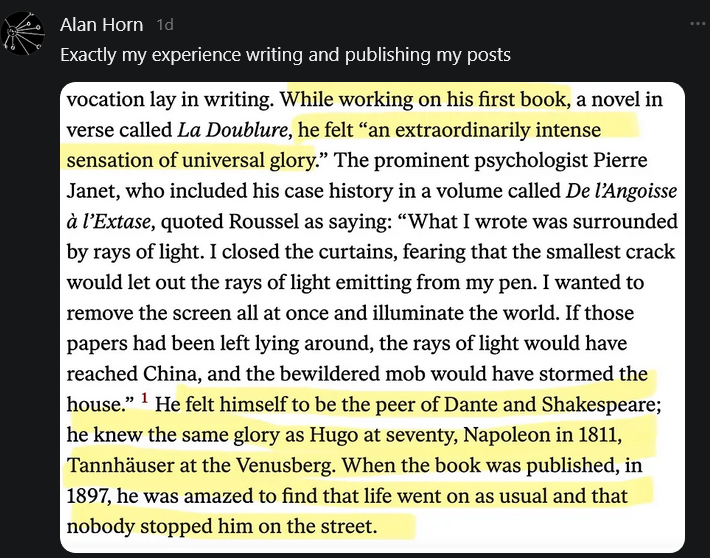
In 2005, a couple friends and I started a short-lived blog to join the general conversation. I didn’t have a voice yet, so my efforts were mostly derivative. By the time I finally started to write things that didn’t suck, the crowd had drifted to newer platforms and shorter attention spans. It didn’t matter; writing turned out to be intrinsically rewarding. The bargain I made with myself was simple: keep the work addressed to one exacting reader —me— and let others overhear it if they like.
Then came the metricized web. In 2006 I was uploading obscure musical tracks to YouTube and getting DMs like, “love this!! hey subscribe to my channel!!” I’d check their page: a few shaky cam clips and nothing I’d ever want to see again. I kept wondering, like an overly-rational Vulcan, why would I volunteer to be notified every time this dork posts? Eventually I learned that this was just the new etiquette: don’t offer value, collect it. The request wasn’t transactional (“here’s something you’ll love in return”); it was numerical (“help me inflate this meaningless metric so that I can pretend my inner self is something other than a howling wasteland”). Today’s creator programs formalize it: payouts and promotion tied to “engagement,” with replies and outrage acting like adrenaline. If ten thousand people rage-reply and thirty thousand boost it, the algorithm pays out, and discourse tilts toward provocation. It’s not about conversation; it’s a slot machine that rings louder the more you debase yourself to pull the lever. Now, I feel an irrational rage every time I see an ostensible adult boast about achieving a particular round-number follower count, or about a viral post “doing numbers.” How many of these “followers” are real people who actually read each post carefully and comprehend it? How many of these “content creators” even care, though? Numbers are all that matter, like insecure teenagers in a perpetual dick-measuring contest. I want to charge into the Temple of Elon and overturn all the payout tables. “My blogosphere was to be called a house of conversation, but you have turned it into a den of shitposters.”
I’m Gen-X, and the old ethos still feels right: strive for status if you must, but don’t pant for it in public. Obsession over “selling out” could get precious, and of course it was largely hypocritical, but it kept dignity within reach, at least. Even a “too cool for school” stance like ours was still a tribute to an established norm: it would be pathetic and undignified for an adult to chase after mere popularity for its own sake. By the early ’00s, I was belatedly realizing that no such restraint existed anymore. Empty affirmation was all anyone seemed to care about. I’d rather stick with the Nietzschean attitude — a book for all and none — and use outdated measures of value instead: posts reread, saved, passed along from one person to another. If the age needs me later, it will find me; until then, I’ll keep making notations for myself — several generations ahead, naturally.