Ornamental hermit. Sciolist. Musician manqué. Poetaster. Armchair psychologist. Pseudo-philosopher. Founder of Panta Rheism™. The complete Rabelaisian man. Great eater, deep drinker, stout fighter, prodigious lover; clear thinker, creator of beauty, seeker of truth and prophet of heroic grandeurs. I coalesce the vapors of human experience into a viable and logical comprehension.
(Contact: asundayofliberty at gmail)
Recently I had a three-hour conversation with a woman on a plane who was struggling with a family issue, and we actually got somewhere. She thanked me for the time, confessing she had almost gone to AI the night before. I was so glad to have taken the place of the machine, even though it cost me some alone time. Now that I know AI’s counselling allure experientially, I aim to resist it all the more. It is an act of human defiance to be there for each other anyway, to continue to fill the spaces the machines would all too willingly fill in our absence.
That’s great. I mean it sincerely. Yet it must be said: his example is a lottery win. It depends on a three-hour flight, the right seatmate, the right mood, the right person willing and able to talk, and a man who has the temperament and perspective to play volunteer counselor on command. Many people don’t get that lucky. They’re not sitting next to Professor Pastoral on a plane. They’re sitting alone in an apartment after a shift at a dead-end job, with a phone, a headache, and nobody who wants to deal with “thinky stuff.” “Be there for each other anyway” is beautiful as an aspiration, but as a prescription it assumes a social world that lots of people do not inhabit.
I’m reminded of the parable of the drowning man: The flood rises. A man refuses a rescue boat — “God will provide” — refuses a second boat — “God will provide” — refuses the helicopter — “God will provide” — and then drowns. In heaven he complains, and God says, I sent you two boats and a helicopter. Milliner admits that he tried to “pray that prayer” of thanks to God for sending such a helpful tool to him, but somehow couldn’t do it. The lofty advice here is: refuse the imperfect help and wait for the ideal help. Don’t use the chatbot; go find real community; do it the “right” way. Okay. When your actual life contains no such community, or contains it only in meager doses, what then? Intellectuals, whether right or left, religious or secular, all tend to gravitate toward the neat, tidy, elegant theory of life. As a miso-intellectual, I’m more interested in the real-world casualties that get left out, the savaged body parts littering the floor around the bed of Procrustes.
This is just a problem of scarcity. Attention is scarce. Thoughtful feedback is scarce. Adult life is triage. If you have the option of real human counsel, by all means, take it. If you don’t, and the choices are to grind alone inside your skull, pester busy people who won’t respond, or use a limited tool that is available and “good enough,” then yes, many people are going to take the boat that actually shows up.
A journalist who isn’t running around like Chicken Little clucking over AI and the end of literacy? Well, if that don’t beat all.
Alan Jacobs noted last year, with regard to the doomsaying over declining readership, that a lot of our panic is covert nostalgia for an unusually favorable moment we mistook for normal. For most of literary history, the definition of “literacy” was merely the ability to sign your name. Virgil, Augustine, Dante: none of them expected wide readership, because serious literacy, as we define it now, was never common. So when people moan about a “post-literate age,” Jacobs says the phrase is basically nonsense: literacy is more widespread globally now than at any point in human history. What’s shrinking, at least in the American context, is not “literacy” as such, but a particular postwar distribution of it.
That postwar distribution is what I think of as the mid-century middlebrow: a brief, flattering climate where reading felt more democratic than it had ever been. The G.I. Bill and mass higher education expanded the literate public; print culture was cheap and widespread; television hadn’t yet monopolized every idle minute. Will and Ariel Durant spent forty years producing an eleven-volume history of civilization written for a non-academic audience. Earl Nightingale, a radio speaker and author, produced short common-sense exhortations on motivation and personal development with epigraphs from Wordsworth, Goethe, and Samuel Johnson, on the clear assumption that the average reader would know and care who they were. The Book-of-the-Month Club featured authors like Evelyn Waugh, George Orwell, Winston Churchill, E.B. White, and Graham Greene. In that window, it was possible to entertain the pleasing illusion that “everybody” was at least casually acquainted with the great books, or with their respectable, middlebrow cousins. Then history resumed.
What resumed, exactly? Competition. First on the demand side: TV, then the internet, then social media, then streaming; each a better-engineered rival for attention than the book ever had to face at scale. And now we’re getting the new pressure on the supply side: AI can manufacture endless “good-enough” text — serviceable summaries, plausible op-eds, competent product copy, adequate homework, infinite sludge, all at negligible marginal cost. Journalists, authors, academics, librarians, teachers, grad-school adjacent types, and hardcore readers — the very people reacting like Chicken Little — form a dense, self-referential ecology online. Unusually verbal, unusually literate, and unusually invested in the status of the written word, they quote each other, react to each other, and amplify each other’s anxieties. It can feel like “the public square,” but it’s mostly just a professional subculture dominating the stage, assigning themselves all the starring roles. The numerous readers of Stephen King, devotional literature, or celebrity tell-alls are “excluded” from the conversation, in the idiotic parlance of our time. Look, I personally know enough intelligent women who mostly read “romantasy” by the truckload, enough so that I’ve started reconsidering whether women should have ever been allowed to learn to read in the first place if this is all they’re going to do with it.
We can debate that another time. Either way, the point is, many if not most people simply don’t give a damn about literature or the self-important conceit of the writer-as-seer, communing with the soul of the world and the spirit of the age. Reading for pleasure and cultivation may well go the way of horsemanship, which was an essential skill for middle and upper classes for millennia; now reduced to a niche interest. In the world that exists, you can either lament, moan, and propose protectionist policies to keep a certain class of writer in business, or accept that “excellent prose” is an acquired taste, maybe even a minority taste, and write something worth reading for whoever still has the appetite. Not everyone will. But the existence of a minority has always been enough to keep real literature alive. At the very least, face our fate with dignity and stop whining.
A chemist who worked on Nantucket Was sifting through poop in a bucket. He said, “That’s not fiber or fruit — That’s primo nose candy en route!” And the whole island shrugged and said —
Jesus, what a bunch of knock-kneed, lily-livered chickenhearts. This fast-growing genre of AI-lament has the whiny tone of Hudson in Aliens: “Game over, man, game over!” Calm your asses down. Writers have survived printing presses, typewriters, radio, TV, the internet, Twitter, and the death of attention itself. I’ve never thought of myself as an optimist, but I seem to have a little more faith in the resilience of human creativity than most. If “AI style” becomes too prevalent the way “2010’s newsletter-style” did, or even the “single-sentence/paragraph clickbait” style that Muni (unwittingly?) reproduces here, those allergic to it will find a new way to express themselves.
Yes, yes, I know — the romantic “writer-as-shaman” conceit. The artisanal mystique. The sacred cave of the soul where the author spelunks for phrases and ideas only he could have formed, unaided by anything but suffering and candlelight. I mean, sure, make it a luxury signal if you want. Put NO BOTS on the dust jacket the way rock bands used to announce NO SYNTHESIZERS in the liner notes. But synthesizers didn’t go away; they won. And AI will too, because this isn’t (X) a moral debate — it’s (Y) an incentives problem. People tend to find their way to the path of least resistance. The tool saves time, smooths friction, and does a serviceable, affordable job at multiple tasks: amanuensis, research assistant, brainstorming-partner, proofreader, editor. People will use it. If you turn that into a sin, you won’t (X) reduce usage; you’ll just (Y) make everyone lie about it. Until, inevitably, some loud anti-clanker crusader gets caught with his pants down in a hotel room with Claude, Gemini, and a bag of white powder and does the full Jimmy Swaggart tear-bath: I have sinned; I have fallen; please forgive me.
You’re not a shaman. You’re a scavenger. So am I. We’re all raccoons, opossums, and vultures with pretensions to artistry. We’ve always worked by conversation, overheard remarks, half-remembered books, accidental plagiarism, and imitation-bad-enough-to-look-original. We steal rhythm from a sentence we loved ten years ago. We borrow a metaphor from a friend and forget where it came from. We build mosaics out of whatever the world coughs up. AI is not the end of writing; it’s just another pile of material in the landscape — another junkyard where you can find a useful hinge, a bright shard of glass, a piece of wire you can turn into something that actually holds its shape. The only real question is whether you can still make it yours.
By the time the church bell quits tolling, they’re already gathering at the gaol. The rumor has traveled faster than any rider: dark doings among the scribes. Something unclean has happened in the scriptorium. A man of the guild! one of them, trained in the sacred arts of ink and ledger! — has been seen consorting with the enemy. The crowd presses closer, anxious and thrilled, crossing themselves as if the very idea might infect the air. They mutter about corrupted ink and devilish machines. And there! Pangram, Botfinder General, straight-backed, solemn, with his shiny new device that turns speculation into a number. He announces his judgment: under interrogation, the scribe’s work has been shown to bear the Devil’s watermark. That’s all they require. Relief loosens their faces. Now they can go home feeling righteous, already anticipating tomorrow’s sport: the culprit in the pillory, the mob’s clean-conscience holiday, rotten vegetables thrown in the name of virtue.
This is what it looks like in a despoiled information ecosystem when people start hunting for scapegoats. Social media already fractured the old reality-brokering order; now AI arrives and further upsets the balance of power. Video can be faked, audio can be faked, and worst of all for the scribes, text can now be convincingly mimicked too. Nobody trusts anything or anyone. It’s a Lord of the Flies media environment, and everyone’s ready to kill over who gets to wield the conch of authoritative speech. The old agenda-setters feel their entire way of life slipping away, and set about like modern Luddites in a futile effort to smash the new narrative-weaving machines. In that atmosphere, even reasonable people start craving a single line between real and artificial, human and machine.
I’m only superficially familiar with René Girard, but I couldn’t help thinking of him here. Fear wants an object. Anxiety wants a face. Suspicion wants judgment and a sentence. One one level, this episode is about the particulars of journalistic ethics. On a deeper level, this is about the anxieties many people feel as their place in the world feels threatened. We’re anxious over what it even means to be human in such a cyborg world, especially when technology can convincingly mimic even the most quintessential human activities, like art and craft. Ironically, we outsource our uncertain judgment to…more machine analysis, more software. Pangram, and other similar bot informers, will serve as the authority demarcating the real from the artificial. Most people won’t know how Pangram works, or how reliably it works, if at all, but it doesn’t matter. We just need to believe it does what we need it to, and then we feel relief. The world makes sense again, and now we can focus on punishing the scapegoats: the species-traitors who collaborated.
In “Mechanical Man,” Lou Barlow sang, “When I said I understood, I only knew where to stand.” He seemed to anticipate the conformist idiocy of online discourse. Not “what is this thing?” but “what vibe is this thing?” Tocqueville noted this two hundred years ago: when you remove custom and aristocracy as sources of authority, people don’t start thinking independently; they just start nervously measuring themselves against their peers. We’ve stopped forming views and started presenting ourselves in stances. Understanding the object is old-fashioned. The point is to locate it on the moral map as fast as possible, because the map is the social world and nobody wants to be caught in the wrong zip code.
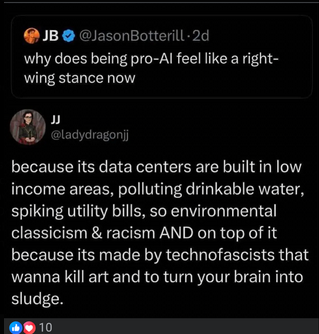
Once the sorting happens, the story writes itself. A complex technology becomes a one-stop portal for every available sin: data centers in poor areas, poisoned water, higher utility bills, racism, “classicism,” fascism, the death of art, and the reduction of your mind to sludge. It’s the inverse of Berlin’s monism: not “all goods must fit together in a harmonious whole,” but “all evils must fit together in a malevolent whole.” Snap on racism. Snap on classism. Snap on pollution. Snap on fascism. Congratulations; you’ve formed IMMORAL VOLTRON. Now you don’t have to argue about particulars; you just point at the monster and scream.
The trick, of course, is that these mad-libs incantations don’t enlighten; they discipline. Once AI is declared contaminated, any hesitation becomes complicity. To question one link in the chain is to “reveal yourself” as the kind of person who would defend the whole chain. Berlin’s emphasis on pluralism, tragic conflict, and incommensurable goods dies here, because pluralism requires the adult ability to say: some harms are real, some benefits are real, and people can disagree on how to balance them without being cast as villains. But stance culture can’t afford that. It needs a single verdict, a single villain, a single shaming label. Tradeoffs are messy; exorcisms are tidy.
For adults, we need warnings that clearly convey the serious risks. The lessons that took tobacco regulators decades to learn should apply to artificial intimacy governance from the start. Small print disclaimers about the effects of smoking have been rightfully criticized as woefully deficient, but large graphics on cigarette packs of black lungs and dying patients hurt sales. The harms caused by A.I. companions can be equally visceral. The groundbreaking guardrails that Gov. Gavin Newsom of California signed into law last year, which require chatbots to nudge minors to take breaks during long sessions, are a step in the right direction, but a polite suggestion after three hours of A.I. conversation is not enough. Why not play video testimonials from people whose human relationships withered after years of nonstop chat with bots?
When I was a kid in ye olden days, reformers were forever trying to save us from ourselves. Smoking will kill you. Drunk driving will kill you and someone else. Drugs will melt your brain. We had assemblies with “scared straight” guest speakers, posters of tar-blackened lungs on the walls of health class, PSA’s, and (God help us) McGruff the Crime Dog records with bouncy little earworms about every substance known to man. The theory was that if we were properly educated, if the warning labels were vivid enough, if the videos were grisly enough, we’d make good choices forever after. And yet people kept smoking. People kept driving drunk. People kept getting high. Not because they lacked information, but because they were stressed, bored, lonely, impulsive, self-destructive, curious, or just plain human.
Now the new panic is emotional intimacy with AI, and the new solution is…warning labels and more regulation. “This is not a substitute for genuine relationships.” “ChatGPT can make mistakes.” And here some newly-minted reformer wants to make teenagers watch video testimonials from recovering chatbot junkies, like driver’s ed films of crumpled cars. But McGruff is the perfect emblem of the whole genre: you’re trying to solve a messy relational problem with a cheesy piece of mediated messaging. You even risk the pink-elephant effect — by foregrounding the forbidden thing (“crack cocaine!” “romantic bots!”) you plant it in the mind with an oddly vivid presence, while the adults congratulate themselves for having “done something.” It’s outsourcing the hard work of parenting and community to a cartoon mascot and a compliance checklist.
None of this is to say that nothing can or should ever be improved. But there is no design standard, warning label, or stern authority that can make life safe and painless. People will always try to jerry-rig comfort out of whatever’s available when their actual lives are starving for it. If you don’t want Johnny turning into a dope fiend, you can’t fix that with a McGruff album. If you don’t want Johnny “marrying” a chatbot, you can’t fix that with a disclaimer. The solution, such as it is, was never primarily informational. It was always relational. And wherever we go, there we are.
I do look forward to today’s cartoon characters producing an album warning kids to not fuck an android sexbot.
Over the last few decades we made a series of choices — technological, cultural, and personal. They changed how we know one another, how character is displayed and read, and what politics means in ordinary life.
First: reputation was replaced by signals. In a thicker, more local world, your “profile” wasn’t a set of statements about the issue du jour. It was how people saw you at work, in the neighborhood, in civic and social settings. They watched patterns: whether you showed up, whether you kept your word, how you treated someone annoying, whether you gossiped, whether you could laugh at yourself, whether you were cool under pressure. Character was something you demonstrated over time. And because you were embedded in overlapping relationships, you couldn’t curate yourself as easily. Reputation had weight and memories were longer.
Then the thick web thinned — unevenly, not everywhere, but enough. More people live far from their birthplace, far from immediate family. Many “relationships” relocated online. Mobility, atomization, fewer shared institutions, fewer mutual acquaintances doing informal background checks. People still needed a way to “place” each other, but the old method — proximity plus time — was harder to come by. So we reached for shortcuts.
Second: the digital medium pushed us toward performed character. Online life is poor at displaying the cues that make a person comprehensible: temperament, patience, warmth, reliability. Even gifted writers struggle to convey a whole personality in text, and most of us aren’t gifted writers. The finer details that used to be passively inferred through everyday contact now have to be presented — selected, framed, packaged (and embellished).
The medium rewards what travels well. Nuance is expensive. Modesty is nearly invisible. But a sharp dislike is easily understood. A snappy retort pops and sizzles. A slogan fits comfortably like a generic t-shirt. So we learn to broadcast ourselves in compressed symbols (bio flags, ritual phrases, approved jokes, basic thumbs up/down opinions) because that’s what the environment can reliably transmit and recognize. And we learn to read others the same way: not as nuanced individuals, but as caricatures.
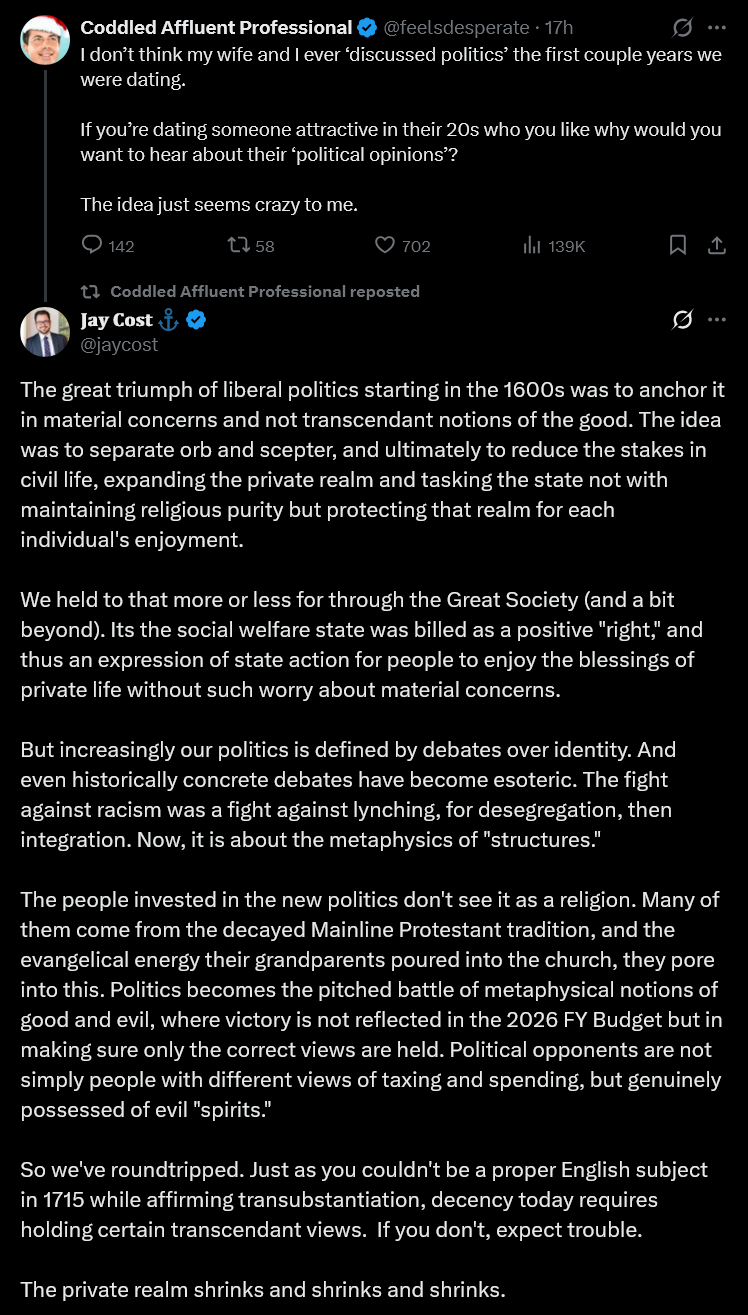
Third: politics became moralized, identitized, totalized, a surrogate religion for people who had left the real thing behind. In a high-context world, you could disagree about politics and still know what kind of person you were dealing with, because you’d seen them in everyday life. Politics stayed in its appropriate sphere more often, one aspect of life among others. But in a low-context world, where lived evidence is scarce, politics became a substitute for what we can’t otherwise know. It turns into a quick proxy for the whole soul: not “what do you think about this or that policy,” but “are you decent, are you safe, are you one of us?”
Once politics is asked to do that job, the stakes increase. Disagreement stops looking like error and starts looking like vice. Opponents become heretics. Silence stops looking like courtesy and starts looking like complicity. This is why politics gets dragged into dating, friendship, hiring, even casual conversation: it’s become the all-purpose sorting mechanism in an environment that no longer supplies slower, better ones.
Is this good or bad? As the wise old Chinese farmer always says: maybe.
There are obvious gains: some injustices have less cover; some people found rewarding communities they couldn’t find locally; some hypocrisies are harder to maintain. The old world wasn’t Eden. But it’s still worth acknowledging what we lost: the ability to read character from real-life patterns rather than declared stances; the ability to grant people nuance and complexity; the ability to keep the public realm from colonizing every private room.
That’s what I call those who take it upon themselves to convince others and make them similar to themselves, make them think in the same way.
I abhor this kind of mental usurping, the great task of political parties and confessions.
What matters for you, doesn’t matter for me. Because it matters for you, it doesn’t matter for me.
To understand oneself, it’s essential (in my eyes) to think differently.
Do you support the campaign? Go rape yourself, that’s my response. Even answering that question concedes too much to the commissar asking it. It’s none of your goddamned business how I feel about AI use. I don’t owe you a pledge, a badge, a logo in my sidebar, or an affidavit about my writing process. If I read something and it feels synthetic, I’m free to close the tab and avoid that writer in the future. That’s how grown-ups handle taste, without forming a militia and a blacklist.
What I can’t stand, as always, is the missionary spirit animating this entire self-appointed class of jumped-up hall monitors: the righteous salesmanship, the demand for public alignment, the insinuation that silence is complicity. This “download a free logo and join us” routine is a ritual with no barrier to entry for people who like the feeling of conscience without the burden of thought. Once the ritual exists, the next stage is guaranteed: bot-sniffing as sport, comment-section inquisitions, and purity audits, as though the only point of reading is to detect the Devil’s watermark.
This is the online HOA, or the Concerned Citizens Council, coming to the door with clipboards and smiles, asking you to sign. And underneath the smile is the implied threat: Do you want us to make it known that you refused? Because that’s how these things work. There is no neutral ground in a holy war. The whole point of the ritual is to sort the righteous from the wicked, and to make “I decline” sound like a confession. Even if you happen to agree with this particular campaign, the same petty functionaries will be back knocking on your door next week, with clipboards and smiles, expecting your participation in the next loyalty test. Whenever you finally decline, the smiles will vanish, and you’ll see them for what they really are.
The most a campaign like this can do is create another platform for virtue-signaling (as if we needed more) and another excuse for resentful mediocrities to claw at higher-status targets under a banner of public morality. Watch how quickly “protecting the craft” turns into guilty-until-proven-innocent accusations. It invites the exact type Valéry despised: the mental usurper, the person who can’t just choose their own life, but must conscript yours into their crusade. No thanks. Read what you want. Write what you want, how you want. And leave me out of your religion.
Youngsters will think I’m just spinning a yarn, but back in the internet’s olden days, Google used to have a “blogsearch” function available in a drop-down menu. I used it to find numerous new sites to read, but that option, like blogs in general, went under the steamrollers of “progress.” Social media claimed eminent domain, and the picturesque country roads of the blogosphere were turned into eight-lane interstates connecting commuters to all the big-box superstores.
I’ve been exploring Kagi as a search engine, and one delightful feature they have is their “smallweb,” which functions pretty much like the old blogsearch. (I even found a disreputable slum called A Sunday of Liberty on there after a couple dozen clicks.) Seeing all those old-style blogs with their proudly-uncool graphics makes me feel like I stepped through my wardrobe — not into Narnia, but into Web 1.0, at least. It brings back the serendipity and genuine random thoughts of early web-browsing. I recommend you all give it a try.
(I should also mention that Ooh has also been helping to keep the old blogosphere spirit alive, though certain disreputable slums have been known to appear there as well, so caveat lector.)
I have long loved Princeton University Press’s collection of Isaiah Berlin’s essays and lectures, and the tragic conflict between our Enlightenment and Romantic cultural heritage is one of his most fascinating topics. In a lecture on Romanticism’s moral fallout, he remarks that we are “children of both worlds.” We award moral “marks,” as he puts it, for consequences (what actually makes human lives better) and also for motive (sincerity, integrity, devotion), and we aren’t fully satisfied by either standard on its own. “We don’t quite know where we stand.”
He treats this split as tragic in the strict sense: not “sad,” but structurally unavoidable. We need consequence-talk because the world contains hunger, cruelty, poverty, power, so it matters what policies and systems do. But we need motive-talk because we’re not machines; we can’t help caring about integrity, authenticity, dignity, the difference between accidental beneficence and deliberate goodness. So we live in a kind of ethical binocular vision that won’t merge into a single image.
The temptation is to demand that the two images must merge, that there must exist one master principle that will reconcile all genuine human goods without remainder. He calls that temptation monism, and he describes it as the belief that (1) every genuine question has one true answer, (2) there’s a reliable method for finding it, and (3) all true answers will ultimately be compatible in a single harmonious system.
Against this, Berlin argues for his famous notion of “value pluralism”: there are multiple real human goods, and they can collide in ways that aren’t just misunderstandings. Liberty can clash with equality; mercy with justice; knowledge with happiness; spontaneity with responsibility. He says these conflicts are “an intrinsic, irremovable part of human life,” and that the dream of total human fulfillment is a chimera. Then there’s his further claim of incommensurability: there’s no universal “common measure,” no moral common currency, that lets you reduce every conflict to a single scale and “do the math” in the abstract.
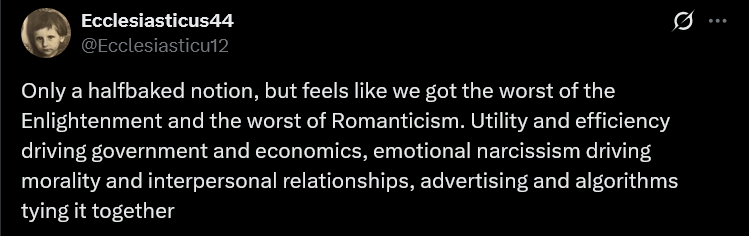
Looking back to the above tweet, we might add that the oscillation Berlin describes has become operationalized. The Enlightenment side (quantification, optimization, efficiency) now has direct access to the Romantic side (recognition-hunger, identity-performance, the demand that inner states be treated as morally authoritative). Platforms don’t need to resolve the split; they can profit from it. They can keep feeding you consequence-metrics (scores, ratios, dashboards, engagement graphs) while simultaneously inflaming motive-theatre (sincerity contests, confessional performance, identity badges), and the two halves reinforce each other in a loop.
Berlin offers neither nostalgia (as if we could crawl back before the split) nor utopia (as if one more theory will heal it). He insists that some losses are real losses, some trade-offs are permanent, and adulthood — personal and political — means choosing without the fantasy that choice can ever be made painless.
I’ve always said you should be careful in conversation, because most people are nuts once you scratch the surface. Not “clinically ill” nuts — just the ordinary human kind: a tangle of superstitions, pet theories, private mythologies, and emotional loyalties. But “nuts” isn’t one thing. There’s low-stakes woo — crystals, tarot, astrology, the I Ching — that functions less as a truth-claim than as a way of goosing the subconscious, enabling lateral thinking, or mapping suggestive symbols onto your life the way you might use a writing prompt. Most “irrationality” is benign and doesn’t interfere with our ability to hold jobs, raise families, and operate heavy machinery.
Then there’s high-stakes craziness: paranoid conspiracism, totalizing world-models, politics-as-gnostic war. That isn’t merely “believing something unscientific.” It’s our pattern-seeking software going haywire. It’s apophenia and pareidolia — the brain frantically connecting dots because uncertainty is unbearable, because a bad explanation feels better than no explanation, because “someone is in control” is less frightening than randomness. And even here, there may be differences of degree. Unlike the perennial, bipartisan obsession with Jews and Israel, there aren’t any organized movements demanding, say, the arrest of the Bush administration for engineering 9/11. There’s just a bunch of weirdos, content with having “figured out” the secret levers that move reality.
Social media, however, is the accelerant that turns craziness into something qualitatively different. Offline life had a kind of federalism built into it: local friction, social veto points, separate contexts, and the discipline of embarrassment. The town crank could bore his family, write letters to the editor, or hold court at the diner, and reality would keep him contained. Now the crank finds ten thousand other cranks by lunchtime and gets algorithmic reinforcement.
Social media is responsible for what I think of as “context collapse” — the erosion of the ability to tailor one’s conversation depending on the listener. Normal people speak differently to their friends as opposed to their acquaintances, colleagues, or strangers. Online, though, posts and videos are addressed to a mass of faceless followers, and the style follows suit. Now, it seems like the online style is bleeding into real life. More people walk around “posting out loud,” with no consideration for the listener, and a decreasing ability to read the cues that say, “I’m not interested, and frankly, you’re making me a little uncomfortable.” People have always been a little nuts; what’s new is that the nuts can organize, scale, and colonize every room with the tone of a comment section.
In most of the ways that matter, linear time is a myth. Entropy has its arrow, sure: we are born, we age, we die, in that order, never in reverse. But moral life runs in circles. The calendar flips, the technology gets more impressive, but the human temptation stays put. We’re still the same animals, still drawn to the same pleasures: the pleasure of certainty, the pleasure of punishment, the pleasure of calling our appetite “principle.” Tenderness and cruelty are Siamese twins, never far apart. If you like religious language, call the recurring temptation the Devil: not a horned monster, but a patient solicitor who never tires, who never stops coming back, each time with a new pitch, each time asking you to sign the same contract — just this once, just this time, for a good cause, with an easy installment plan included.
The Devil doesn’t need you to become a villain in one grand gesture. He only needs you to get used to small exceptions. He only needs you to stop flinching. That’s why the call to battle is so effective: it dulls the nerve endings of conscience and fills your ears with a drumbeat. And the world will always supply new drums. New scandals, new enemies, new emergencies, new reasons you “have to” be hard, “have to” be ruthless, “have to” stop worrying about the “edge cases.” There is no finish line where you can finally relax into goodness, no historical utopia that vindicates all your choices. The test returns in different guises, over and over, asking the same question with new vocabulary: Will you bend the rule? Will you take the shortcut? Will you let the ends justify the means?
You’re never finally safe from it. You can only hold out as long as you can. The only victory available is the stubborn refusal to sign. The world will remain mixed and your crusades will not purify it. But you can keep your own hands clean. You can insist that a “false positive” is not an acceptable rounding error because it is a person, and a person is not collateral. You can refuse to let the battle-frame make you stupid and cruel. Because the real danger isn’t that you’ll one day wake up believing in Evil like a mindless acolyte; it’s that you’ll get used to the bargain, that the shrug will become second nature, that “Who gives a shit?” will start to feel like maturity. To quote Kafka one more time: once you have taken Evil into yourself, it no longer insists that you believe in it.
Yet that is what romantic philosophy would condemn us to; we must all strut and roar. We must lend ourselves to the partisan earnestness of persons and nations calling their rivals villains and themselves heroes; but this earnestness will be of the histrionic German sort, made to order and transferable at short notice from one object to another, since what truly matters is not that we should achieve our ostensible aim (which Hegel contemptuously called ideal) but that we should carry on perpetually, if possible with a crescendo, the strenuous experience of living in a gloriously bad world, and always working to reform it, with the comforting speculative assurance that we never can succeed. We never can succeed, I mean, in rendering reform less necessary or life happier; but of course in any specific reform we may succeed half the time, thereby sowing the seeds of new and higher evils, to keep the edge of virtue keen. And in reality we, or the Absolute in us, are succeeding all the time; the play is always going on, and the play’s the thing.
The modern citizen lives with a rectangle glowing in his palm like a little oracle. From it comes a constant stream of emergencies, outrages, villains, heroes, and urgent calls to prove you are one of the good ones. The world is always ending; the stakes are always infinite; the moral pressure is always immediate. And because it’s immediate, it feels intimate, right here, right now, in your face, as if the drama on your screen were the whole world instead of a curated sliver of it. This is how you get the weird inflation of self-importance: people acting as if they’re standing at Thermopylae when they’re actually standing in a yoga studio lobby.
Here we are, then: the yoga studio, some staff behind a counter, a handful of righteous scolds demanding their due. The charge is grand: complicity, collaboration, silence in the face of evil. It has the romance of clandestine resistance — Vichy collaborators, secret police, the brave few defying the grey mass. It even flatters the accuser with historical resonance: I am not merely a petty bitch; I am fighting fascism. And then the “resistance” takes the form of… piling dumbbells on the floor for low-level employees to clean up.
It’s impossible not to notice the mismatch. If your cause is world-historical, why does your bravery so reliably select soft targets? Why does your fury funnel itself toward people who can’t meaningfully answer back — front-desk staff, service workers, the human beings stationed at the end of institutional pipelines? The pattern is predictable: the higher the rhetoric, the smaller the actual stakes of the chosen battleground. The nobility is abstract; the punishment is concrete. The moral grandeur is vapor; the mess on the floor is real.
People will tell you — always — that they are motivated by principle. But even if the principle were genuine, the conduct still betrays something uglier: the constant temptation to treat other people as props. You are not persuading anyone. You are not changing policy. You are not speaking “truth to power.” You are simply enjoying the privilege, for a moment, of being the kind of person who can make a mess and watch someone else clean it up, while calling it righteousness.
What is the reward? Not the stated reward — the utopia at the end of history which never arrives — but the actual reward, right now, in the nervous system. The reward is the intoxicating relief of moral permission. You get to be harsh without being harsh; you get to be cruel without being cruel. Your anger becomes virtue, and virtue becomes an alibi. You break the ordinary norms of civility, restraint, proportion, mercy, and you call the breach “courage.” Better still, the audience claps. Thousands of strangers give you a little pellet of approval: stunning, brave, truth-teller. Forbidden fruit is always sweet, but it’s even sweeter when you can call it medicine. It’s a powerful seduction for anyone who has been simmering with resentment, boredom, loneliness, or a need to feel consequential.
The tragedy is not that the world is evil, but that the world is mixed. It has always been mixed. It will remain mixed. There are genuine horrors and genuine beauties, and our small lives brush against both. But most of us will never be world-historical individuals, and the universe does not grant us sainthood as a consolation prize. The yoga studio refusing entry to federal agents would not rewrite national policy. A tantrum in the lobby will not cause the President to reverse course on immigration. Nothing in these little dramas carries the weight the actors pretend it carries.
The world does not move in a straight line toward Good or Evil like a train running on tracks. It lurches, compromises, repeats itself, forgets, remembers, repeats again. And that’s why the temptation is so persistent: because you will never be “done.” There is no final victory, on earth or in heaven. There is only the daily test, administered repeatedly: will you keep faith with the basic rules of civilized life even when you have a rationalization that tells you you’re exempt?
The rot begins with the easy little indulgence: this person “deserves” it. The staff deserve it. The bystander deserves it. The wrong tribe deserves it. The “complicit” deserve it. And because your cause is righteous, your petty vengeance is transmuted into justice like lead into gold. You learn to enjoy the taste of your own anger. You learn to confuse the stimulation of drama with the seriousness of truth.
Zoom out far enough and it’s laughable. The banners change. The hashtags change. But the human pattern doesn’t: give ordinary people an excuse, and some will use it to act out the small cruelties they were already inclined toward. They will call it activism. They will call it accountability. They will call it “speaking out.” But the constant feature is the pleasure of being allowed to do what you wanted to do anyway. “The joy of violent movement pulls you under.”
If you’re fortunate, you may find yourself reflecting at the end of your life, when the volume is turned down and the stage lights go out. The slogans evaporate. The causes blur together into a collage of righteous poses. The algorithm is gone. The audience is gone. And what remains is not your intention but your residue — what you did when you could have done otherwise.
You may see, with a clarity you avoided for decades, that the world is still its familiar mixed bag. It did not become heaven because you were furious. It did not become hell because you were silent. It simply remained what it always was. And against that unchanged backdrop, you finally confront the only thing that was ever really up for grabs: the self you made.
A ledger opens. Not a cosmic ledger; just the plain memory of choices. The times you used sanctimony as a weapon. The times you chose humiliation over persuasion. The times you unleashed chaos and congratulated yourself for doing it. The times you took pleasure in spite and called it sanctity.
And the worst part is that you knew. Deep down, you always knew. You felt the little recoil of conscience and you smothered it with a pillow: this is different; I’m different; they deserve it; history is watching. History wasn’t watching. Your followers weren’t watching, not really. Only you were capable of watching, there in your own soul, and you turned away like a coward.
“Reading books…is a very cheap way to, I guess, entertain, I wouldn’t call [it] entertainment because my brain is far too advanced…I’m too smart to read. I know you’re sitting there going, ‘Smart people read!” No. I need action. I need constant chaos in my life to feel content, I need to be driving a supercar, and fucking fighting, and fuckin’ a bunch of hoes, champagne, and goin’ crazy, I can’t just sit there, ‘Oh! And the pirate, on the boat…’ it’s just, it’s for people with slow brains.”
If you were to reinvent the “Dawn of Man” scene from 2001: A Space Odyssey for the social media age, I suppose you couldn’t do better than this. A book looms like a monolith as this balding, chinless, degenerate chimpanzee hoots, leaps around, and flings feces at it. All we need is Richard Strauss for the soundtrack.
Baudrillard wrote about a world where images and signs don’t represent reality so much as replace it. That’s what this is: “masculinity” as pure sign-value — supercars, chaos, fighting, hoes and champagne — cardboard props arranged around a human-shaped void to suggest an essence that never needs to exist. Reading is intolerable not because it’s “for slow brains,” but because it’s one of the few activities that can’t be faked by posture; it demands the humiliating possibility of understanding something you didn’t already know. And a life modeled on action movie trailers and gangsta rap videos can’t afford that kind of reality.
This kind of man has to sneer at reading because books are indifferent to charisma and slogans. A book doesn’t care how loud you are. It doesn’t care what car you rented. It doesn’t care how many people you can frighten, flatter, or herd into agreement. The page just sits there, silent and patient, waiting for you to either do the work or admit you can’t.
“I need constant chaos to feel content” isn’t a flex. It’s the equivalent of a car alarm — loud, easily triggered, and convinced the world is impressed by the noise. The only “advanced” part is the sophistication of the spin: a puffed-up fraud tries to shame you for having the kind of attention span that makes civilization possible, a civilization expansive and generous enough to allow worthless pimps like this to exist and thrive.