From today’s Blendle email, truly, one of the pressing issues of our time:
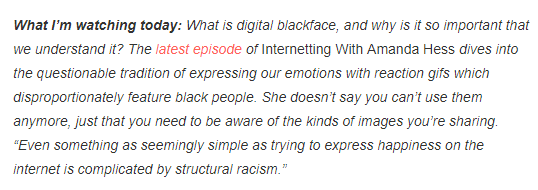
From today’s Blendle email, truly, one of the pressing issues of our time:
I tweet too much; I know that not just because of the sheer number of these short messages I’ve sent, but also because I’ve noticed over the last few years that I form thoughts in 140-character bursts. I think in tweets.

Then, suddenly this week, everyone was granted 280 characters, and we were left with screens filled with huge blocks of text instead of a few sentences. Few users are happy about the change, and more than a handful warn that it could render the social media service unusable.

Learning how to write in 140-character bursts is therefore a job skill for many in journalism, and has almost certainly changed the way writers do their work.

Twitter has changed the way we think and has changed the way we express ourselves, and by expanding to 280 characters, I fear it will become a victim of its own success. Because for all of its benefits, Twitter has also helped shorten our attention spans—which makes us even less willing to read 280-character blocks of text.

In just a few short weeks, on November 8, thousands of Americans in at least nine cities will take to the streets to “scream helplessly at the sky.” You can probably guess the reason: It’s to mark the one-year anniversary of the election of Donald Trump.
To face the sky and roar
In anger and despair
At what is going on,
Demanding that it name
Whoever is to blame:
The sky would only wait
Till all my breath was gone
And then reiterate
As if I wasn’t there
That singular command
I do not understand
Bless what there is for being
Which has to be obeyed, for
What else am I made for,
Agreeing or disagreeing?
— W.H. Auden, “Precious Five”
Given the eager acquiescence of millennials to the all-online world, Generation X has a formidable responsibility to keep faith with reality. They are the last analog generation. Raised in a prerevolutionary moment technologically, they are children of paper, books, handshakes, body language, and eye contact. They learned—even if they didn’t always practice or appreciate them—the virtues of patience, self-control, and delayed gratification. They knew what it meant to be out of contact with someone they loved. Some of them—too few—learned how to fix an engine or wire a light fixture. Most remember how quiet things used to be; how easy it was to be alone.
…So what can Generation X do to help save America? It can begin by reasserting the relevance of the flesh-and-blood world that formed it. On an individual level, this means putting the iPhone down, turning off the computer, and taking a book out of the library or visiting a museum. It means going to a movie theater instead of binge-watching a Netflix series. It means talking to your friends face-to-face more instead of mostly texting or e-mailing them. On a societal level, it means pushing back against those who blithely accept that technology can be the solution to all our social and political problems. It means adopting a healthy skepticism of millennials’ efforts to disrupt every industry, every institution, and every economy with technology and an ethos of “sharing.” It means fighting for your privacy.
Demographics are destiny. We grew up in the world and mind of the baby-boomers simply because there were so many of them. They were the biggest, easiest, most free-spending market the planet had ever known. What they wanted filled the shelves and what fills the shelves is our history. They wanted to dance so we had rock ’n’ roll. They wanted to open their minds so we had LSD. They did not want to go to war so that was it for the draft. We will grow old in the world and mind of the millennials because there are even more of them. Because they don’t know what they want, the culture will be scrambled and the screens a neverending scroll. They are not literally the children of the baby-boomers but might as well be— because here you have two vast generations, linking arms over our heads, akin in the certainty that what they want they will have, and that what they have is right and good.
The members of the in-between generation have moved through life squeezed fore and aft, with these tremendous populations pressing on either side, demanding we grow up and move away, or grow old and die—get out, delete your account, kill yourself. But it’s become clear to me that if this nation has any chance of survival, of carrying its traditions deep into the 21st century, it will in no small part depend on members of my generation, Generation X, the last Americans schooled in the old manner, the last Americans that know how to fold a newspaper, take a joke, and listen to a dirty story without losing their minds.
…Irony and a keen sense of dread are what make Generation X the last great hope, with its belief that, even if you could tell other people what to say and what not to say, even if you could tell them how to live, even if you could enforce those rules through social pressure and public shaming, why would you want to? I mean, it’s just so uncool.
In a suspicious coincidence, these two pieces appeared nearly simultaneously to argue that my generation’s sense of jaded irony is apparently the only thing that can save us from true believers who take politics and technology too seriously. Allow me to raise a skeptical eyebrow in response. But then, I would do that, wouldn’t I? Look, I’m saving the world by continuing to do what I was already doing anyway! ♫ Hey, Dad, what do you think about your son now… ♫
His voice raised in a British lilt, Robinson announces, “One of the things alt-right guys are good at is making all these weird, young, disaffected teens feel like they’re the cool ones and the left side is the boring side. We need to have that kind of thing.”
Then Robinson becomes expansive, his spoon arm swinging urgently, describing his wish for the new left in the wake of Donald Trump’s presidency. “We are the people you want to be around, we’re the fun people, we’re the cool people, the people who make life better!” he exclaims.
A cynic might suggest that signaling an image of cool sophistication is the only thing the left has going for it anymore — that, and Ghost Dancing for the return of the Great Welfare State and the disappearance of the neoliberals. Well, when you’re lacking in substantial ideas, you might as well play up aesthetics and image. Nothing says fun, cool and forward-looking like posing for a photo next to a miniature bust of Marx, if you ask me.

It’s amazing how a metaphorical cliché appropriate for rock music lyrics becomes profound when Dr. White Coat, Ph.D. uses it. “Such-and-such affects your brain like cocaine” is the “It was a dark and stormy night” of pop neuroscience writing. We need a Bulwer-Lytton category expansion to include nonfiction clickbait.
As Jenkins tells it, however, her inspiration came from Bertrand Russell — one of the founding fathers of analytic philosophy and a titanic presence at Cambridge.
“What I didn’t realize when I was studying his philosophy of mathematics was that he wrote about all these other things,” Jenkins recalls. She particularly means his 1929 book, Marriage and Morals, in which Russell advocated for what he called “free love.” Jenkins calls the book “a precursor of the contemporary sex-positive movement.”
You should be able to repeat this one from memory by now. What are the twin pillars of the utopian project? Come on, you remember, we’ve talked about it a few times. A remade economy and…? That’s right, reinvented sex. It’s the latter we’re dealing with here, in yet another article propagandizing for polyamory, soon to become the hot new sexual liberation cause. You’ve already seen several articles in this genre, and trust me, you’ll see many more in the near future, but this one stood out for me thanks to the above section. Bertrand Russell was her inspiration to start philosophizing about free love? I wonder if she made it to the part in his autobiography where he said, while reflecting on the chastening consequences of his attempts to escape the irrational cage of monogamy, “Anyone else could have told me this in advance, but I was blinded by theory.” Ploosa shawnje, ploosa la memshows, I said to myself, as I read an article in an academic publication attempting to impress me with the fact that Jenkins has provided theoretical rigor to back up her lifestyle. Oh, well, yes, I’m sure that’s why all the previous attempts of utopian communities to transcend monogamy fizzled out — they just didn’t have enough academic philosophers around to theorize for them.
The article never mentions children, interestingly enough, since they are probably the biggest obstacle to the progressive fantasy of a society consisting of multiple lovers flowing languidly into and out of each others’ lives. That would widen the focus to include questions of responsibilities, obligations, costs, and tradeoffs, and progressives are much more comfortable sticking to the narrow question of maximizing personal choice and pleasure. Most people will eventually want to have kids, and in doing so, will quickly realize, on a visceral level, the benefits of domestic stability and romantic favoritism. Free love as a romantic ideal will primarily appeal to the young and childless, but considering how much the media seem to be dominated by the perspectives of college-age gender-studies majors, we can expect to see a disproportionate amount of breathless attention paid to it.
But the collective hysteria that followed shows what happens when Nazi Germany crowds out all other history. The poverty of peoples’ collective memory and imagination is such that the first minute any politician strays from the path of universalism, commentators reach for the most shocking (and only) historical comparison they can think of.
It is tediously predictable that every progressive political setback is treated as a harbinger of incipient fascism. I have become so jaded by this that I was almost delighted to see the term “Stalin-esque purge” being used in reference to routine personnel shuffling among Trump’s advisers. Finally, a new twist on the tired old theme! You mean he’s already had tens of thousands of underlings executed or sent south to work on constructing the Mexican border wall with their bare hands on starvation rations? No? You mean this is just more absurd hyperbole from people already lacking in all credibility? At this rate, will they even have anything left by January when he’s actually sworn in?
It is a piquant irony that I, of all people, should be forced to defend small talk, a practice in which I am neither a skilled nor enthusiastic participant, but thus have the fates decreed it. I must say, my esteem for Dan Ariely has taken a plunge after reading this article, which reads as if a social engineer with severe autism has legislated that conversations become key parties.
Now, as many supercilious, antisocial adolescents have long observed, small talk is often frivolous and tedious. But like many sub-optimal practices, it has evolved that way for a reason, given the inherent difficulties of easing tensions and forging bonds with complete strangers. Ariely and Berman note that their experiment works precisely because it is structured, or “socially coordinated” — being informed in advance of the new rules governing this particular social interaction obviates the need for individuals to tentatively feel their way through it by means of light conversation. Festivals like Halloween, which temporarily subvert the normal order and expectations of social life, are also powerful and exciting for that reason, but only a freak raised in a Skinner box would conclude that we could and should routinely go around wearing masks and costumes because it makes us feel creative and liberated. Likewise, heady talk about “creating new social norms” which make all the participants “happier” based on superficial metrics is the kind of hyper-rationalist delusion one might expect to read about in a history of utopian intentional communities. A practice like this could only function in very specific situations with clearly-understood rules; blurring the boundaries between random strangers in public and PostSecret is not likely to end well.
The unexamined axiom here is that deep, profound conversation is what we all truly desire on a ritual basis, and if only the inefficiencies of the oppressive system were removed, we would blossom in our natural, uninhibited state. But perhaps bad faith is our natural state. Perhaps we secretly appreciate shallow living while making occasional aspirational gestures toward deeper meaning and significance. Perhaps the forced intimacy of Ariely’s dinner party would be an unwelcome mirror and harsh light to our self-image. Only the most naïve idealists go around overturning rocks that have been secured in place for ages and expect sunshine and charming melodies to come forth.


I mean, I get it. Really, I do. It’s tough to be a progressive. Always trying to find some new angle, some novel way to put yourself in the moral vanguard. It has to be exhausting, running around like Mencken’s definition of a Puritan, telling everybody that they’re doing everything wrong (and for shameful reasons to boot). And as fewer and fewer people bother to take you seriously, you start becoming desperate, trying to find a previously-overlooked source of sinfulness that will make them pay attention again.
And so here we are. While I’m sure that, like most of their pathetic outbursts, it’s best to just ignore this, I have to admit that I don’t consider this sort of outright blasphemy against my lord and savior to be amusing. I suddenly have a strong urge to join the NRA, buy an AR-15, and take a selfie in front of my AC unit, daring them to come and take both. Some arguments just deserve nothing but trolling in response.
Evgeny Morozov once dismissed a book by Jeff Jarvis with the acerbic one-liner, “This is a book that should have stayed a tweet.” Neil deGrasse Tyson hasn’t written a book, merely a Facebook post, but still, the same principle applies; he should have just left things well enough alone.
What I find most interesting is that Tyson helpfully links to several critical articles written in response to his original tweet, from which he apparently learned nothing. Like Mr. Magoo blithely traipsing across the yawning chasm of the is/ought divide, he somehow manages to arrive at the proposition — offered, as far as I can tell, in all seriousness — that in his utopian state of Rationalia, we might create an “Office of Morality” (because “Ministry of Truth” was apparently already trademarked) where moral codes can be debated and settled. Perhaps these new morals can be enforced by an equally-innocuous-sounding agency, like, say, the Committee of Public Safety, or some such. Had Tyson bothered to study the, uh, evidence accumulated thus far, he might have realized that Brian Carnell’s vision of the glorious future much more closely resembles what we’ve learned from empirical observation.
There are many things to laugh at in this Marxist rant about the counter-revolutionary wrongthink of Pokemon Go, but after some tough deliberation, I think this has to be my favorite part:
The map of your neighborhood you see when you play the game is a GPS map, something originally designed to help steer guided missiles.
It’s just so…so…mwah!… so gratuitous, so out of the blue! I mean, you expect to see theoretical jargon, you expect to see references to Marx and Heidegger, and you expect, oh my Lord do you expect to see the writer fuming about the way in which the bovine masses prefer their false consciousness and commodity fetishism to their revolutionary potential, but nothing so perfectly paints a picture in words of the futile pounding of tiny, ineffectual fists as this little aside. It’s like he had a sudden attack of self-awareness, realized the absurdity of being forced to labor in the clickbait factory while holding onto a faint hope of salvation through a discredited religion, and made one last, desperate attempt, through some kind of Six Degrees of Kevin Bacon-logic, to halfheartedly fling some shit against the walls of the system in the hope that something finally sticks. Yeah, man, I was ready to write you off as just another doctrinaire leftist with all that talk about changing the experience of reality from alienation to liberation, but that point about GPS, man, that really made me think, you know?
The isolating ideology of wellness works against this sort of social change in two important ways. First, it persuades all us that if we are sick, sad, and exhausted, the problem isn’t one of economics. There is no structural imbalance, according to this view—there is only individual maladaption, requiring an individual response. The lexis of abuse and gas-lighting is appropriate here: if you are miserable or angry because your life is a constant struggle against privation or prejudice, the problem is always and only with you. Society is not mad, or messed up: you are. Secondly, it prevents us from even considering a broader, more collective reaction to the crises of work, poverty, and injustice.
Well, that’s certainly one possibility, that there’s an ancient neoliberal conspiracy, stretching all the way back to the Stoics, to keep us from rising up collectively and smashing the ruling class by deflecting our attention toward small, personal efforts at self-improvement which pose no threat to the system. But if the amount of liquid oppression in the glass of society is equal to half its volume, then it depends which part you choose to emphasize. Alternatively, it could be that you’re just a congenitally miserable crank whose entire laughable, clichéd ideology is merely an attempt to transfer responsibility for your contentment to the rest of society. It might even be that your pose as the world’s whiniest bodhisattva is less genuine concern for all the suffering beings in the world and more a means of making millenarian fantasies such as, uh, “the end of patriarchy and the destruction of the money system” the necessary conditions for your happiness, thus conveniently guaranteeing that you’ll never have to stop complaining, and never have to risk being crestfallen should it turn out that all your revolutionary reveries came true and you were still unhappy, leaving you with no more excuses. Finally, there’s the troubling likelihood that most people have considered, yet still reject, your false dichotomy of individual vs. collective well-being in favor of trying to strike some sort of imperfect balance between the two. Everything in moderation, as some damned neoliberal Greek once said.
Lydia DePillis interviewing Ralph Nader:
What about something like Black Lives Matter, which I think has made quite an impact on the discourse?
Yeah, but how far does Black Lives Matter go? Is it raising money for offices and permanent staff? It’s like Occupy Wall Street. They had the same technology. It gets you to first base, and it doesn’t get you further.
Well, what if it serves a purpose in the moment — which is to make an impact on the debate — and doesn’t carry on as an institution?
OK, well, there’s a negative, which is demoralization when they can’t get there. You’ve already seen that with Black Lives Matter. They’re so sensitive to injustice, and then they don’t see any response to their work.
It’s like an unwitting caricature of millennial politics. The empty jargon about having an “impact” on the “discourse” which would fit interchangeably in either the academic or corporate TED-talk settings. The perplexed inability to imagine why viral videos, likes and retweets wouldn’t change the world.
Oh, well, there’s always more impotent fantasies of cleansing violence. Wait till Generation Safe Space learns that tear gas, truncheons and stun guns don’t require affirmative consent.
#BathroomWars 2020: Otherkin who identify as dogs challenge public urination bans b/c they should be able to piss on fire hydrants
— Cathy Young (@CathyYoung63) May 25, 2016
I laughed because I thought she was just joking, but literally two minutes later, I saw this.
A few years ago, politicians in Berlin made headlines for their attempts to bring gender equality to their city’s crosswalk signals. They wanted to create an “Ampelfrau,” or “traffic light woman,” a female counterpart to the iconic “Ampelmann” invented in East Germany in the 1960s. It became clear right off the bat that Ampelfrau would be laden with biases and complications that Ampelmann escapes. In her motion requesting Ampelfrau, Social Democrat District Leader Martina Matischok-Yesilcimen specified that the figure should represent a self-assured, modern-day woman, yet without any “sexist stereotypes” — meaning no ponytails or skirts, and definitely no high heels or mini skirts — according to the Local.

Sofie, Ampelfrau and other female-designed crosswalk symbols do challenge a male-centric worldview just by existing. They occupy a crucial space in our roadways, where we are required to look at them in their skirts and ponytails, reminding us that there are people besides men and perspectives besides men’s perspectives. However, they simultaneously highlight the difficulty of dismantling that worldview.

For Wade, creating female crosswalk icons — even if it requires us to use imperfect, clichéd markers of femininity — is inherently valuable because it challenges the male-centeredness of our public space.
“It would force men to see themselves in that ‘walking woman,’” she says. “That is actually a really profound thing, because it requires men to see female people as human beings, just like they are.”

So are Amersfoort, Valencia and others wasting (albeit minimal) resources on feminized crosswalk signals? Are these cities attempting to treat a symptom of sexism and hoping it will cure the disease?

So if there is a perfect feminist crossing signal design, we may have many more streets to cross before we find it.
