Here’s what I have to say about Rachel Dolezal. The fact that her story hit the news almost immediately after the media feeding frenzy over Caitlyn Jenner, as if designed to throw them into sharp contrast with each other, is clear, unambiguous proof of the existence of a trickster deity who loves us and wants us to be happily amused.
fresh hell
If All You Have Is Critical Theory, Everything Looks Like Subtext
The dull success of Pharrell’s 2014 track “Happy” wasn’t just down to its repetitive lyrics or its adherence to the saccharine pop-hit formula, but also because it tapped into this ideological hegemony. When Pharrell sings that “happiness is the truth,” he is, in fact, making a profound ideological statement, and one that accords with much that neoliberalism implies. Our immediate physical reality, Pharrell instructs, is unimportant. What matters is how individuals interpret and react to it. We have the agency to choose, our politicians and pop singers tell us, and thus the logic of the market is extended beyond the realms of commodities and services, engulfing our emotional states, too.

Summer is truly the silly season. A few years ago, the latest Batman was said by the Zhdanovite hacks at Salon to be promoting anti-OWS propaganda. Last summer, before Pharrell moved on to insidiously making neoliberalism sound wikked kewl to teenagers, he and Robin Thicke were being accused by hysterical ninnies of providing the soundtrack to rape culture. This year, the memo apparently went out to idiots everywhere telling them to conduct inane debates on whether the new Mad Max is a feminist movie or not. So, overanalyzing banal lyrics? Sure, why not, let’s go stupid hard or go stupid home.
However, if we’re going to salvage the money our parents spent on a liberal arts education by pressing feel-good pop songs into service as political vehicles for carrying ideological instructions the way dump trucks haul gravel, let’s not settle for the drastically foreshortened perspective of critical theory, I mean come on. This conflict dates back to far before late-twentieth century economics. It is abundantly clear to me that Pharrell is best conceived of as the Marcus Aurelius to Bobby McFerrin’s Seneca, with these latter-day Stoics most productively located in theoretical opposition to rival visions of the good life such as the Spartan militarism embodied by Manowar, the decadent, Elagabalus-style hedonism of Lil Wayne, the Cynical provocations of GG Allin, and the Caligulan, megalomaniacal egoism of Kanye West.
Thoughtcriminal Background Check
Seems like just yesterday* the Internet was moaning in ecstasy as Trevor Noah, the heir apparent to the Daily Show throne, expertly stroked its cosmetic-diversity G-spot. Now it transpires that he’s a serial social media thoughtrapist preying on Jews and people of girth. Just when you think you know a fellow. **
* It was just yesterday.
** I don’t know anything about him.
Never Met a Wise Man; If So, It’s a Woman (Slight Return)
Research has found that women are superior to men in most ways that will count in the future, and it isn’t just a matter of culture or upbringing—although both play their roles. It is also biology and the aspects of thought and feeling shaped by biology. It is because of chromosomes, genes, hormones and brain circuits.

All wars are boyish. People point to Margaret Thatcher, Indira Gandhi and Golda Meir as evidence that women, too, can be warlike. But these women were perched atop all-male hierarchies confronting other hypermasculine political pyramids, and they were masculinized as they fought their way to the top. There is every reason to think that a future national hierarchy staffed and led by women who no longer have to imitate men, dealing with other nations similarly transformed, would be less likely to go to war.

As women come to hold more power and public authority, will they become just like men? I don’t think so. Show me a male brain, and I will show you a bulging amygdala—the brain’s center of fear and violence—densely dotted with testosterone receptors. Women lack the biological tripwires that lead men to react to small threats with exaggerated violence and to sexual temptation with recklessness.
Perhaps it is time for us to consider returning to the hunter-gatherer rules that prevailed for 90% of human history: women and men working at their jobs, sharing, talking, listening and tending children. Men didn’t strongly dominate because they couldn’t; women’s voices were always there, speaking truth to male power every night around the fire. There was violence, and it was mainly male, but it was mostly random, accident more than ideology.

Specific yuks aside, there’s a couple things that are meta-amusing about this. One, it’s funny to see the WSJ, of all papers, blatantly trolling its own readership with articles you’d expect to see on the HuffPo. Two, I remember decades ago seeing mediocre stand-up comedians play with the conceit that women would make the world more peaceful and efficient. But the spirit of our age is such that, if you add in a smattering of neuroscientific buzzwords, those old jokes are suddenly fit to print as serious think-pieces.
I Cried Because I Had No iPhone, Then I Met a Man Who Had No Personalized Emoji
“If you say you’re going to diversify, why not add a few red-haired emoji in the mix?” asks Emma Kelly, the site’s proprietor. “Natural redheads may be rare at less than two percent of the world’s population, but that is 138,000,000 iPhones waiting to happen.”
Kelly isn’t the only advocate who says hair is the next frontier of emoji diversification. Writing at the Guardian, Rhik Samadder noted that there are no emojis for beards or afros. Survey the list of humanoid emojis, and the hair is mostly black, brown, and straight.
No beards?! Okay, I retract my earlier sarcasm. This is serious.

Yeezus Christ Pose
Being a Kanye West defender in 2015 is a thankless task. Yeezy makes it hard: he’s frequently offensive and (I’m told) deeply unlikable. He’s been called arrogant, narcissistic, materialistic, pretentious, rude, insensitive, and insane. But this is exactly why I like him.

Kanye West keeps making points that are more or less correct. But to avoid engaging with those points, the media draws focus onto his personality. We call him a crazy man so that we don’t have to hear what he’s saying.

Kanye can mess up. Feminism, particularly, tends to be something he stumbles over. While he very vocally defends Kim and Beyonce from all critics, he also portrays women in his songs as sexual territory to be claimed in battles between men (“I’ll fuck your Hampton spouse / come on her Hampton blouse,” etcetera). His most recent comments about his ex, model Amber Rose, are a good example of how Kanye can slut-shame and objectify with the worst of them. I should be outraged. I am disappointed. But where some may see irredeemable misogyny, I see something more like human complexity. Admittedly, being a white woman flavors my reactions. As a man of color, Kanye is both privileged and oppressed.

If you are political in public, you too will experience some tiny fraction of what it is to be Kanye. Everyone who writes about oppression online knows the baiting, the casual abuse, and the desire for something your enemies can use to craft an unflattering narrative. Feminists online are subjected to such harassment that many are beginning to retire. You know who hasn’t retired? Kanye West has never once been shut up by public disapproval, although the public has disapproved of him, loudly, for over a decade.

There Goes the Neighborhood
“Always remember, young ‘un”, my grandpappy used to say as he bounced me on his knee, “it’s no coincidence that ‘semiotics‘ and ’emoticons’ are damn near anagrams.” Wise words, indeed:
But with new edition, emoji commentators (myself included) asked: Where are the emoji for people of color? For while there were hundreds of emoji, and more than 100 different representations of human bodies or faces, nearly all were white or a “neutral” yellow. Only two—an apparent East Asian boy, and an apparent South Asian man—seemed to be people of color. There were no non-white women whatsoever, and no black people.
Then, in November of last year, the Unicode Consortium made a quiet announcement in its draft of the new Unicode standard. Different skin tones would be introduced to the emoji standard through a toggle board: A user could click and hold on an emoji while typing it and a menu would coming up, letting them type it in one of five skin tones. (The tones correspond to the Fitzpatrick scale, a numerical method of categorizing human skin pigmentation.)
“People all over the world want to have emoji that reflect more human diversity, especially for skin tone,” said the draft.
Great. Without the background context consisting of the shared, unconscious assumption of white supremacy, how are my friends and I supposed to communicate with whimsical symbols of basic emotions now?
Now, anyone can make the easy joke about how, even as we speak, sites like Salon, Alternet, Vox and the like are in a race to see who can be the first to publish an article about how white privilege is being able to take for granted one’s majority status in a crowded room full of emoji. I, on the other hand, prefer to stalk bigger game. I’m shielding my eyes and looking toward the horizon, anticipating the inevitable article analyzing the phenomenon of white flight from emoji use, dating back to this policy change. For that one, I think we’ll need the New Republic, or maybe the Atlantic itself.
One Day There Will Be Associated with My Name the Recollection of Something Frightful
“Ooh, baby, I’ll love you better/Wanna be with you night and day…”
Familiar enough to catch my attention, wrong enough to make me focus. That mismatched rhyme scheme… “I think you mean, ‘Baby, I love your way’“, I said. She was skeptical, so off to Google we went. A few seconds later, we were looking at Peter Frampton videos on YouTube. She relented. “Hmpf. Fine, you were right.” As a conciliatory gesture, I admitted that I didn’t know Frampton had done it originally. My first experience of the song was in high school, when some pop band had done a cover of it, with a section from, of all things, Lynyrd Skynyrd’s “Free Bird” grafted onto it.
In the pre-Internet days, it would have mercifully ended there. I didn’t remember the band’s name, and it wasn’t worth the trouble to try to find it. But Google’s omnipresent search bar sits right there, beckoning. A portal to things best left unseen and forgotten. And so, by adding “free bird medley” to our original search, we found ourselves face-to-face with it. And now, because we’re all in this together, you’re going to see it too:
Eight seconds in, you’ll notice something awfully incongruous for an ’80s pop video.
I hadn’t given any thought to the band’s name, assuming it was just a cool-sounding phrase they had heard in a deracinated form somewhere else in pop culture. Suddenly, it seemed ominous. Off to Wikipedia, where my suspicions were confirmed: “He chose the name Will to Power for the group as an homage to German philosopher Friedrich Nietzsche’s theory of an individual’s fundamental will to power.”
Judging by the mustache he sports in the video, the band’s name wasn’t the only homage.
Nietzsche has been accused of being a formative influence on fascism, postmodernism, conservatism, and who knows how many other -isms, with varying degrees of accuracy. His influence on ’80s soft-rock, though, has hitherto been unacknowledged, a shame too secret for academic historians to face. Frankly, I don’t know how I can defend him against this. I’m going to need time to reconsider his philosophy in light of this new context.
She broke the stunned silence. “I was just trying to be romantic!” I know, my dear. But still…

Somebody Else Calls It the News, But That’s Yesterday’s News
Oooh; what he did there, I see it! 1992, you see, that’s when the Crowes were last culturally relevant, when they last had big hits on the charts. If your songs aren’t in the Top Ten Most Tweeted, why would you even want to go on living?
Oh, A.V. Club. That’s just so…so…you.
I come neither to praise nor bury the Black Crowes. I’m just somewhat perplexed by the way in which “relevance” has become so prominent in arguments over taste (and trust me, dismissing an artist for perceived irrelevance is a constant theme at the A.V. Club, where noting “This artist has unsurprisingly declined in popularity over the years!” is an endless source of amusement), when I would have assumed it to be the commonest of sense that relevance is just another word for “fashionable”, and neither word tells you anything about the integrity or lasting value of art. Mostly, though, I’m just struck by the laziness, if anything, the way in which a writer for a pop-culture geek site with pretensions of critical respectability, when he has nothing else to say yet feels compelled to say it, falls back on the reflexive sneer, the defensive irony. God forbid anyone get the impression that he might be reporting on this little bit of music news in earnest, as if he or anyone else might actually care!
Freddie was right about these people; their recurring nightmare is that one day, the music will stop and they’ll be the ones left standing without a seat, and everyone else will point and laugh uproariously at them, and they’ll look down and see that they’re naked — naked in the sense that everyone can see exactly what cheesy music and films they like and what they only pretend to hate, and as they stand there trembling, wishing for a blanket of jaded detachment to cover up with, they’ll hear someone say the words that cut them to the bone: “Ohmigawd, how completely uncool!” What a sad, perpetually adolescent way to go through life.
A Philosopher for Everyone and No One
Despite all the varying interpretations, however, a general trend holds true: whatever Nietzsche was, he is not easy to categorize politically. In fact, it seems that it is precisely because of all these different Nietzsches that the only consensus that can be manufactured out of this diversity is that Nietzsche must be regarded, in some sense, as uncategorizable. Nietzsche is obviously not a socialist, nor a leftist in any conventional sense, nor certainly not a liberal, and, of course, Nietzsche is not a conservative.
Or is he?
Dunh-dunh-dunh! Thus begins the latest round of “Pin the Ideological Tail on Nietzsche.” Personally, I would recommend against playing that game. It’s an awful lot of motivated reasoning to go through for very little payoff in terms of genuine understanding. Besides, I think a trifling website like Salon has a trademark on these kinds of “Historical Figure X would totally have voted for Y” cotton-candy essays; you might find yourself slapped with a lawsuit for infringing on intellectual property rights.
Averbeck notes that both right and left seem united in agreement that Nietzsche, whatever else you want to say about him, was not “conservative” in any meaningful sense, but rather than taking this as a strong hint that her tendentious revisionism should just be allowed to die in the crib, she chalks this up to some sort of academic elitist stranglehold on the Nietzsche-interpretation industry. Well, as I’ve said many times, I’m just a nobody with a high-school diploma, and I’d also place this concept in “not even wrong” territory. Was there anything cautious, sober and restrained about his writing? How many examples would suffice to illustrate his incompatibility with conservatism’s major themes? Hell, is there really any usefulness in proceeding as if “conservatism” has always meant the same thing, been concerned with the same issues, whether in late-18th-century Britain, late-19th-century Germany, or early-21st-century America? Or does “conservative” mean little more than “here there be dragons” on this particular intellectual map? (Actually, given Corey Robin’s fatuous roster of conservative all-stars approvingly quoted by Averbeck, that might not be too far off; more on that in a moment.) Like Brian Leiter said, he was primarily concerned with questions of value and culture. Political considerations per se were simply absent from his work.
Anyway, whatever. People who consider taxonomy more important than context and understanding aren’t worth the trouble to argue with. Besides, I’ve had a lingering cold for a couple weeks and don’t have the energy to get exasperated over this.
So, I outsourced the exasperation to my buddy Arthur:
Where to start? How could you even begin to un-fuck this piece of U.S. Intellectual History twaddle? First of all, taking seriously, even if in the case of Nietzsche taking exception to, (Corey) Robin’s book, which states at the outset: “I seat philosophers, statesmen, slaveholders, scribblers, Catholics, fascists, evangelicals, businessmen, racists and hacks at the same table: Hobbes next to Hayek, Burke across from Palin, Nietzsche in between Ayn Rand and Antonin Scalia, with Adams, Calhoun, Oakeshott….”
Burke, champion of the American Revolution, bitter enemy of Colonial exploitation in the person of Warren Hastings, champion of the Irish, the man who prophetically saw the seeds of totalitarianism in the Jacobins with their template combination of violence and propaganda, is seated at the same table with the intellectual powerhouse, Sarah Palin, and with “the fascists,” “slaveholders,” and “scribblers”? (“Scribblers” really sets the tone here: we’re obviously on the intellectual high ground.)
Surely this book is a parody, a joke? No one would seriously sit down and write a simple-minded hyper-PC piece of propaganda and mean it, and get it published, and receive po-faced reviews? And surely this article is meant as a Nietzschean joke? The author is reluctantly compelled by intellectual honesty to conclude that Nietzsche is “still some kind of conservative.” Note the rigorous qualifier, the crucial philosophical nuance… Some kinda…
Who the fuck are these people, who don’t even feel the need to define “conservative”? They just utter it like the most self-evidently damning imprecation, like a Calvinist crying, “Satan!” The simple-mindedness is breathtaking.
And how carelessly do you have to read The Closing of the American Mind to come away with the idea that Bloom viewed Nietzsche “as a threat that had to be vanquished”? How many times in that book does Bloom express the deepest respect for him as a great philosopher, perhaps (with the exception of Heidegger, in his view) the last great philosopher? His whole point is to contrast the gravitas of Nietzsche announcing the death of God and the consequent un-groundedness of values with the shallow, glib nihilism of his American successors and soi-disant disciples, who take the death of God to mean the world is a shopping mall where you mix-and-match any old values that catch your consumerist fancy?
And the idea that Nietzsche was primarily concerned with culture and the seriousness of the esthetic aspect of life is just not on the table—all estheticism is bourgeois estheticism: case closed. “The birth of the Reich [1870] was the death of German culture.” Nietzsche despised politics in general. Apolitical? Does not compute. You’re either a faux-Leftist or a cartoon-devil Conservative.
Here’s the late, iron-lunged Deleuze:
It is his [aphoristic] method that makes Nietzsche’s text into something not to be characterized in itself as “fascist,” “bourgeois,” or “revolutionary,” but to be regarded as an exterior field where fascist, bourgeois, and revolutionary forces meet head on. If we pose the problem this way, the response conforming to Nietzsche’s method would be: find the revolutionary force. The problem is always to detect the new forces that come from without, that traverse and cut across the Nietzschean text within the framework of the aphorism. The legitimate misunderstanding here, then, would be to treat the aphorisms as a phenomenon, one that waits for new forces to come and “subdue” it, or to make it work, or even to make it explode.
Never mind the fact that I’m no fan of Deleuze anymore, and find his use of the word “revolutionary” absolutely facile, as it is with all modern Leftists except those who “seriously” advocate the violent overthrow of Capitalism, etc., and then you’re talking about a clown named Zizek, who I’m sure secretly—or not so secretly—laughs at his own huxterism and the ease with which he puts it over on the Lumpen-Left. (He’s a Communist, says Eagleton proudly. What, you mean he spouts Communist rhetoric, that makes him a Communist? Of course, the world is just one big talk show, and Zizek’s act is “I am a Communist.”)
But it’s also Deleuze who includes Nietzsche in a trinity of thinkers who have been crucially influential on modern thought, along with Marx and Freud. The reason Nietzsche still has a future, while Marx and Freud belong to the past, he points out, is that Marx and Freud were obsessed with building institutions, with indoctrinating people with their ideas, and in doing so they mummified those ideas into dogma suitable for creating simplistic movements and schools—which proceeded to discredit ideas that were already self-discredited by their own dogmatic arrogance. Nietzsche’s thought, on the other hand, never dogmatized itself, was and remains mercurial and up for grabs. Yet there is a fundamental gravitas, an anguished human concern and an awareness of the stakes, that keeps him from being a dilettante—as Bloom illustrates brilliantly, in my view.
Then there’s the last little bit of twaddle—so it’s elitist of the academic elite to adjudicate whether or not Nietzsche was conservative? VIRTUE-SIGNALING ALERT. HYPOCRISY ALERT. That’s what makes sanctimonious liberal puritans continually feel like they’ve stuck their finger in a light socket when they read Nietzsche. He, unlike them, is avowedly an elitist. Nietzsche never tells lies, never uses euphemisms, never tries to win points for being good. He never sugar-coats, in fact, delights in putting his case in the most extreme, provocative way. That’s the scandal, not his imaginary connection with the Nazis or, much more seriously, Loughner! (It’s also God’s fault that thousands have murderers have claimed He told them to pull the trigger, right? God is very conservative.)
And Nietzsche, after all, was trying to transcend all values, right?
Uh, wrong. First of all, Nietzsche very deliberately used the word “overcome” to avoid the religious baggage that “transcend” carries. Second, he did not propose “transcending” all values, anything but. “Man is the value-making animal.” We can’t help creating values. We would rather will nothingness than not will at all. The point is that we have to be courageous enough to posit values in the absence of any metaphysical grounding or sanction from God. We have to commit ourselves to those values while knowing that they are just that—values and not eternal verities, Platonic Ideas existing somewhere outside of this world. And for Nietzsche some values are obviously better than others: life-affirming values, including the ultimate affirmation of one’s existence that wills its eternal return.
Buzz Lightweight
Mark Marino wants to shake up academic publishing. To declare his intentions, the associate professor of writing at the University of Southern California chose a format both fitting and provocative: a BuzzFeed listicle.
Posted on Thursday, Mr. Marino’s piece, “10 Reasons Professors Should Start Writing BuzzFeed Articles,” serves as a “manifesto” for BuzzAdemia, a new journal he’s creating to encourage “BuzzFeed-style scholarship.”
To banality and beyond! I shared this with Arthur for the lulz, and he responded:
Good idea, but they’d better start improving their writing style: be deep, but make it snappy, is the Darwinian directive, or else large numbers of the academic species will be eliminated by the competition. How catastrophic! Will self-referential pedantry survive the epochal shift from academe to acadeMEME? Who gifs a damn!
He then asked if I had been click-baited into the linked article explaining post-structuralism by means of hipster beards. I hadn’t, so I went back and checked it out, and, you know, I have to say, I’m all in favor of this idea now. Stripped of all the mystifying jargon, it’s somewhat bracing to see just how trite these struc/post-struc “insights” really were.
All Those Red Marks on Our Shoulders, Self-Back Patting, Homemade Trophies
But the real key here is that “social justice warrior,” in this context, refers to browbeating, moralistic behavior, much more than any coherent or credible ideology. It is a largely American phenomenon in which those with a Puritanical disposition, but a secular viewpoint, use vague social and political stances as a platform for moralizing and witch hunting. Basically, imagine if Pat Robertson or Jerry Falwell had been born into a family of coastal liberals in 1990, and you should get the idea.
There is the further implication that the SJW does nothing to help real people. “Social justice warrior” is meant in the same vein as “keyboard warrior.” It is not a precise term and it is kind of a stupid one, but that is the term we have. You can agree with the characterization or disagree, but this what people from gamergate and elsewhere have in mind when they make reference to social justice warriors.
Social justice warriors are drawn to causes involving race, gender and sexual orientation. But only some people who are drawn to those issues are SJWs. For the SJW, the appeal of these issues draws from the fact that one of the greatest stigmas one can carry in contemporary culture is to be labeled a bigot. Compare where Donald Sterling or Michael Richards wound up in the public eye to the outcomes for other celebrities who have, say, been involved in killing someone, like Matthew Broderick, Ray Lewis or Vince Neil.
By declaring themselves the authorities on these subjects, social justice warriors are able to claim the right to administer the scarlet letters associated with them: racist, sexist misogynist, homophobe and so on. This power, to declare their moral superiority over others, is what motivates them. The stereotypical SJW has little to no interest in the suffering of classes that are not linked to scarlet letters. Victims of unjust wars, for example, or the homeless, or nerds.
We can see the overlap with the hipster easily. Both types are driven by a desire to feel more enlightened, intelligent and generally superior than those around them. “I eat better food than you do, I dress better than you do, I listen to better music than you do and you are a racist who approves of rape, while I am not.” It fits together quite nicely.
Brian sends me occasional emails. Most of them are along the lines of “Gee, Damian, you’re my all-time hero. What can I do to be more like you?” Or, “Wow, Damian, your post today was the best one you’ve ever written until the next one you write!” But along with the fawning sycophancy, he’s sent me a few links to Ruthless Reviews articles, including this one, which happens to be one of the best summaries of Gamergate and the satellite issues in orbit around it that you’ll ever see. It is quite long, and could probably have benefitted from some editorial pruning, but still, it’s worth your time and you should check it out. One little excerpt doesn’t nearly do it justice.
U Got That Look
I can’t help but wonder also if this public display of raw masculinity isn’t also a reaction to the relative decline in male power in American life and culture. As girls beat boys in school, and as women increasingly beat men in college, and as women out-pace men in vast swathes of the economy, and as old patterns of allegedly sexist male culture are policed and patrolled with ever-greater assiduity, the beard and the old-school manliness of the lumbersexual become new ways to express masculinity which cannot be denigrated or dismissed as sexist. It’s a way to reclaim manliness without running afoul of the new prophets of gender justice.
It’s s strange feeling to be ambling along for however many years, just doing my unremarkable, un-self-conscious thing, only to wake up one day and discover that certain tastemakers and media outlets have suddenly pronounced it to be a thing. Complete with an ideological stance, even! I knew there was a reason I kept those flannel shirts from twenty years ago; I just thought it was because they were so soft and comfortable and made to last.
Me, I was devastated years ago by the loss of my youngest dog to lymphoma, and in my grief, I happened to let a few weeks go by without shaving. As I returned to equilibrium, I decided that I greatly preferred the way I looked with a beard and decided to keep it, and so I have done. I wish I could pretend it had a more exciting genesis than that, but at least I’ll still like the way I look with it long after the politically-bearded have moved on to different fashions.
And what about that suddenly-fashionable appearance of mine? Well, according to the correspondent who recently sent me this picture from a beard site, I bear a “striking resemblance” to this guy:

Hmm. Well, the build and hairstyle are pretty much the same. My eyes are normally a little wider than that. I’m not as visibly tattooed, though, and my hair is a blend of ash-blond and light brown rather than red. And he’s probably a month or two ahead of me in the beard-length department. But yeah, I could probably strike a very similar pose, so I’ll accept it and be flattered by the comparison! I mean, that’s one handsome dude. Why, I could possibly even go a little gay for a fine-looking fellow like that. What? I could. Just a little bit, you know.
Howard: If I don’t get some action soon, I’m going gay.
Vince: What? You?
Howard: What’s so funny about that?
Vince: You are the LEAST gay person I’ve ever met.
Howard: I COULD go gay. You’ve got me all wrong. I could go gay like THAT, sir!
Vince: You can’t just go gay! It’s not like buying a ladder!
You Say You Got a Real Solution, We’d All Love to See the Plan
Oh, I’ve been workin’ like a rented mule. I could use some comic relief:
For the past year Brand has been airing his views on the Trews (or the True News), a daily YouTube broadcast. In recent weeks, he has discussed democracy in Hong Kong, the importance of embracing real politics by ignoring Westminster, and whether Obama should give back his Nobel Peace prize. In the book, his conclusion is simple: capitalism is kaput, celebrity charity won’t plug holes, revolution is the only solution. Yet it also feels like a bit of a cop-out: he insists all this can be achieved through love, peace and understanding.
Would he ban private education? “Yes.” And private health? “Yes.” He would “cull corporations” after they have served their purpose. Does he really believe all this can be achieved without coercion? “Yes.” How? “By focusing on the important issues. We’re not even talking about moderately wealthy people – we’re talking about a society so unequal, so ludicrous, that 85 people have as much money as the 3.5 billion poorest in the world.”
…He grins like a shark. “Yeah, I love it out here. This is where I belong. When I look at them Eton-educated people that govern us, I ain’t afraid of those people. I am excited. I’m going to enjoy this like nothing else, because for once I’m on the right side of the argument. And this is the right time. I feel it. I feel it. The means exist.”
I ask if he normally talks so fast. “Yes. Yes. So now, why I’m excited and why I endorse not voting, is because the farther politics drifts to the right, the better it is. Good. Antagonise people. Let’s get to the point where people are no longer just satisfied with iPods, iPads, iWatches. To the point where people go, ‘I’ve had enough.’” Is he advocating rioting? “It doesn’t have to be through rioting. It can be through total disobedience, non-payment of taxes, non-payment of mortgages.”
…Another man approaches: “Got any spare cash?”
He hasn’t, because he’s celebrity royalty. “I ain’t got a penny, mate. You got any money, Simon?”
Brilliant, I say, digging into my pocket. I’m interviewing you about the revolution and you’ve not got a couple of quid to give to this fella.
As Brand talks to the homeless man, the posh boy says Brand has got a touch of Marx, Che Guevara and Jesus. “But really, parallels shouldn’t be drawn because he’s in a league of his own.”
Hmm. I think I’d go for the John Lennon comparison instead. I could totally see Russell protesting a war by staying in bed for a week, or singing “Imagine no possessions” while owning an air-conditioned closet for his fur coat collection.
As amusing as Brand is, it must be said that his is just the kind of mostly-inoffensive naïveté you expect of entertainers. I’m more incredulous at the fact that the Guardian considers this kind of thing important enough to devote a lengthy article to. I tend to read them, especially their Comment Is Free section, primarily to make myself feel better about the vapid state of American media.
What a Bellend We Have In Peezus
As longtime readers know, I have always been uncomfortable with the progressive enthusiasm for silencing and marginalizing dissenters and opponents. In a neoliberal age, of course, we’re happy to let market forces do our censoring for us, because, hey, it’s only a problem if it’s the government trying to shut you up. At any rate, the point here is not to rehash that debate, just to note a different flaw in my argument: in order to convince people to adopt a more generous spirit of free speech, one would have to appeal to people who actually cared about principles, who aimed for consistency, who felt troubled by looking like the most brazen hypocrites. But you can’t shame the shameless:
Ethical journalism is not about silencing people who disagree with you — this is a censorship campaign, pure and simple. We can see through your mask…and boy, do you make it easy.
It’s not fair when our tribal opponents use the advertiser boycott to their advantage and succeed at it! Only we righteous ones get to do that! This man has all the intellectual conviction of a windsock.
But wait! There’s more!

“Those people are a bunch of rapists.”
“Rapists?!”
“OK, phonies. Same thing, really.”
You know, if I honestly believed that sexual assault and rape were nearly-invisible epidemics, I would be furious at seeing imbeciles like this frivolously throwing the word “rapist” around as a loose synonym for “people I dislike”. If I found myself doing this in a moment of madness, I would be aghast at the thought that I might be undermining a cause I care deeply about through my selfish stupidity. But it would be prematurely cynical, in my view, to suggest that this proves that Peezus doesn’t actually believe his own bullshit, let alone care about it. I think he does care about what he imagines is a widespread social wrong. I think he’s just too stupid to realize he’s not helping.
Leaders of a Revolution of Compassion
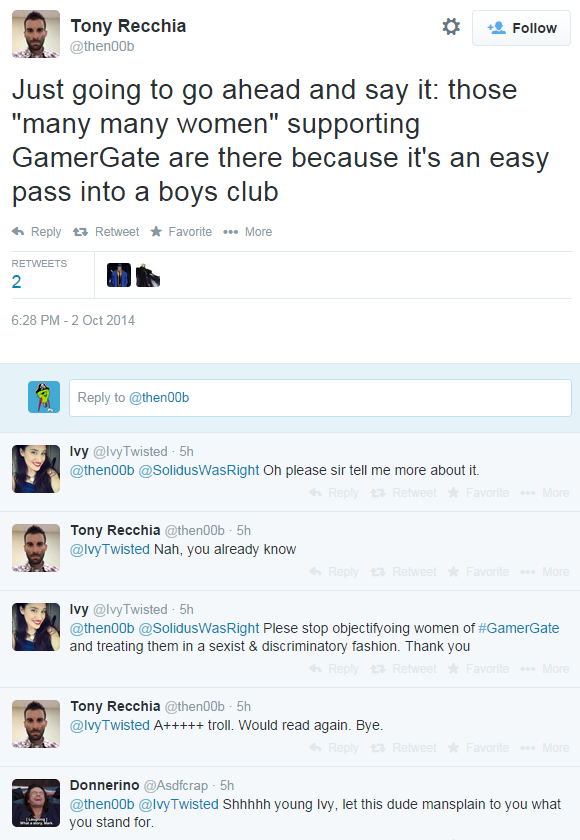
How irresistible it all was, an elite shortcut to political influence. In the ordinary world, outside the universities, such youngsters would have had no way of gaining attention. They took as their models Mao, Castro and Che Guevara, promoters of equality, if you please, but surely not themselves equal to anyone. They themselves wanted to be the leaders of a revolution of compassion. The great objects of their contempt and fury were the members of the American middle class, professionals, workers, white collar and blue, farmers — all of those vulgarians who made up the American majority and who did not need or want either the compassion or the leadership of the students. They dared to think themselves equal to the students and to resist having their consciousness raised by them. It is very difficult to distinguish oneself in America, and in order to do so, the students substituted conspicuous compassion for their parents’ conspicuous consumption. They specialized in being the advocates of all those in America and the Third World who did not challenge their sense of superiority and who, they imagined, would accept their leadership. None of the exquisite thrills of egalitarian vanity were alien to them.
From a book written in 1987, describing the students of twenty years earlier. The more things change, indeed. Anyway, it cracks me up every time I see this in action. Let one member of the oppressed classes raise up and talk back to their self-appointed advocates, and just watch how quickly the pimp hand draws back.
Speaking of GamerGate, I agree with Shetterly — this is one of the best articles I’ve seen on it yet.