- Robbie Robertson — Mahk Jchi
- Primal Scream — Exterminator
- The Dresden Dolls — Night Reconnaissance
- Andreas Kisser — Virgulândia
- Tomahawk — Antelope Ceremony
- The Wildhearts — Tim Smith
- Faith No More — Stripsearch
- Erik Mongrain — Fusions
- Black Mountain — The Hair Song
- Eisbrecher — Kuss
- The Obsessed — Touch of Everything
- Sigur Rós — Ágætis Byrjun
- Yawning Man — Sonny Bono Memorial Freeway
- Dead Can Dance — The Ubiquitous Mr. Lovegrove
- Nine Inch Nails — My Violent Heart
- Primus — Here Come the Bastards
- Rob Zombie — Virgin Witch
- Type O Negative — Haunted
- The Beta Band — Alleged
- Grandaddy — Collective Dreamwish of Upperclass Elegance
music
Halcyon Daze
I’ve been enjoying Steven Hyden’s multi-part retrospective on the ’90s alt-rock takeover of popular music, even though it must mean I’m officially getting old if it’s time for these Gen-X reminiscences. This week’s installment was kind of funny in a bittersweet way:
Even more than Sixteen Stone, Jagged Little Pill demonstrated that mainstream pop had assimilated the sound and feel of alt-rock and could now turn out artists that fit the mold without all that troublesome baggage of BS punk-rock credibility. Jagged Little Pill made edgy gestures—lead single “You Oughta Know” thrust an aggressive finger in the chest of the tired Carly Simon-style singer-songwriter template just enough to make it feel alive again—while turning out a steady stream of ear-pleasing pop tunes that toed the line with trends that were now firmly in place. Listeners were so wrapped up in the “controversy” over who exactly Alanis was supposed to be blowing in a movie theater in “You Oughta Know” that they never stopped to ask, “You know, who really gives a shit?”
Gather around, childrens, and let Grandpa Damian spin you a tale. ‘Twas the early fall of 1995; I remember it well. I came home one day and told my then-girlfriend that I had heard the most unbelievably wretched song on the radio while out on the road that morning. I said it was some girl who sounded like every drunk you’ve ever heard on a karaoke machine yowling her way through some stupid song about having one hand in her pocket while the other hand is doing this, that and the other. Seriously, the lyrics were insanely stupid and she sounded like she was affecting an annoying, whiny drawl on purpose, like you might do if you were sarcastically singing along to a song you hate. I figured it was one of those weird things that might get played once or twice on alternative radio, and then quickly – mercifully – disappear into obscurity.
Well, as you can guess, that was Alanis Morissette with her song “Hand in My Pocket”, one of the singles from a record that, if I recall correctly, went on to be the number one top-selling record by a female artist ever, period, full stop. I still laugh, imagining what it would have been like if I had been the A&R representative sent to a club to check out the buzz on this Alanis girl and see about possibly signing her to a contract. I would have reported back, “Forget it, boss. Ain’t no way in hell anyone’s going to pay money to listen to that shit!” I’m sure I would have been canned shortly thereafter.
Her inexplicable success, along with seeing blatantly derivative bands like Bush, Silverchair and countless other bastard children of Eddie Vedder and Layne Staley embraced by the same people who, a mere two years earlier, had greeted Stone Temple Pilots with unbridled, ferocious loathing more appropriate for serial rapists and war criminals over STP’s much less serious crimes against originality, driving singer Scott Weiland into the consoling arms of heroin addiction in the process, is what finally made crystal-clear to me that I no longer had my finger on the pulse of popular culture. I’ve felt like an outcast ever since, unable to comprehend why people like what they do.
Gaudium Certaminis
I suppose most of us have relatives or acquaintances who forward us those corny inspirational emails from time to time. I usually do read mine, you know. I figure, given my solitarian nature, it’s a good way of keeping at least in sporadic touch with the zeitgeist, of being reminded what it is my fellow Myrrhkins find profound and important. Most of them make me feel like I’m eating rainbows and washing them down with syrup chugged straight from the bottle, but still, gastric distress aside, they’re mostly anodyne collections of banal pleasantries (and pictures of fuzzy animals). Harmless and easily forgotten, very few of them rise to the level of being truly off-pissing, reddening my cheeks and whitening my knuckles with rage.
This was one of them.
WHAT WE CAN LEARN FROM BEETHOVEN’S TRIALSTo what purpose, then was his gift? For what reason was he granted incredible talents, if only for them to be denied before their fullest triumph? Is the story of the Heiligenstadt Testament an isolated incident of a man and a mission separated by misfortune? Names such as Joan of Arc, Lincoln, and Churchill seem to indicate that this is not the case.This story of Beethoven may remind us that our greatest strengths are not our own. It could be a lesson that our most important gifts defy time and circumstance, are never completely innate, and sometimes require tragedy for triumph. But a serious inquirer might be taught something more. The story of Heiligenstadt does not end there.Beethoven returned to society. He still grappled with the loss of his hearing. He often quarreled with family and friends. His failures, after all, were as real as his success. But after the immediacy of his loss had worn away, he began to recall a dream born years before. As a youth he had read the words of Ode to Joy, a poem by Frederich von Schiller. The first time he heard those words, the lines inspired an intense desire, a hope for untouched joy and perfect peace. He determined then to set those words to music. But it was not until after Heiligenstadt and all that followed, not until after over 200 attempts to embody those words in musical form that he gave life to the idea that joy is not elusive, but our destiny.
Okay, maybe I exaggerate a bit for effect, but still. It’s not even the barely-concealed religious message, talking of joyous destiny, a “gift” that was “granted” and strength not our own, that irks me. It’s the mentality expressed in the title itself, so philistine, so acquisitive. The reduction of great artists and their work to lesson plans in the Great Big Book of Bourgeois Self-Improvement. How Beethoven’s formula for greatness can maximize efficiency and productivity in the workplace! How listening to Mozart in the womb can give your rugrat an advantage when it comes time to compete for a place in the best preschool!
Of course, one can’t help but admire the heroism of a man who goes on to compose masterpieces after losing his hearing, the romantic image of a tragic figure defiantly shaking his fist at fate. But the best art temporarily releases us from our narrow, egocentric concerns. This obsession with finding teachable moments everywhere is all about reinforcing them. What’s in it for me? How can I make this relate to my everyday life? As if Beethoven existed just to encourage you to become all the Vice-President of Sales and Marketing in the Tri-County Region you can be.
Just a couple posts ago, I chided Paul Murray for talking about Nietzsche in similar terms, although I’m pretty sure Murray was only guilty of using an infelicitous phrase or two out of laziness, not out of any heartfelt conviction that “Nietzsche Is Pietzsche“. But I’ve heard many other people use Beethoven as an example of the sort of “never give up” attitude more typically found on inspirational office posters for cubicle drones; a friend once remarked during a conversation about his music that “He certainly was a wise teacher.” Really? How so? On parenting advice? As a cautionary tale about drinking your wine from lead goblets? If the man weren’t safely separated from us by the romantic veil of a couple centuries, people like this would be too aghast at his dissolute, erratic, unseemly behavior to find anything redeeming in his music.
Lots of art is pretty. Catchy melodies. Pictures of sunsets and mountains (and fuzzy animals). But art that is truly beautiful usually grapples with tragedy. The irresolvable conflict between the way things are and the way we want them to be. The transience of the things we love. The realization that not all questions have satisfactory answers, not everyone gets what they deserve, and not everything turns out for the best. The jarring fact that a man can be both a phenomenal composer and a lousy human being. This is what’s so anathema to a mindset that only sees negatives and setbacks as temporary obstacles, subordinate to and redeemed by the glorious final result. It understands nothing about the kind of joy that doesn’t depend on winning and achieving. Beautiful art doesn’t exist for anything else. It is its own “purpose”.
Rather Be Dead Than Cool
Unfortunately, Axl Rose embracing Nirvana seemed to confirm Kurt Cobain’s worst fears about signing with a major label. For Cobain, Axl Rose represented everything horrible about corporate rock. On a personal level, he found Rose to be a despicable human being, the epitome of racist, sexist, homophobic, proudly redneck and macho assholes that his music was intended to irritate and destroy…Rose signified old-guard, cock-rock superstardom, and Cobain was never more deliberate in his desire to dismantle that institution than in his outspoken criticism of Guns N’ Roses. Cobain’s aversion to turning into Axl Rose bordered on obsession…It’s convenient shorthand to paint Axl Rose as the meathead rock cliché and Kurt Cobain as the genuine artist, but what gets left out? Looking back, I see the crucial difference between Axl and Kurt being how they chose to act out their darkest, ugliest sides. Both men had troubled childhoods that led to adult lives distinguished by intense mood swings and a compulsive need to control their surroundings. Both men hated the press for spreading “lies” that often turned out to be true, and both were drawn to complicated women who created as much misery as ecstasy in their lives. Both men saw fame as a double-edged sword; it gave them the attention they craved after a lifetime of being ignored, and yet it also seemed to intensify their feelings of self-loathing. They were, to use medical terminology, a couple of fucked-up individuals, which both men expressed eloquently in their music.
Ah, so it was one of those situations where the surface animosity distracted from the underlying similarities, eh? Perhaps Kurt saw more of himself reflected in Axl than he would have ever admitted? If so – may we wildly speculate? – maybe what led Cobain to suicide was a vivid premonition of what a sad joke Axl would eventually turn into, and he decided sticking a shotgun in his mouth was preferable to risking the same fate himself:
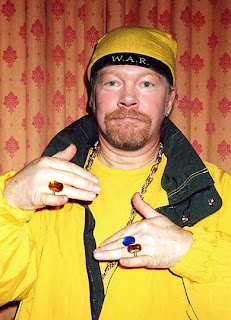
Ladies and gentlemen, the man who terrorized parents and teachers for several years in the late ’80s and early ’90s. No, that’s not a Photoshop job. That’s an actual outfit that MC Chiquita apparently wore on purpose, un-ironically. I wonder if he was dressed like that when he had his slap-fight with Tommy Hilfiger.
Addendum
I asked my friend Arthur what he thought of Kristen Hoggatt’s essay, and this is what he wrote back:
Music affects us on a more primal level than language (a fact Schopenhauer made much philosophical use of) and it will tend to overshadow (distort, transfigure) whatever words or lyrics you set to it. A song can survive, even “ennoble” mediocre lyrics; but no lyrics, however brilliant, can survive unmemorable music. It’s great when words in songs are intellectually or aesthetically stimulating in themselves, but the qualities that make the words seem to work as poetry when set to music are not necessarily the qualities that would make them work as poems. Who worries whether the librettos of great operas are poetry in themselves? They usually are not, and composers like Richard Strauss, aware of the greater authority of their art viz a viz merely literary merit, have been brutal with the literary pretensions of their librettists (like poor Hoffmansthal, Strauss’s collaborator on many of the great operas): give me what works (serves the technical needs and imaginative ambitions of the composer, me), not what seems beautiful or profound to you as a poet.The poets of our tradition stopped being troubadours centuries ago. Poetry is its own music, both for the ear and for the imagination. It comes into its glory read aloud, but not necessarily when set to music. (Which is not to say that great poems can’t be set to great music. But it’s surprisingly rare. Schubert was inspired to new heights by Heine, but he could compose equally great songs to fairly fun-of-the-mill poetry.)Music is a Dionysian art; poetry is Apollonian.P.S. I forgot to add something about Stevens, a propos of Simon’s comments. Strauss often cut out metaphors and verbal associations he thought crowded the aural canvas and distracted from the music. A poet like Stevens wants to pursue verbal associations and imaginative ideas wherever they take him, to let poetry revel in its own extravagance, its own “fictive music.” Poetry is the music of the mind in motion among its metaphors, and it addresses something solitary and inward in us–just as music itself often does, when it isn’t telling us to get up and boogie.
Which echoes Shanna’s observation that good music can make up for insipid lyrics every time. Sometimes trite sentiments or outright surreal nonsense can still be fun to sing if the rhythm and melody are too irresistible.
The Ballad of Naked Man
Get the hell away from me, you goddamned naked man. Go the fuck away from me, back to Naked Land.
I don’t have anything to say about the story. But how many times do you get to quote lyrics to an awesome Butthole Surfers song in reference to anything? I couldn’t pass it up.
Prose by Any Other Name Would Smell as Sweet
Shouldn’t someone at the forefront of the poetry movement try to discourage the misconception that poetry is highbrow? Poetry kicks ass, and if I were Billy Collins, I would do everything in my power to convince others that it does, using the most powerful verses to get my point across, which naturally include — come on, poets, let’s get off our high horses — song lyrics. At least I can get away with saying this: Billy Collins, you have made a grave mistake. The poetry muses should string you up and throw pointy paper quills at you.The truth is that lyrics are often the most pervasive way to bring words to a person’s attention. Walk into a restaurant or a clothing store, and likely you will hear lyrics playing in the background. Attend a sports event and lyrics will likely be sounded from the loudspeaker during half time. This is reality — yes, it’s a far cry from hearing Keat’s odes sounded from somebody’s car audio system, but it is far more helpful to focus on the similarities between lyrics and poetry than to polarize the two genres. After all, songs and poems were at one time the same thing.…Most important of all, both lyrics and poetry are composed of language, one of the true wonders of human development. Lyrics and poems are linked in the way all genres of the written word are, the beauty of language and artistic expression leveling disparity — both lyrics and poetry are literary arts with equal merit. Though naturally I’m biased to say that poems are superior, doing so would only harm the mission to bring poetry into the mainstream. Rather, one should focus on how song lyrics can be a gateway into poetry by making words the focal point, and as such, a person can then realize how powerful words can be by themselves.
I’m certainly one of those who was bored to tears by the way poetry was taught in school, only to discover the intoxicating power of wordsmithery via song lyrics. And while many of the lyrics that struck me as so profound when I was seventeen would make me wince these days for being so maudlin and histrionic, they nonetheless spoke to me and my then-experiences in a way that prim and proper poetry did not. Even now, as undeniably cultured and sophisticated as I am, there are still plenty of alterna-rock musicians who can provide eminently quotable couplets and quatrains which are all the more impressive for having to be tailored to fit the rhythm and melody of the song. And let’s not forget that even Homer, “the fount of Western literary eloquence”, was basically writing songs for an oral culture, or that Shakespeare was hardly above playing to the crowd himself. Some people will use words to touch and commune with others; some will use them to distance themselves and appear forbidding and unapproachable. I don’t see that the rest of the distinctions matter.
I did find it funny that she used Paul Simon’s lyrics as Exhibit A when it comes to artists who blur the line between lyrics and poems. There’s a guy named, uh, Paul Simon who would take issue with that:
The lyrics of pop songs are so banal that if you show a spark of intelligence they call you a poet. And if you say you’re not a poet then people think you’re putting yourself down. But the people who call you a poet are people who never read poetry. Like poetry was something defined by Bob Dylan. They never read, say, Wallace Stevens. That’s poetry.
Tee hee. Anyway, all this reminded me of something my reclusive genius co-blogger Arthur wrote in a recent email. (Yes, he really does exist. He’s not one of my multiple personalities or a literary character. He just stubbornly swears he doesn’t have anything worthwhile to say when it comes to blogging, which is why I have to trick him into expounding on these things privately, so that I can reprint them here.)
“Graffiti,” like all the “graph” words (ultimately meaning “scratch,” as in clay tablets), is related to English “carve” (and “writing” itself has this primal meaning)… Surely, the place of writing is part of the meaning of a piece of writing. Ancient shamans wrote or carved or painted in out-of-the-way places so that readers–acolytes, et al.–would have to go out of their way to read them. The remoteness of the place and the effort and sometimes danger required to get there was part of the experience of the sacred. “Sacred” means “set apart”.
So while I fully agree with Hoggatt that clever lyrics can indeed be a gateway into an appreciation of the power of words and thus to the realms of officially recognized poetry, perhaps there will always have to be a different level of wordplay, one more remote and inaccessible to the lay reader, and not even purely for the snobbish reasons of wanting to distinguish oneself from the great unwashed. Quibbling over whether or not to properly classify certain lyrics as “poetry” seems a little beside the point. The highbrows will just start calling their work something else.
Saturday Shuffle
- School of Seven Bells — I L U
- Against Me! — Spanish Moss
- Meat Beat Manifesto — Repulsion
- Greg Ellis — Form 4
- Einstürzende Neubauten — Morning Dew
- Social Distortion — Ring of Fire
- Nobody — Hip$ters
- Dreamend — Magnesium Light
- Charlotte Gainsbourg — Master’s Hands
- Son Volt — Down to the Wire
- Lisa Gerrard and Pieter Bourke — Pilgrimage of Lost Children
- Blackeyed Susan — None Of It Matters
- My Life With the Thrill Kill Kult — Spotlite Hooker
- Rasputina — Olde Dance
- The Vines — A Girl I Knew
- Clutch — Opossum Minister
- Gomez — Machismo
- KMFDM — Juke Joint Jezebel
- Mazzy Star — Into Dust
- Michael Nyman — Against Constancy
Let’s see Peter Jason Rentfrow find the common thread in that.
Musical Mysticism
Let’s fall in love with musicThe driving force of our livingsThe only international languageDivine glory, the expressionThe knees bow, the tongue confessesThe lord of lords, the king of kings– Mother Love Bone
In keeping with this, we find that the interest inspired by philosophical and also religious systems has its strongest and essential point absolutely in the dogma of some future existence after death. Although the latter systems seem to make the existence of their gods the main point, and to defend this most strenuously, at bottom this is only because they have tied up their teaching on immortality therewith, and regard the one as inseparable from the other; this alone is really of importance to them. For if we could guarantee their dogma of immortality to them in some other way, the lively ardour for their gods would at once cool; and it would make way for almost complete indifference if, conversely, the absolute impossibility of any immortality were demonstrated to them. For interest in the existence of the gods would vanish with the hope of a closer acquaintance with them, down to what residue might be bound up with their possible influence on the events of the present life. But if continued existence after death could also be proved to be incompatible with the existence of gods, because, let us, say, it presupposed originality of mode of existence, they would soon sacrifice these gods to their own immortality and be eager for atheism. The fact that the really materialistic as well as the absolutely sceptical systems have never been able to obtain a general or lasting influence is attributable to the same reason.
The early Christians were, ironically enough, called atheists by the Romans because they refused to recognize the state gods. In somewhat the same way, I call myself an atheist because, as far as the common conception of God in my culture is concerned, I am. I don’t believe in any sort of personal god, which, as I keep asserting, is the only kind anyone is really interested in, and I myself am not interested in a god that has to be defined out of existence to be kept away from the prying eyes and grasping hands of science. But it’s always worth repeating, I think, that I don’t even consider the existence of God or the lack thereof to be all that important. It’s fun to argue about, in a mental exercise, intellectual sparring sort of way, but as the man just said, the only reason anyone even cares is because their ideas about personal immortality are all caught up in it. I’m not aware of any cultures that worship anything like the omniscient, omnipotent, omnibenevolent Christian God without a corresponding belief in personal immortality (though perhaps I should check with Pascal Boyer again and see if I forgot some), but some schools of Buddhism have managed to hold a belief in personal identity surviving physical death without any deity being involved. The thought of death, the knowledge of its inevitability, gives us all pause at the least, if it doesn’t inspire outright fear. We want to believe that it’s not really the end for us. Everything else flows from that. In keeping with that, I feel that disbelief in the “self” is far more radical than mere atheism, and more relevant to the heart of religious belief. If you’re not going to experience any reality except life in this world, and the most God is ever going to bother revealing about himself is vague images to thrill superstitious old ladies in the form of a stain on the wall, a burnt section of their waffles, or writing on a cat, then all that existential angst disappears in a puff, and all the tons of paper wasted on tortured attempts at theodicy can be used to start fires in cold weather.
But continuing with our themes of personal identity, life, death and nineteenth-century German philosophy, here’s an interview with Nietzsche scholar Julian Young that touches on a type of immortality I can fully endorse:
How did Nietzsche’s ideas about music affect his philosophy?“Without music life would be an error” is a great T-shirt slogan, but its meaning is far from obvious. Here is how Nietzsche glosses his aphorism in a letter from 1888, the last year of his sanity:“Music … frees me from myself, it sobers me up from myself, as though I survey the scene from a great distance … It is very strange. It is as though I had bathed in some natural element. Life without music is simply an error, exhausting, an exile.”Nietzsche’s first book, The Birth of Tragedy, dedicated to Richard Wagner, is constructed around the duality between the “Apollonian” and the “Dionysian.” Apollo stands for intellect, reason, control, form, boundary-drawing and thus individuality. Dionysus stands for the opposites of these; for intuition, sensuality, feeling, abandon, formlessness, for the overcoming of individuality, absorption into the collective. Crucially, Apollo stands for language and Dionysus for music. What, therefore, music does is to–as we indeed say–”take one out of oneself.” Music transports us from the Apollonian realm of individuals to which our everyday self belongs and into the Dionysian unity. Music is mystical.Since the human essence is the will to live–or for Nietzsche, the “will to power”–the worst thing that can happen to us is death. Death is our greatest fear, so that without some way of stilling it we cannot flourish. This is why musical mysticism is important. In transcending the everyday ego we are delivered from “the anxiety brought by time and death.” Through absorption into what Tristan und Isolde calls the “waves of the All,” we receive the promise and experience of immortality.Later on, Nietzsche realized that not all music is Dionysian. Much classical music, based as it is on the geometrical forms of dance and march, is firmly rooted in the Apollonian. Yet as the 1888 letter indicates, he never abandoned the musical “antidote” to death. Without music, life would be anxiety and then extinction. Without music, life would be an “exile” from the realm of immortality.
Lowbrow but I Rock a Little Knowhow
If I told you my taste in movies, would you be able to tell me what kind of music I listen to? How about my favorite reading material, or taste in television?Peter Jason Rentfrow can — and it’s no parlor trick. The Cambridge University psychologist is lead author of a new study that finds a person’s entertainment choices tend to share certain basic characteristics, which may or may not be immediately obvious.…The highbrow/lowbrow split, which has dominated cultural criticism for the past century or so, remains alive and well: The researchers report most people gravitate toward one dimension or the other. But Rentfrow and his colleagues also identified an area of common ground. (Hint: It’s occupied by Oprah).…After analyzing the data, the researchers concluded that people’s aesthetic tastes can be broken down into five “entertainment-preference dimensions.” They are: Aesthetic (which includes classical music, art films and poetry), cerebral (current events, documentaries), communal (romantic comedies, pop music, daytime talk shows), dark (heavy metal music, horror movies) and thrilling (action-adventure films, thrillers, science fiction). The first two fall under the general heading of highbrow, while the final three are labeled lowbrow.…For instance, “individuals who enjoy the aesthetic entertainment factor, which may be regarded as abstract, dense and demanding, tend to be creative, calm, introspective and in touch with their emotions,” they write. Those who are drawn to dark entertainment genres tended to rate high on intellect and extraversion, but low on conscientiousness and agreeableness; they “may generally see themselves as defiant, reckless and immodest.”In contrast, “It appears as though the psychological characteristics most central to individuals who prefer the communal entertainment factor are rather similar to the defining characteristics of that factor: pleasant, lighthearted, unadventurous, uncomplicated and relationship-oriented,” the researchers add.
I seem to be split between highbrow and lowbrow, with my enjoyment of watching professional soccer being the only thing I can think of that would qualify as communal taste. But I’m a little skeptical that there’s much of a common thread to be found between movies and music by Rob Zombie on the one hand, and the complete works of Mozart on the other. Or, to use an example from a recent post, books by Isaiah Berlin versus escapist fantasy novels. And where does an exceptional TV show like The Wire fall within this framework? Even Amazon can give suggestions based on individual purchases as to similar music, books or movies you might like, but this seems to suggest there’s a way to find deeper connections between tastes despite what seem to be wildly disparate surface appearances.
The Universal Language
There’s this guy I work with, a big, roly-poly good ol’ boy (that’s the good kind of redneck). Full of Southern pride, middle-aged, somewhat conservative, a truck driver. At a glance, you’d think his musical taste ran from Johnny Cash and Hank Williams to maybe the Allman Brothers Band and Black Oak Arkansas.
I was leaving work one morning not too long ago, when I caught myself and realized I needed to run back into the warehouse for something. I left my car running with the door open and music playing, in this case, the Chemical Brothers’ “One Too Many Mornings“. When I came back out, he was dancing (I guess you could call it that) next to it. Just happily shaking his moneymaker and gyrating all over the place. As I stared in amazement, he finally turned himself around, saw me and exclaimed, “Man! This is great! What is this?’ I told him. “Aw, man! I love this! I tell you what, I could listen to this kind of thing all night! But I just don’t know where to find this kind of stuff! Who plays this?” I filled him in a little bit on the genre, told him a couple radio stations to check out and promised to make him some mix CDs of similar music, which he loved. In fact, someone just complained to the landlord of the warehouse complex because he was coming in blasting it too loudly every day.
So there’s at least one good ol’ boy driving around Virginia, grooving to electronica, big beat and other types of dance music. Who woulda thunk it? It’s cool when people surprise you like that, transcending categories, defying stereotypes.
Megadouche
WHAT HAPPENED TO DAVE MUSTAINE’S VOICE?Tuesday, August 24th, 2010 by Axl Rosenberg
Genetics and puberty, I guess. Life ain’t fair. Oh, wait, you mean lately?
When I saw Megadeth a few weeks ago, the band sounded great — but Dave Mustaine’s vocals sounded about as appealing as the idea of watching a porno flick starring Billy Milano and Snooki.
Bear in mind that we’re talking about a guy who, in his prime, had one of the most grating nails-on-a-chalkboard voices of all time. When Megadeth recorded their version of Black Sabbath’s “Paranoid” for the Nativity in Black tribute album in 1994, good ol’ Ozzy was said to remark upon hearing it, “Whoever’s singing that needs to get a fucking day job.” This is a guy who was once described as “sing(ing) like he’s getting a vacuum-cleaner enema” during a positive album review in a guitar magazine. How could it possibly have gotten any worse?
Anyway, fuck him in half. Even if I could attempt to tolerate his voice for the sake of the music, his terminal case of gargantuan throbbing assholitis makes me not want to bother. He used to be somewhat libertarian/independent in his outspoken politics (Perot supporter in ’92), but after getting born again again (apparently the first time, in the early ’90s, didn’t take), he veered sharply right and kept on trucking. This is from an interview in 2007:
“I know I’m not making any friends at the U.N. with this album,” Mustaine continues with a harsh laugh. But, frankly, he’s not too worried. Like many born-again Christians, Mustaine favors the interpretation of the Book of Revelations that views the founding of the United Nations—and its eventual demise—as part of a series of prophesied events that will inevitably lead to the Second Coming. “I got saved a few years ago, and I believe what the Bible says, that the U.N.’s gonna fall. In order for the predictions in the Book of Revelations to take place, it’s gotta fall. I don’t ever expect to go there, except to look where the building used to be, you know? I’m hoping that someone’s going to pull the chain, and that’s where the butthole of the United States is, and it just disappears!”…There’s righteous fury galore on “Amerikhastan” and “Washington’s Next,” two songs that take extreme issue with what Mustaine sees as the Bush Administration’s half-assed policies on immigration and the Middle East. Asked his opinion on the ongoing Iraq War, Mustaine pulls no punches.“We needed to drop a really big bomb on that country about 16 years ago, and then we wouldn’t be having this problem,” he growls. “I think Bush made a tragic mistake invading Iraq. I voted for the guy, so I’m absolutely ashamed of my vote, but it was better voting for him than John Kerry. The fact that we’ve been humiliated to the degree that we have, because of our president’s ineptness… I think in America right now, there’s a lot of hope for the future. But I also think that our country has never been hated as much as we are right at this moment.
Yes, the guy who thinks his Christianity would be compromised by sharing a stage with a band whose name he disapproves of thinks we should have nuked Iraq in 1991. I’m sorry, but what could the Devil do that would be any worse than that? Fucking idiot.
Asked about his own drug use, which sent him to rehab several times over the past two decades—he also briefly died in 1994 from an overdose of Valium—Mustaine rolls up his sleeves, revealing two pale, sinewy arms completely devoid of needle marks. “I never shot up, actually,” he says. “No, I gotta take that back—I did for one day, and it was so disgusting. I thought, Now I know why y’all suck dicks to shoot up!” He laughs. “You stick a needle in your arm, and the next thing you know, there’s a dick in your mouth!”
Charming (though I can’t say I follow the logic in that statement. Whatever.) What makes me sad is to think of all the talented musicians who have died far too young from drug abuse. This cockbiter probably still has enough residual pills, heroin and cocaine in his bloodstream to get you high from a transfusion, but here he is, like an indestructible roach, still plaguing the metal scene with his atrocious voice. I repeat, life ain’t fair.
Of Mouse and Men
The first time I really listened to any of Danger Mouse’s output was when he worked on Beck’s excellent Modern Guilt record two years ago (I’m a huge Beck fanboy). Earlier this year, I was enthralled by the Broken Bells record, where he collaborated with James Mercer of the Shins. And earlier this month, we got the official release of the long-delayed collaboration between him and the late, much-lamented Mark Linkous of Sparklehorse. I’ve been listening to that disc over and over and over since then.
Can he simply do no wrong?
He Is Iron Man
Scientists are studying Ozzy to see how he’s managed to live through so much drug abuse.
I just wonder how many people are going to make some excruciatingly predictable joke about the anti-narcotic properties of bat heads.
Jesus vs. Brian Wilson
I was talking recently with a liberal Christian, when the conversation turned to the Bible. At one point, I said that I didn’t see any value in trying to extract the “true” message of Jesus, given the contradictory verses that are purportedly his own words, not to mention the problem of trying to read the book as a coherent text written for the purpose of providing a historically accurate account of precisely what was done and said. He stuck to the party line, though, insisting that there is a common message of love to be found through the Gospels that takes primacy over any inconsistencies or disturbing passages. Anyway, that’s standard stuff. I then said that I personally didn’t find his words to be all that inspiring in the first place, to which his immediate, incredulous response was, “Not even the Beatitudes?”
In case you hellbound deviants don’t have them memorized, here’s a refresher:
Blessed are the poor in spirit,
for theirs is the kingdom of heaven.
Blessed are they who mourn,
for they shall be comforted.
Blessed are the meek,
for they shall inherit the earth.
Blessed are they who hunger and thirst for righteousness,
for they shall be satisfied.
Blessed are the merciful,
for they shall obtain mercy.
Blessed are the pure of heart,
for they shall see God.
Blessed are the peacemakers,
for they shall be called children of God.
Blessed are they who are persecuted for the sake of righteousness,
for theirs is the kingdom of heaven.
I said that I actually preferred the Beach Boys song, “Wouldn’t It Be Nice”:
Wouldn’t it be nice if we were olderThen we wouldn’t have to wait so longAnd wouldn’t it be nice to live togetherIn the kind of world where we belongYou know its gonna make it that much betterWhen we can say goodnight and stay togetherWouldn’t it be nice if we could wake upIn the morning when the day is newAnd after having spent the day togetherHold each other close the whole night throughThe happy times together we’ve been spendingI wish that every kiss was neverendingOh, wouldn’t it be nice…Maybe if we think and wish and hope and pray it might come trueBaby then there wouldn’t be a single thing we couldn’t doWe could be marriedAnd then we’d be happyWouldn’t it be nice…You know it seems the more we talk about itIt only makes it worse to live without itBut let’s talk about itOh, wouldn’t it be nice…
Same sappy, pie-in-the-sky wishful thinking, but with good music in this case. Did Jesus ever write any songs as brilliant as Brian Wilson? I rest my case.
Saturday Shuffle
- Mozart — Clarinet Quintet in A major K. 581, 4th Movement
- LCD Soundsystem — I Can Change
- Kasabian — Take Aim
- The Beatles — Honey Pie
- Infected Mushroom — Forgive Me
- Blonde Redhead — The Dress
- Glen Porter — Transient
- The Chemical Brothers — Three Little Birdies Down Beats
- Murderdolls — Graverobbing U.S.A.
- Cold War Kids — Every Valley is Not a Lake
- Ministry — The Land of Rape and Honey
- dead horse — Peaceful Death
- Dntel — Last Songs
- Broken Bells — Trap Doors
- Mint Royale — Show Me
- Golden Bug — Disco Sensation
- The Gaslamp Killer — Turk Mex
- Joachim Witt — Jetzt und Ehedem
- Mother Love Bone — Bone China
- Beck — Dark Star