From this morning’s Blendle email:
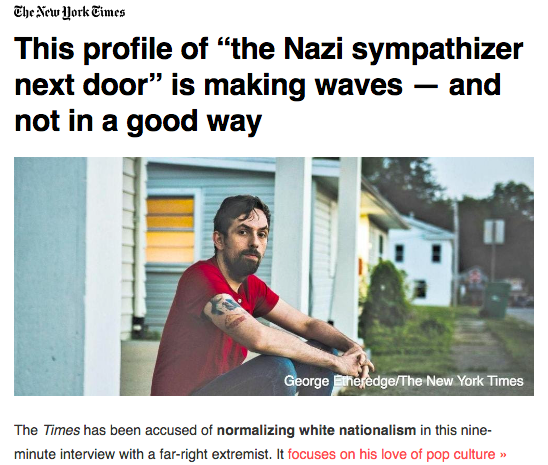
Which calls to mind the famous poem by Leonard Cohen:

From this morning’s Blendle email:
Which calls to mind the famous poem by Leonard Cohen:
If Weinstein’s name is to be removed from the credits of television shows in the production of which he played even a small part, what are we to do with the mountains of records, CDs, posters, books, memorabilia, commemorating rockers? What about the so-called “Rock and Roll Hall of Fame”? What is the point at which it becomes necessary for us to channel our inner Savonarolas and just start burning? Is one confirmed incident enough? How many Station to Stations or Physical Graffitis are worth the assault of a single woman or child? Are we affirming or materially contributing to their crimes when we watch films or listen to music made by abusers?
Like the rest of human life, sexuality has been subsumed over the course of the last few decades into the language of economics. The sexual act, we tell ourselves, is a simple matter of exchange between consenting partners, like a business transaction. It has nothing whatever to do with marriage or children. Like the deregulation of the economy, the privatization of sex has given us some apparent winners and a rather larger number of clear losers.
It’s hard to care how much has to burn for us to start listening to them.
That’s the problem with feeding frenzies. As entertaining as it may be to see an odious, degenerate elephant seal like Harvey Weinstein being torn apart by sharks, the blood in the water attracts all sorts of annoying smaller fish desperate to join in, and if they can’t get close enough to the intoxicating action, they’ll just turn and snap at anything within reach. Walther wants to extend the bloodlust to every celebrity who has committed similar offenses, so apparently we’re supposed to abstain from listening to the music of Don Henley, Led Zeppelin, David Bowie, Ted Nugent, Charlie Parker, and the Rolling Stones in solidarity with their victims. I presume he didn’t intend to present us with such an overwhelmingly white list of offenders, when such obvious (and arguably more relevant) candidates as Chuck Berry, Tupac Shakur, Nelly, Mystikal, and R. Kelly could have been included, but then again, feeding frenzies are dangerous places, and you don’t want to show up, eager to sink your teeth into a sexual predator, only to find yourself being devoured by the anti-racist barracudas.
Aldo Leopold, in his “Odyssey” essay, poetically demonstrated the interconnectedness of all life by describing a particular cycle in the existence of a nitrogen atom, from rock, to flower, to acorn, to deer, to Indian, “all in a single year,” and on and on. I mention it here in order to make a short metaphorical hop over to suggesting that Walther’s incoherent fantasy of isolating “bad” people in a moral quarantine is just that, a fantasy. What if, let’s just say ferzample, the cure for cancer ends up being discovered by a scientist who spent countless hours researching and experimenting while being inspired by listening to Led Zeppelin on repeat? Would that “justify” their music against whatever claims could be made against it on behalf of abused, underage groupies? What kind of imbecilic utilitarian (but I repeat myself) would even attempt to devise a calculus to meaningfully answer that inane question? Was the music of Bach or Mozart contaminated by the fact that commandants in Nazi death camps could force prisoners to play it for their entertainment? Shall we go on compiling similar examples? Like Leopold’s nitrogen atom, human lives and human creations restlessly zigzag across neat-and-tidy definitional boundaries, contributing to both good and bad in the world simultaneously. T’was ever thus, t’will forever be.
As Nietzsche said, “Beware all those in whom the urge to punish is powerful.” To people like Walther, it’s not important whether there’s any meaningful, accurate way in which moral credits and debits can be tallied when it comes to the production and consumption of music and films; what’s important is that he and people like him assume they’ll be the judges who make those decisions. But once the statues start toppling, and the records and books start burning, these moral purification rituals tend to take on a life and momentum of their own. He may be too stupid to realize that, or he may be cynically presenting a stupid, unworkable idea for the sake of meaningless Internet virtue points. I’m not sure which would be worse.
So what can you do when a customer wants a book that you not only find objectionable but also believe actually dangerous in the lessons it portends amidst such a politically precarious time? If it helps, swap Elegy for any book that you find particularly insidious, whether it’s Atlas Shrugged, The Communist Manifesto, or The Bible. The question remains: without stooping to the level of crazed book-burning, does the bookseller’s role ever evolve past the capitalist exchange of money for paper and pulp? And are there meaningful ways to resist the continued sales of disastrous books?
Koziol has a problem. When he’s not playing to perfection the role of a Smug, Condescending Progressive straight out of central casting, he’s a bookseller, you see, and he’s distraught over the fact that even the “largely liberal, well-educated and well-meaning people” who patronize his store insist on seeking out such subversive thoughtcrime as, uh, J.D. Vance’s Hillbilly Elegy. What to do, what to do? Well, eventually our hero grudgingly concedes that there’s nothing he can do except to “start conversations” and listen “without judgment” as customers explain why they would even want to waste their time with such trash, but given his druthers, he would prefer to strangle distribution of the book by boycotting Vance’s publisher. Unfortunately, sigh, that doesn’t seem feasible. A question of tactics, not principle, you understand. But it’s so trying for him, having to stand by silently while all around him, people are making choices without consulting him first!
It’s hard to pick a favorite part. Is it the idea that a typical customer would be the slightest bit interested in justifying their purchase to some obnoxious employee demanding an explanation? Is it the demonstration, yet again, that would-be censors and commissars unfailingly assume that they will always be the ones with the power to decide what gets promoted and what goes down the memory hole? Is it the way, as already noted, that zealots like Koziol can’t even trust their “liberal, well-educated and well-meaning” peers to handle anything from the progressive Index Librorum Prohibitorum without supervision? For me, I think it’s the way he offers up alternative candidates for censorship as a “gotcha” — he apparently blithely assumes that everyone else is as much of a control freak as he is. Hell, one of the first books I ever sold was one of Ayn Rand’s novels. I even sold a copy of Mein Kampf on Hitler’s birthday. Free speech and free markets, baby, let the best ideas win!
The Closing of the American Mind makes for interesting reading today. The thrust of its complaint about elites and relativism has only intensified. But some of it does not hold up well at all. Take its snarkily written chapter with the heading “The Nietzscheanization of the Left or Vice Versa,” for example. In it, Bloom argued that the left had largely abandoned the discredited economic doctrines of Marx and, in their place, adopted a stylized anti-bourgeois Nietzsche. Nietzsche and his “will to power” over flabby liberal values no longer sustainable by reason or myth were still casting a revolutionary spell, Bloom asserted, but it was no longer over adherents of German and Italian fascism, discredited (to say the least) as those movements were by the horrors of World War II.
Nietzsche’s thought was now being transmitted through European leftists such as Georg Lukacs, Alexandre Kojeve, Maurice Merleau-Ponty and Jean-Paul Sartre, who had jettisoned Marx’s “embarrassing economic determinism” and created a new “mutant” crossbreed of Nietzsche and Marx:
The mature Marx had almost nothing to say about art, music, literature, or education, or about what the life of man would be when the yoke of oppression was lifted. His early “humanistic” writings were looked by some for the inspiration lacking in the later ones, but they turned out to be thin and derivative stuff. Since the Nietzscheans spoke so marvelously well about all these things, why not just appropriate what they said? So they took over “the last man,” whom they identified with the Marx’s bourgeois, and “the superman,” whom they identified with the victorious proletarian after the revolution. [The Closing of the American Mind]
Without crawling further into the weeds, suffice it to say that, in 2017, the philosophical picture that Bloom painted in 1987 has been inverted. In the post-crash, post-Picketty era of global inequality, the Marxist-minded left is very much interested in those discarded economic doctrines. And the far right, as evidenced by Spencer and his ilk, is very much interested in Nietzsche as he was originally understood by 20th-century fascists.
Lord, what a deeply stupid article. I mean, Francis Fukuyama may have proclaimed “the end of history” after the fall of the USSR, but I’m pretty sure even he never suggested that political fashions would no longer be recycled in the same superficial manner as clothing and pop music. Yes, the “Marxist-minded left” most certainly has been doing its best to reanimate the mummified corpse of their old dogma. And what of it? Even as we speak, Venezuela is busy segueing from every airhead’s favorite example of “hope for the socialist future” to the inevitable “it was never real socialism anyway” denouement. Progressive media’s favorite neo-Nazi claims to have been inspired by Nietzsche? Well, yes, as ever, people can find whichever philosophical justification in Nietzsche they’re determined to find, fascists included. Is this supposed to tell us something meaningful about the substance of these beliefs, or are we just supposed to find something profound about the ephemeral fact that everything old is currently new again? What happens in a few years when Trump is out of office, the media are bounding around after a different red laser dot, socialist theory is still moribund, and today’s social media revolutionaries have all reached their thirties and settled down with corporate careers and families? Will that make Bloom prescient again? To address questions like that, you’d need context and perspective, and you’re not going to find them amid this tripe.
Ironically enough, this article itself reads as a confirmation of Bloom’s point. Whether he was right or wrong in asserting that the left has settled for an aesthetic style of politics after losing faith in historical dialectic and economic determinism isn’t the point; this is just a rhetorical angle from which to approach the actual subject of the article, namely Richard Spencer. Because God knows, criminally stupid progressive media clickwhores haven’t given the man enough free publicity as it is. They need a narrative, and a demographic that was apparently educated by the History Channel naturally responded to Brexit, Trump, et. al. by seeing Nazis, Nazis everywhere. Not because it provided a useful explanatory framework to understand these events, but because it provides said demographic with a chance to LARP as the French Resistance and thus provides a frisson of purpose to their comfortable lives, which they feel terribly guilty about anyway. It presses down hard on nerves that have been long since deadened by comfort and security. There’s no reason to believe that “Spencer and his ilk” are any more pervasive or threatening than any other fringe white-power groups from the last several decades, but he’s become the subject of countless media profiles in recent months because he plays a central role in the story progressives love to repeatedly tell themselves, and if the fact that so much political punditry consists of nothing but this storytelling doesn’t prove that Bloom was pinpoint-accurate in his assessment, I don’t know what would.
What’s clear is that the people buying from you and working for you want to know if you’re on their side. Or not. They want to know if you’re doing something to make the world better. Or not. And they will reward — or ignore or perhaps even boycott — you accordingly.
This is our new marketing reality, and cultural values are marketing’s new table stakes. Few are the brands who court controversy as a matter of strategy. But in today’s landscape, avoiding taking sides and bringing your cultural values to life to avoid controversy is a fast track to irrelevance.

Yes, “doing well by doing good” is a decades-old truism. But showing the world what you stand for (and occasionally against) is now as important, efficient and effective an eyeball-grabbing platform as exists. To win today’s battles for attention — as in, relevance, engagement, resource allocation and return — you’d better let people know whose side you’re on.

Today, brands can be neither quiet, defensive nor isolated. They have to be proactive, and they have to stand for something — for both the world’s and their own good.

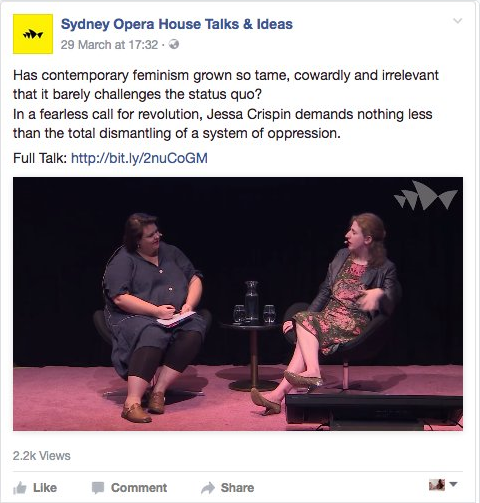
Feminism began, necessarily, by rightfully demanding equality from men. Men, who once held all the cards rather than just most of them, were increasingly challenged to demonstrate an egalitarian spirit: to consider the claims of women, the work of women, the needs of women, as being equal in value and importance with their own. And where has this history led women like Jessa Crispin? To a haughty, point-blank refusal even to listen to any man who may have a response to her work. Some soi-disant feminists drink their tea from “Male Tears” mugs, while others wear T-shirts reading, “Kill All Men.” Is it any wonder that American feminism is dead? Good riddance to it, honestly.
The wider context for Bustillos’s accurate observation here is one of disappointment — she agrees with Crispin that any feminism worthy of the name cannot be merely a piecemeal, practical strategy for improving various aspects of women’s lives, but must be a utopian, transformative social movement. Hearts need to change, not policies. It seems to me that what they really yearn for is another Great Awakening, even if our secular sensibilities won’t allow us to call it as such. Well, we’re all about accentuating the positive here, so as far as that goes, Bustillos has pinpointed why fulminations like Crispin’s are destined to echo no further than the back row of the misandrist choir. Still, I’m starting to suspect that religious conservatives are correct when they insist that the denial of religious impulses often leads to unintended consequences — namely, salvationist tendencies start bleeding over into your politics, and that never ends well.
Of course, this being a polemic, there’s not much space given to how, exactly, the total disengagement with our individualist and capitalist society might be achieved.
“Of course.” I like the implicit admission here. You weren’t expecting something more than the impotent flailing of tiny fists, were you? Tsk.
Here, we have a former Jezebel editor in the New Yorker reviewing the ever-ridiculous Jessa Crispin’s new book about how feminism has been co-opted by the system and rendered toothless, harmless, and far too friendly to bourgeois capitalist social norms. In other words, the same problem radicals have been fruitlessly complaining about for decades: despite being endlessly challenged, interrogated, deconstructed, and reimagined, the “system” of leaving people free to make piecemeal improvements to their own lives at their own pace via their own discretion has continued to blossom in popularity like Audrey II, leaving mystified radicals to wonder what in the unholy name of Adam Smith happened. I like to think of it as the infinity mirror problem of radicalism: an endless line of identical poses reflecting an illusory substance. “Of course” nothing is going to change, but at least writing an angry feminist book, or reviewing it in a prestigious outlet, gives you a vantage point from which to look down and sneer at the “shallow” sorts of feminists who don’t realize that emblazoning car bumpers, tote bags and coffee mugs with clichéd quotations about girl power is simply gauche. Decorating your actual politics with chimerical yearning, however, is apparently the height of sophistication.
Milo Yiannopoulos gets schooled at Berkeley: Ferocious protests greeted the right-wing provocateur last night https://t.co/0twmoCtCdO pic.twitter.com/ZzpC4jcL21
— Newsweek (@Newsweek) February 2, 2017
I wouldn’t have thought anything would be more pathetic than seeing balaclava-wearing middle-class anarchists doing their best to embody the mocking image Mike Doughty painted of them almost two decades ago in his song about the 1999 Seattle WTO riots, “Busting Up a Starbucks.” It’s hard to outdo a bunch of imbeciles fighting “fascism” by, uh, disrupting peaceful assemblies, smashing store windows and beating people in the streets with metal poles. But legacy media desperately attempting to stay relevant by cheering them on is even worse. Yes, Milo sure did get “schooled” by having his book rocket straight to the number one spot on Amazon’s besteller list and getting even more invites to appear on TV programs. Honestly, if this weren’t just part of a long, long tradition of the utterly useless, self-defeating stupidity of left-wingers, I’d suspect Milo organized the whole thing as a brilliant marketing strategy. As it is, they were like this long before he was even born, and will continue like this into the foreseeable future, never learning a thing.
This kind of vicious, self-righteous hit piece is exactly why right-wing populists will keep winning victories. https://t.co/uNznfgZ2dT
— Russell Blackford (@Metamagician) January 24, 2017
this strikes me as quite a sinister development, pressuring businesses to take official views on political issues https://t.co/W4TuxKJOiT pic.twitter.com/GP9jN3IDit
— Ed West (@edwest) January 31, 2017
You’ve heard me say it before, and no doubt I will have to say it many more times: there’s no neutral ground in a holy war.
Lord knows that humans need no special incentive to indulge in tribalism. Protecting the in-group and attacking the out-group is one of the most deeply-engrained instincts in the species of chimpanzee that made good. As numerous experiments have shown, even the most trivial and nonsensical distinctions can turn formerly peaceable people into bloodthirsty enemies.
It’s easy enough to shrug off these latest exercises in public shaming and forced political awareness on the assumption that of course pop music superstars and Fortune 500 companies will attract this kind of unhinged, obsessive attention. But rest assured that the only thing preventing these righteous crusaders from reintroducing a modern version of impressment for the culture wars is the problem of logistics, not the lack of desire. They would gladly conscript nobodies like you or I as well if they could.
Again, it’s incredibly easy for any human to reduce a complex issue to a Manichean battle between the saved and the damned. But this particular type of totalitarian impulse, to completely obliterate the idea that anything could be allowed to escape the gravitational pull of partisan politics, is especially appealing to left-wingers. It is axiomatic for conservative philosophy that there will always be a certain amount of imperfection and injustice in the world, and a sane response to this fact entails that people have to allow some sort of cultural or personal space to forget about crusading. At five o’clock, the whistle blows, and we set the bare-knuckle political brawling aside until the next day, like Sam and Ralph. There are more important things to concern ourselves with, better sources of solace like family and art to occupy ourselves with, and the fight will never be conclusively won anyway.
But to the progressive equivalent of theocracy, the idea of a “secular” space, free from political considerations, is heretical. Unsupervised free spaces like that are a breeding ground for subversive, reactionary ideas. For a political philosophy that accepts no inherent limits on mankind’s ability to perfect itself, the very existence of imperfection and injustice is an affront to its deepest identity. The grinding years of imperfect life cannot be forgiven. If something inherent in the world makes it incapable of being custom-fit to the Procrustean beds of reformers and revolutionaries, and provides no satisfying outlet for their utopian energies, they will eventually tire of vainly flinging themselves against the bars of their cage and start releasing their frustration on others unfortunate enough to be within reach. This is what we see here — in a world which, to them, seems to have gone completely insane, in opposition to all their wishes, they are reduced to lashing out against people guilty of standing by too innocently. In their desire to perfect the world through politics, they would destroy the oases of individual privacy and freedom that make this imperfect world bearable at all.
A lachrymose paean to the fallen idols of socialism. A fawning tribute to the up-and-coming defenders of the Marxish faith. A daily selection of links from all around the leftist web, with a recurrent focus lately on the imminence of fascism. I’m beginning to think that when we switched our clocks back at the beginning of last month, we somehow traveled back in time to 1933 or thereabouts. It’s ironically amusing how much time “progressives” spend being stuck in the past, re-fighting lost causes, frantically performing CPR on Marx’s corpse.
FdB:
Up from below. For universal rights or against them. In support of egalitarianism or in support of the vicious inequalities of “meritocracy.” These are the conflicts. If you’re a conservative who thinks that black people in poverty in Detroit deserve it because of a supposed culture of dependence, you’re my enemy. If you’re J.D. Vance, author of Hillbilly Elegy, and you think white people in poverty in the Cincinnati suburbs deserve it because they don’t take initiative in their own lives, you’re my enemy. If you’re Donald Trump and you think undocumented immigrants deserve to be kicked out of the country, you’re my enemy. If you’re some wealthy liberal aristocrat writer, sneering down at the rubes and condemning them to misery because you’ve decided they’re all bigots, you’re my enemy. People deserve their suffering or they don’t. I say they don’t. That’s it, that’s all there is.
Honestly, Freddie should just go ahead and find religion if he wants to keep arguing over metaphysics such as whether people “deserve” their lot in life. He’s already got the instinct for martyrdom, and it’s just being wasted in the political arena. Why quibble over a trifling detail like whether Christianity is “true” or not when you so clearly believe in its otherwordly moral vision? If you’re ready to burn at the stake for the sake of a world in which politics is the ultimate cure for suffering, how is it any more of an affront to your intellectual integrity to accept doctrines of virgin births and resurrected corpses?
As an aside, if you can read Hillbilly Elegy, or listen to J.D. Vance’s public talks, and come away with the conclusion that he thinks poor white people “deserve” their poverty simply because he doesn’t agree that the state is ultimately and totally responsible for their well-being, you are a Manichean ideologue (as all the Matthew 12:30-style rhetoric would suggest) and a self-made idiot. There’s always the possibility that you could just be another hack willing to be dishonest when convenient, but I, too, am capable of being idealistic.
Neoconservatives used to joke, during the heady days of seemingly-imminent American empire, that “Everyone wants to go to Baghdad. Real men want to go to Tehran.” Richard Dawkins has apparently repurposed that slogan, deciding that Canada is just oh-so-passé; real rational liberals want to flee to New Zealand.
I spent some time traveling around the progressive blogosphere, visiting sites I haven’t been to in many years. From Atrios and Digby down through the also-rans and lesser lights, they seem to have settled on racism, sexism and inveterate stupidity as the culprits behind Trump’s victory. In other words, nothing to learn here, move along, more of the same, please. Four more years of in-group signaling and emotionally incontinent ranting that changes no minds and accomplishes nothing. I can’t say I expected any differently.
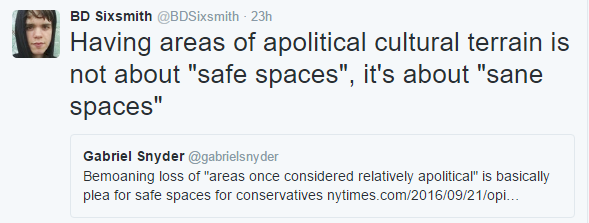
And there you have it — for zealots like Snyder, there is no such thing as neutral ground in a holy war. Likewise, Jamelle Bouie informs us, with a pointed stare and a raised eyebrow, that using a useful descriptor like “virtue signaling” makes you guilty by association with the alt-right. Okay, fine, you got me, I surrender. Yes, I only recently stopped beating my wife. Yes, I’m a conservative. Yes, I consort with neo-Nazis in the darkest corners of the web where we plot foul deeds. Yes, I’ve sworn fealty to the Trumplord. There’s no point in arguing. Confess early, confess often. Cheerfully admit to anything and everything in the hopes that your inquisitors will conclude you’re too insane to understand what you’re even saying.
Ben additionally makes an interesting, related point here: what does it even mean to call yourself a progressive when you oppose much or most of what modern progressivism preaches and practices?
The concept of Rationalia began when Taylor Milsal insightfully mentioned at a cocktail reception of the Starmus Science Festival in Spain’s Canary Islands (July 2016) that, perhaps, a new virtual country should be created: “Rational Land”, containing member states that, by and large, embrace rational thinking in their conduct and policies. This idea was prompted by how much irrational conduct currently drives world politics.
Goya warned us that
monsters rise when reason dreams.
Neil deGrasse Tyson,
with “the evidence”
brandished like a crucifix,
strides on, unafraid,
into that dark night.
Superstitions like the rest,
history’s ghosts are
banished with a snort
of contempt. Enlightenment’s
glow will permeate
all dark corners of
the mind, the heart, the halls of
power. Let it shine!
Oh, the irony,
the poor Cassandra critics,
their words unheeded.
It turned out that his
idea of reason is
rather circular.
The kind of proof he
wants to see is only found
in laboratories.
It’s almost as if
evidence is an inkblot
not a diagram.
♫ You see dimensions in two
State your case with black or white ♫

Thirty years ago, moral panic profiteers like McIntosh and his vice squad partner Sarkeesian would have been leading the charge against subliminal messages on heavy metal records, or the epidemic of Satanic child abuse in day care centers. One day soon, we’ll be able to look back and laugh at the thought that anyone took these frauds seriously. The bad news is, that will just mean that we’ve found a new moral panic to fixate upon. People don’t “progress”; they just trade an older-model hysterical delusion in for a newer one. And so it goes.
