It’s difficult to say what amuses me the most about the way our revanchists do their utmost to deny the separation of church and state. On the one hand, you would think people who are so extremely concerned to make sure that every citizen regularly displays a gaudy excess of sentimental patriotism, lest the nation collapse from a lack of self-esteem, would be constantly harping on one of the things we Myrrhkins can all be justifiably proud of. As I mentioned recently, we’ve grown so used to the idea that metaphysical differences are not worth bloodshed that it can be easy to forget just how long it took for us to get to that point. Fifteen hundred years of Christianity being synonymous with state power, and we never did get around to acting on all those supposed ethics at its core, but a mere couple hundred years of secularism have already accomplished far more. Even many colonial religious groups understood this, realizing it would be in most of their better interests to keep any one denomination from enjoying state favoritism.
religion
Very Superstitious, Nothing More to Say
A believer can never truly stomach a sceptic, because the latter’s refusal to take anything for granted is always perceived as a slight. For some inexplicable reason, a sceptic can never simply be acknowledged as someone who has made the choice to stick with the logical over the illogical and it is always, always taken personally.
In the longest and remotest ages of the human race there was quite a different sting of conscience from that of the present day. At present one only feels responsible for what one intends and for what one does, and we have our pride in ourselves. All our professors of jurisprudence start with this sentiment of individual independence and pleasure, as if the source of right had taken its rise here from the beginning. But throughout the longest period in the life of mankind there was nothing more terrible to a person than to feel himself independent. To be alone, to feel independent, neither to obey nor to rule, to represent an individual – that was no pleasure to a person then, but a punishment; he was condemned “to be an individual.” Freedom of thought was regarded as discomfort personified. While we feel law and regulation as constraint and loss, people formerly regarded egoism as a painful thing, and a veritable evil. For a person to be himself, to value himself according to his own measure and weight – that was then quite distasteful. The inclination to such a thing would have been regarded as madness; for all miseries and terrors were associated with being alone. At that time the “free will” had bad conscience in close proximity to it; and the less independently a person acted, the more the herd-instinct, and not his personal character, expressed itself in his conduct, so much the more moral did he esteem himself. All that did injury to the herd, whether the individual had intended it or not, then caused him a sting of conscience – and his neighbor likewise, indeed the whole herd! It is in this respect , that we have most changed our mode of thinking.– Nietzsche
Adam’s Curse
Like so many other Christians I had chosen to view the story of Adam and Eve as a metaphor for something. I just wasn’t sure for what.
How Sharper Than a Serpent’s Tooth
The problem is that this tidy narrative is an American myth. The real story of religion in America’s past is an often awkward, frequently embarrassing and occasionally bloody tale that most civics books and high-school texts either paper over or shunt to the side. And much of the recent conversation about America’s ideal of religious freedom has paid lip service to this comforting tableau.From the earliest arrival of Europeans on America’s shores, religion has often been a cudgel, used to discriminate, suppress and even kill the foreign, the “heretic” and the “unbeliever”—including the “heathen” natives already here. Moreover, while it is true that the vast majority of early-generation Americans were Christian, the pitched battles between various Protestant sects and, more explosively, between Protestants and Catholics, present an unavoidable contradiction to the widely held notion that America is a “Christian nation.”…America can still be, as Madison perceived the nation in 1785, “an Asylum to the persecuted and oppressed of every Nation and Religion.” But recognizing that deep religious discord has been part of America’s social DNA is a healthy and necessary step. When we acknowledge that dark past, perhaps the nation will return to that “promised…lustre” of which Madison so grandiloquently wrote.
Born Against
The history of philosophy throughout the world has been a struggle between two basic fundamental systems — idealism and materialism. Spirituality is a kind of idealism. It takes the view that the spiritual world, the world of ideas, imagination, and mental formations, is the true reality. Matter is regarded as secondary at best or sometimes even as nonexistent. We are spirits trapped inside bodies made of gross matter – and some bodies are a lot grosser than others – and the way to happiness, according to the idealists, is to get free of this material world and its miseries. In many Eastern philosophies we are told, “I am not this body. I am the spiritual soul within.”
Pablo Picasso Never Got Called an Asshole
But the Maher strategy is a little disturbing, as well, since that she was a religious seeker in her youth is not actually very relevant to her contemporary candidacy. O’Donnell’s story is a sad reminder that many religious seekers, who experiment with a number of traditions, are not actually so much open-minded as in search of a narrative about life that will give them certainty (the Society of Krishna Consciousness is as close as Hinduism gets to fundamentalism in its own right). Once O’Donnell settled on right wing Christianity, she became insufferable. And that is what should damn her politically– that she wants to impose her sectarian morality on all of us– not that she tried out other fundamentalisms when young.
A very popular error – having the courage of one’s convictions: Rather it is a matter of having the courage for an attack upon one’s convictions.Even if we were mad enough to consider all our opinions true, we should still not want them alone to exist: I cannot see why it should be desirable that truth alone should rule and be omnipotent; it is enough for me that it should possess great power. But it must be able to struggle and have great opponents, and one must be able to find relief from it from time to time in untruth – otherwise, it will become boring, powerless and tasteless to us, and make us the same.
Shall I Compare Thee to Summer’s Eve®?
Thou art more douchey, and more intemperate.
Hypatia’s Revenge
On average, people who took the survey answered half the questions incorrectly, and many flubbed even questions about their own faith.Those who scored the highest were atheists and agnostics, as well as two religious minorities: Jews and Mormons. The results were the same even after the researchers controlled for factors like age and racial differences.“Even after all these other factors, including education, are taken into account, atheists and agnostics, Jews and Mormons still outperform all the other religious groups in our survey,” said Greg Smith, a senior researcher at Pew.That finding might surprise some, but not Dave Silverman, president of American Atheists, an advocacy group for nonbelievers that was founded by Madalyn Murray O’Hair.“I have heard many times that atheists know more about religion than religious people,” Mr. Silverman said. “Atheism is an effect of that knowledge, not a lack of knowledge. I gave a Bible to my daughter. That’s how you make atheists.”
If the Mountain Won’t Come to Muhammad, Fuck It, He’ll Invent His Own Mountain
The religious message is “less clear when you wear an Om and you have no idea what it means,” says Prothero. “Smooshing the Buddha together with a cross and star of David has a clearer message of someone who is spiritual and doesn’t belong to one religion.”He adds that even though all of these symbols may be floating through the fashion world on shiny gold bangles or set with diamonds, people should be religiously literate and know what the symbols they’re wearing stand for. “I’m torn. Sometimes I do get annoyed when venerable religious symbols get dumbed down, but when has it never been like that? Besides, all religions are just different paths up the same mountain.”
Of course, those who claim that the world’s religions are different paths up the same mountain do not deny the undeniable fact that they differ in some particulars… It is to deny that those differences matter, however. From this perspective, whether God has a body (yes, say Mormons; no, say Muslims) or whether human beings have souls (yes, say Hindus; no, say Buddhists) is of no account because, as Hindu teacher Swami Sivananda writes, “The fundamentals or essentials of all religions are the same. There is difference only in the nonessentials.”This is a lovely sentiment but it is untrue, disrespectful, and dangerous.
Titus Androgynous
Via PZ, this is funny:
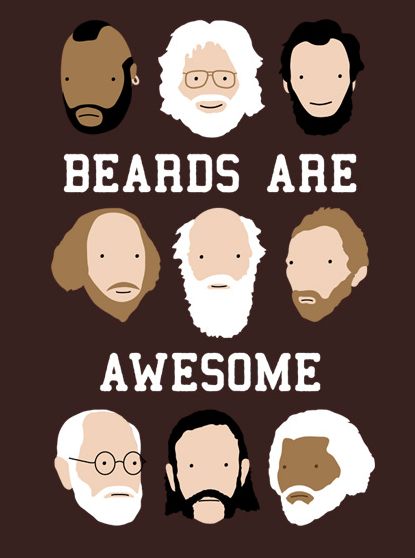
In western countries in particular, a few years ago beards were often confused with a segment of society that reflected rebellion, namely the “hippy” movement of the 60’s and 70’s. It was felt that we should not in any way resemble those that reflected an attitude like this, or the drug culture that went along with it. We have to separate ourselves from that, and to have a beard a few years ago could be confusing, especially to an older generation of people at that time that were especially repulsed at the conduct of those of the younger generation. Even though we are some 30 or 40 years removed from that situation that existed during the late 60’s and early 70’s, it has been proven by experts that some people on some subconscious level do not trust a man with a beard. The underlying message that some get from a beard is that if you have one, you have something to hide, as if you are hiding behind the beard. I have even heard that idea expressed in sales courses that I have taken for secular activities. Beards are discouraged by some sales trainers because of the subconscious message that some people receive from a person with a beard, and some feel that a person without a beard generally speaking has a more professional appearance than a person who does.…In the 1950s, in the the USA, beards were widely unpopular among the general public and most men who wore one were immediately perceived as beatniks (and later, hippies). In that American, Cold War climate, a young man who didn’t sport a military-esque brush cut and bare chin was out-of-hand labeled a communist or homosexual.
Paul, the apostle, said something similar in 1Cor 11:14 about long hair being a dishonor to a man… Obviously Paul’s words were intended for his militant Roman contemporaries. That society started the cropped military haircut and clean-shaven face to keep lice to a minimum and avoid giving an enemy something to grab, in a skirmish.
In the Depths of Their Humanity, All I Saw Was Bloodless Ideology
I’m not telling you anything you don’t already know, but the perpetually aggrieved Bill Donohue is a steaming, whistling little teakettle of a man, forever boiling over one thing or another. What is it this time, Bill?
The pope did not go far enough. Radical atheists like the British Humanist Association should apologize for Hitler. But they should not stop there. They also need to issue an apology for the 67 million innocent men, women and children murdered under Stalin, and the 77 million innocent Chinese killed by Mao. Hitler, Stalin and Mao were all driven by a radical atheism, a militant and fundamentally dogmatic brand of secular extremism. It was this anti-religious impulse that allowed them to become mass murderers. By contrast, a grand total of 1,394 were killed during the 250 years of the Inquisition, most all of whom were murdered by secular authorities.
Yawn. Same old, same old. I’ve heard this so many times it’s starting to sound in my ears like the way adults talk in the Peanuts TV shows: Mwuh mwah muh mwah mwah mooah. Hitler an atheist? Nope. Stalin and Mao primarily driven by radical atheism? Pick your favorite response.
But let’s leave Mr. Donohue to his angry jitterbug on the stove burner and take a closer look at the more interesting theme here. One thing all three of those famous monsters actually had in common with Christianity was a belief in the teleological progression of history toward utopia, as well as in the redemptive, cleansing power of blood and violent sacrifice. Biblical scholars are united in saying that Jesus, assuming he actually existed as a historical person, was just one in a long line of Jewish apocalypticists. I know they don’t tend to emphasize this in devotional readings for some reason, but the entire point of his ministry was to prepare anyone who would listen for the coming end of the world, with violent retribution for all whom he felt deserving, followed by endless paradise. Since then, whether it’s based on visions of heaven, the classless society, or living in perfect harmony with nature, this idea that the ends justify the means pops up repeatedly throughout history. Utopia is waiting just around the bend, right after we get through the great purification by flood, fire, earthquakes or mass murder. It honestly has nothing to do with religion or the lack thereof. It’s an abstract concept of perfection that isn’t exclusive to anyone in particular.
As I’ve said before, I expect that we’re in for some hard times in the next few decades as the glory days of life in America fade further into the past, and we face choices over how far we’re willing to go to maintain our privileged position in the world, especially as nations like India and China look to get some of our standard of living for themselves. Perhaps some more equitable, balanced lifestyle will be the end result of our downward spiral, but human nature being what it is, I’m not optimistic. And because of that, I don’t see any reason to gleefully anticipate the chaos and upheaval that may come. Hell, I’d be happy to be wrong. For me, a rule of thumb is that if you’re so attached to your ideological convictions that you would rather see widespread suffering on a massive scale than to have to revise those convictions, if you can envision that sort of suffering while feeling smug over having accurately predicted it, you might just be the kind of zealot we’re talking about here.
Musical Mysticism
Let’s fall in love with musicThe driving force of our livingsThe only international languageDivine glory, the expressionThe knees bow, the tongue confessesThe lord of lords, the king of kings– Mother Love Bone
In keeping with this, we find that the interest inspired by philosophical and also religious systems has its strongest and essential point absolutely in the dogma of some future existence after death. Although the latter systems seem to make the existence of their gods the main point, and to defend this most strenuously, at bottom this is only because they have tied up their teaching on immortality therewith, and regard the one as inseparable from the other; this alone is really of importance to them. For if we could guarantee their dogma of immortality to them in some other way, the lively ardour for their gods would at once cool; and it would make way for almost complete indifference if, conversely, the absolute impossibility of any immortality were demonstrated to them. For interest in the existence of the gods would vanish with the hope of a closer acquaintance with them, down to what residue might be bound up with their possible influence on the events of the present life. But if continued existence after death could also be proved to be incompatible with the existence of gods, because, let us, say, it presupposed originality of mode of existence, they would soon sacrifice these gods to their own immortality and be eager for atheism. The fact that the really materialistic as well as the absolutely sceptical systems have never been able to obtain a general or lasting influence is attributable to the same reason.
How did Nietzsche’s ideas about music affect his philosophy?“Without music life would be an error” is a great T-shirt slogan, but its meaning is far from obvious. Here is how Nietzsche glosses his aphorism in a letter from 1888, the last year of his sanity:“Music … frees me from myself, it sobers me up from myself, as though I survey the scene from a great distance … It is very strange. It is as though I had bathed in some natural element. Life without music is simply an error, exhausting, an exile.”Nietzsche’s first book, The Birth of Tragedy, dedicated to Richard Wagner, is constructed around the duality between the “Apollonian” and the “Dionysian.” Apollo stands for intellect, reason, control, form, boundary-drawing and thus individuality. Dionysus stands for the opposites of these; for intuition, sensuality, feeling, abandon, formlessness, for the overcoming of individuality, absorption into the collective. Crucially, Apollo stands for language and Dionysus for music. What, therefore, music does is to–as we indeed say–”take one out of oneself.” Music transports us from the Apollonian realm of individuals to which our everyday self belongs and into the Dionysian unity. Music is mystical.Since the human essence is the will to live–or for Nietzsche, the “will to power”–the worst thing that can happen to us is death. Death is our greatest fear, so that without some way of stilling it we cannot flourish. This is why musical mysticism is important. In transcending the everyday ego we are delivered from “the anxiety brought by time and death.” Through absorption into what Tristan und Isolde calls the “waves of the All,” we receive the promise and experience of immortality.Later on, Nietzsche realized that not all music is Dionysian. Much classical music, based as it is on the geometrical forms of dance and march, is firmly rooted in the Apollonian. Yet as the 1888 letter indicates, he never abandoned the musical “antidote” to death. Without music, life would be anxiety and then extinction. Without music, life would be an “exile” from the realm of immortality.
Mama Weer All Crazee Now
One of these kids is doing his own thingC’mon, can you tell me which one?Can you guess which kid is doing his own thing?Before my song is done?And now my song is done.– Sesame Street
Waste Not, Want Not
I really don’t see what all the fuss is about here:
Long before she became the latest fascination of the political press and the cause-of-the-moment of the Tea Party movement, Christine O’Donnell (R-D.E.) was appearing on news outlets large and small extolling the sins of not just sex but masturbation.The Delaware Republican, who is challenging Rep. Mike Castle in the state’s Senate primary and has earned the financial backing of a portion of the Tea Party movement, made an appearance in the MTV series “Sex In The 90s.” Entitled “The Safest Sex Of All,” the episode was ostensibly geared towards understanding the importance of abstinence. But O’Donnell’s guidance went a bit further. Masturbation, she argued, is not a moral substitute for sex. “The Bible says that lust in your heart is committing adultery. So you can’t masturbate without lust.”“The reason that you don’t tell [people] that masturbation is the answer to AIDS and all these other problems that come with sex outside of marriage is because again it is not addressing the issue,” she extrapolated. “You’re just gonna create somebody who is, I was gonna say, toying with his sexuality. Pardon the pun.”
St. Thomas Aquinas went so far as to consider masturbation as more evil than forcible rape. His reasoning was that even though forcible rape might cause injury to another person, it could still result in procreation and therefore could not be peccatum contra naturam (a crime against nature), whereas masturbation was definitely against nature since it could never result in procreation. Aquinas no doubt had this text in mind when he wrote in the 13th century that “right reason declares the appointed end of sexual acts in procreation.”
Show Your Work
Most of us have seen the movie Weekend at Bernie’s, right? Two guys going through all sorts of wacky hijinks in order to convince people that their dead boss is still alive, while going to hilariously desperate lengths to deflect any close scrutiny that might reveal the truth?
Why is anyone paying attention to what Stephen Hawkings or most other scientists say about religion except on the basis of their presumed authority? And it’s the flimsiest kind of authority on the topic, based in a reputation gained in an entirely different field of study. As far as I have been able to see, Stephen Hawking has never published a scholarly paper on the subject in a reviewed journal so it’s not even passed that level of testing. Perhaps if he had tried his ideas in that academic realm he might have avoided limiting himself to one, very crude assumption about religious thinking, believing that all of it is as unaware of the vicissitudes of the study of religious questions as he obviously is.Anyone who has read even a little of the rigorous, formal literature around various religions, would know that the contemporary critics of religion almost never have the slightest knowledge of what serious people have said on the topic.
Not a single law of science is anything other than the product of human thought. Not a single one of them has been developed except within a realm which excludes everything but what we can discover of the physical universe. I believe that exclusion is based in our experience and the extension of our logic, which, itself, is a means to address our experience of the physical universe.…A passage in the Book of Isaiah that often comes to mind when thinking about this topic, is when God is said to have said, “My thoughts are not your thoughts, neither are your ways my ways,”. Whatever else people have held about God, no matter how much of our limited minds and thoughts and even our crimes and injustices we have attributed to God, even the most anthropomorphic religion holds that God is not a human being. To think that God would be required to follow our laws of science or, indeed, any possible actual mechanisms of a universe created by God, is rather touchingly naive in a way that even the “ignorant goat herders” who are believed by the incredulous to have written the Bible were able to surpass.
It seems to be an emotional need of the new atheists to believe they have disposed of the question of purpose but most people seem to be unimpressed with that artificial substitute for reason. And that’s only one of the questions that we, mere mortals, have about the universe which we find ourselves in. I am more convinced as I see us destroying ourselves, to a large degree with the products of science and technology, that unless we include questions of purpose, justice, rights, morality and other entirely non-scientific features of human thought and culture, that science is inadequate in itself to ensure our continued existence.
The Metamorphosis of Narcissus (Hopefully)
Have you ever noticed that when you’re driving, anyone going slower than you is an idiot? And anyone going faster than you is a maniac? Why, I tell ya, folks, it’s a wonder we ever get anywhere at all these days, what with all the idiots and maniacs out there. Because no one ever drives at my speed.
– George Carlin
Religious people have no real interest in Dawkins, whom they find extreme, clinical, mechanical, and monolithic.