That’s the genius of Twitter. All of this scaffolding has emerged around a very basic human impulse. A tweet is the manifestation of the human desire to communicate with many other humans at once—to exercise some influence, to inform, amuse, or outrage. Of course, people have been informing, amusing, and outraging each other forever. It’s been said that Twitter is more of a discovery than an invention. What did it discover to make its insane growth possible?
First, Twitter discovered that blogging is hard. At the time of its birth in 2006, many people in traditional media mistakenly thought that blogging was too easy, and would lead to a profligacy of voices and perhaps even the downfall of polite society. But creating and maintaining an old-fashioned blog took time, effort, and an audience. Twitter democratized blogging by redefining it—the term “microblogging service” is today as meaningless as “microcomputer,” but that’s what Twitter was. It gave millions of people voices they might not have known they possessed—and now is in position to sell a place among those voices to advertisers.
Ahahahaha. Thinking is hard. Complete sentences are hard. Brain all hurty! I know, I know, he’s just speaking the truth — we live in a time when people find it too laborious to check their email, let alone read carefully, contemplate at length, and compose a worthwhile response. I just find it hilarious, especially so soon after reading Anne Trubek’s attempt to talk Twitter up as a dazzling new literary genre in its own right. Now, here’s Ford to confirm that, nope, Twitter is anti-writing, writing for people who find actual writing too challenging, the Saturday-morning youth soccer league of writing, where simply being able to stand upright while maintaining a pulse means you’ll be assigned to a team and get to have juice and snacks afterward, even if you spend the whole game picking your nose and chasing butterflies. And to top it off, as Ryan Tate notes, most people who aren’t underemployed tech-savvy Internet junkies couldn’t be arsed to care about it at all:
But it’s not just that Twitter is small and unprofitable. The truth is that few people here in the States actually use the thing. The social network remains a niche product, beloved by journalists, celebrities, and a hard core of miscellaneous obsessive users — but few others.
Anyway, sorry to sound like everyone’s dad ever, but yes, it’s true, most things worth having and doing require time and effort. Reality’s kind of elitist like that.
Jonathan Franzen, in his latest screed against social media, takes on the pitfalls of this new expectation of writers. Referring to one very active author on Twitter, he argues that now, “literary novelists are conscripted into Jennifer-Weinerish self-promotion.” There is some truth to the claim that authors are pressured to tweet. But when he then disparages “yakkers and tweeters and braggers” as shallow, he leaves writers with no way out. We are both forced to Tweet and labeled superficial for so doing. The only way one can opt out is to be very rich and famous already, too big for publishers to pressure us to help sell more copies. As my friends and I joke (on Twitter), “Only Franzen has the luxury of not being on Twitter.”
I was going to make a comment about how common this particular whine is, but I scrolled down to the first comment and saw that a familiar name done showed up and pretty much said it already, so I’ll say this instead: There are millions, literally millions, of people out there who did very well in English class and could probably write a halfway-decent story if they put their mind to it. Many of them will put their mind to it, at least for a little while. What I’m saying is, Jonathan Franzen’s insouciant opinions about your silly hobbies aren’t what’s preventing you from making a middle-class lifestyle out of your writing ability, it’s just a matter of supply and demand. Who knows, maybe if you weren’t wasting so much time fucking around on Twitter (or whining about Franzen), you might write something that people would actually want to pay for! Probably not, but we can still hope.
Anyway, as I was writing this, I kept thinking: where do I know her from? I mean, this was sho nuff a stupid article, but there was still this miasma of “daft ditz” hanging around her name that couldn’t be attributed solely to that; I must have seen something else she wrote that impressed me with its stupidity…ah, yes, that was it. Wow. On second thought, maybe Twitter is the ideal environment for such people. Maybe some delicate intellects need a sort of cerebral asylum, where they can play with harmless ideas in a safe, supervised setting.
Say you’re a supervillian. Your goal is not to take over the world, but to create more unpleasantness. So you set out to create a device that would ensnare normal, rational people and turn them into ranting lunatics. What would your Argument Machine look like? How would it work?
…I’m not saying that Twitter was designed to create arguments. I’m just saying that, if you set out to create an Argument Machine, it’d come out looking a lot like Twitter.
I’m convinced. I’m also comfortable broadly asserting that no intelligent person with a serious point to make would ever choose Twitter as the forum for kicking off the discussion. (Someone like Richard Dawkins, I assume, is just indulging a newfound love of trolling.)
“To modern eyes, the chaotic and adversarial media environment of the 1640s has much in common with the Internet’s blogging culture,” he writes. “To modern eyes these tablets, with their flat writing surfaces surrounded by a wooden frame, look strikingly similar to tablet computers.” Well, I suppose if you’re looking for similarities between the primitive wax tablets used for correspondence by the Roman elite and the iPad, you can find them. But how similar are they, really, aside from their rectangular shape? The iPad is a commercial product from a multibillion-dollar corporation, marketed to middle-class consumers who use it to send messages, take photos, play games, compose marketing presentations, watch episodes of MasterChef, wake themselves up in the morning, and myriad other purposes. A wax tablet is a wax tablet.
Things that appear similar from a distance gradually reveal their differences on closer examination, and the more you think about some of Standage’s analogies, the keener the differences become. I quite liked the section about how the residents of ancient Rome would scribble messages on city walls—hotel reviews, sexual boasts, political endorsements—but I’m not entirely convinced that those messages actually constitute some sort of antediluvian Facebook wall. It certainly seems that, like today’s social platforms, Roman walls offered relatively unmediated spaces in which residents could interact, with nobody to direct the conversations or guide them toward productive ends. But there is a significant difference between messages that exist in a fixed physical space and those that exist only in digital form. A different format means a different user experience, and Standage’s failure to substantively address these differences makes it hard to actually gauge the value of the comparison.
Similarly, I question whether Martin Luther’s experiences are all that relevant to our understanding of modern viral content. Yes, the speed with which Luther’s arguments spread somewhat resembles the way that modern causes can find huge support in a small amount of time. But isn’t the difference that something actually came of the 95 Theses? Luther fractured Christendom. He sparked the Reformation. Modern social campaigns come and go in days, as flighty Tweeters move on to the next big cause or petition, or simply turn their attention to hot new photos of dogs wearing hats. That’s not to say that Twitter and Facebook and the rest could never be used to galvanize significant social change. It’s just that today’s social media platforms are so much busier and broader than those in Luther’s era that it’s hard to attempt any sort of direct or useful comparison. If Luther had issued the 95 Theses today, they would be forced to compete for attention with lists of 95 Great Places to Eat in Wittenberg; which do you think would be more popular?
To get one’s news in such a highly mediated fashion is clearly dangerous. The ersatz dialogue which occurs on Twitter can give the misleading impression that all opposing opinions have been given a fair hearing, and thus that the dominant opinion at the end of the day must be the inherently superior one. No need to weigh the various arguments yourself, Twitter already did the work for you. Touted for its promotion of decentralized and democratic dialogue, Twitter more often enables the rapid formulation and dissemination of orthodox opinion. At the same time, if you maintain a bit of critical distance, watching the construction of conventional wisdom on Twitter can teach you plenty. You can see which arguments trump others, which positions are taken to be unassailable, what affect works best. Taken as a whole, it’s an unprecedented wealth of sociological data.
Observing Twitter in this way, one quickly notes that an addiction to outrage seems to afflict writers across the political spectrum. Opponents are castigated for being insufficiently scandalized by the atrocity of the hour, and authors of offending posts are roundly demonized and ridiculed. Silver linings are rarely sought in bad news, common ground with adversaries seldom found. The right is arguably more reliant on this Manichaean rhetoric, but the left has a strong habit too. As opinion crystallizes on Twitter, posters become increasingly uncompromising, attracted to whichever position most strongly attributes moral purity to their own side and depravity to the other. Meanwhile, anyone who would criticize an outraged writer’s moralistic tone risks appearing too callous or naïve to realize the enormity of the crime at hand—whether it’s Obama’s visit to an Amazon warehouse or a university’s experimentation with MOOCs. Outrage may look like moral bravery but, on Twitter at least, it is safe as can be.
Twitter, hell; it was always like that on blogs, too. That whole system of social media provides a neverending supply of cheap stimulation for adrenaline junkies, as well as a permanent stage where they can perform their manufactured outrage for an appreciative audience. One of my favorite aspects of this faux-moral performance art is when, lacking the usual visual cues of authentic real-life anger, the performer is required to simulate hizzorher vein-popping, carpet-chewing, spittle-launching fury — in text form, which obviously requires a certain amount of both mental and physical composure. It never fails to tickle my absurdist funny bone, imagining someone sitting quietly at their computer, composing a fictional representation of barely-controlled psychotic rage (with no typos or misspellings, even!), and then taking pleasure in the plaudits. What did these people do before there was a twitosphere to provide them with some semblance of meaning in their empty lives?
Traditional media outlets will still be around to sort out the noise and rumors on Twitter, analyze it and turn it into stories. But no one can beat Twitter for breaking coverage, the fast transfer of thought, and an endless supply of original content that’s easy to consume on the go. Twitter will be – and already is – the only way for us all to stay relevant.
Relevant! You know, I admit it. I clicked on the link to an article entitled “Why You Should Care About Twitter,” because, well, I figured such directness deserved the benefit of the doubt. The title implies that the author is fully aware that many (most) people do not care about it, and thus, one might expect to hear a strong case presented, one that incorporates all the usual criticism and offers a rebuttal. Instead, we get the above excerpt as a conclusion, confirming that, yes, the social web is every bit the vapid fashion catwalk you thought it was. Marketing, branding and spotlight-seeking for its own sake. Anything more than five seconds old or written above a sixth-grade reading level risks irrelevance. Jesus Aitch.
In the late ’90s, early bloggers expected the level of discourse to be high. In fact, intelligent commenting was seen as a path to gaining respect in the blogging community. At the beginning of 1999, there were only about two dozen blogs (which were mainly lists of interesting Web sites), but as the number exploded, it became hard for bloggers to follow the fragmenting conversations. In 2000, the blog service Blogger introduced permalinks, which allowed each blog entry to have its own URL, and in 2002, Moveable Type implemented the TrackBack, which automatically alerted an author that a permalink from his blog had been posted elsewhere. The TrackBack was meant, at least in part, to blur the lines between commenters and writers; the conversation surrounding one blog post no longer needed to be relegated to the comments section, but could be sprinkled across disparate blogs with the TrackBack as its link. That was great, in theory. But while conversations were the model for interactions, the technology couldn’t sustain what real conversations required.
I think some of the diaspora of commentary on blog posts happened because blog comment threads are to a first approximation cesspools of stupid hate. As Scalzi says in his post, the phrase “Don’t Read The Comments” is widely used for a reason. It’s partly because moderating comments is work, and partly because people give inexplicable latitude to vandals whose sole intent is to piss all over your living room rug. Meanwhile? On Facebook? If you post a link to an outside blog post and make a comment on it, and someone replies by insulting you, you have moderation powers. That’s not a bad thing: it’s a democratization of the ability to enforce respectful discourse.
Anyway. What had been a more coherent commentariat for many mid-sized to large blogs has splintered. A provocative blog post might now spawn conversations on Facebook, Twitter, Tumblr, Reddit, Google+, and a handful of other major venues. With a very few exceptions, I think mainly constituting large blogs that offer their commenters a distinct sense of community, the comment diaspora has happened and I don’t think we’ll be going back to 2005.
My secret to ensuring intelligent discourse in the comments is to have very limited appeal. I’ve never enjoyed trying to have a conversation in a boisterous crowd; why would it be any different in a text-based medium? As the mawkish poet James Kavanaugh wrote, I do not like many people, love; they bore me, or attack me, or talk too much when there is nothing to say. QFT. The less people who stick around to become regulars, the better the chance of conversing with them as individuals rather than two-dimensional ideological symbols, and the easier it is to feel patient and considerate when they persist in arguing wrongheadedly against your superior wisdom. I know Internet currency consists of pageviews, retweets and likes, and by such standards I’m a po’ boy indeed, but at least I’ve had my fair share of good conversations here.
One of the worst things about the internet is that it tempts everyone to be a sophisticate – to take positions on what is hip and to consider, under pain of being considered unhip, the positions that everyone else is taking. Kraus may not have cared about hipness per se, but he certainly revelled in taking positions and was keenly attuned to the positions of others. He was a sophisticate, and this is one reason Die Fackel has a bloglike feel. Kraus spent a lot of time reading stuff he hated, so as to be able to hate it with authority.
The question is whether the effects of this dynamic are salutary or negative. Being the internet skeptic that I am, I personally feel that the dynamic is an unhealthy one. While I believe in the necessity of social conditioning, I think that such conditioning is most appropriate when influencing community behavior, and least beneficial when it comes to arguments and ideas, which suffer if they are too easily influenced by social pressure. In other words, the online world, which much more resembles a debate hall, classroom, or legislative body than a social community, is precisely where we would least hope to find explicit markers of social approval. What’s more, it’s important to think about what kinds of online behavior tend to get these little nods of approval. Jokes, insults, messages of professional regard, and showy displays of disaffection are just as likely to receive these little digital strokes as good writing, thoughtful ideas, or kindness. And by their nature, some of the most important of social values can never be rewarded in this way: humility, reserve, gentleness, restraint, and quiet compassion. If the internet frequently feels like a pit of meanness and obligatory jokes, that’s because those are the behaviors that are most rewardable and are most rewarded.
Which do I leave first: Facebook or Twitter? I’ve been mulling that question for about a year now, but it always seemed theoretical. On top of that, it would have been a no-brainer. Twitter is essential for work, while Facebook – increasingly burdened by adverts, security issues and intellectual property disputes – is not. But I am now watching Twitter become morally depopulated and seriously considering how long I’ll be on there.
…The solution has to be radical and collective, for the stakes are high. Twitter is the first mass, global conversation, and if it becomes fatally polluted by frat-boy perversity and the verbal spew of sociopaths it will take some time to rebuild elsewhere. Policing it comprehensively is impossible.
I laughed until I nearly choked, I did. Not just at the absurd spectacle of a supposed adult going all garden-of-Gethsemane over such a pathetic trifle, though that is indeed funny. No, my favorite part is that second paragraph — he still holds fast to his utopian vision of the potential for “the first mass, global conversation” even as he’s frantically backpedalling in horror upon hearing just what it is the global masses have to say. Ain’t that always the way? The starry-eyed morons who wax eloquent about an ideal form of humanity are the same ones who want nothing to do with the way most people actually live. Mass communication would be great if only the masses could somehow be excluded from it. We had to censor the conversation in order to save it.
You’ve probably seen a lot of the same articles I have on the web — you know, those achingly stupid pieces about how “the ancient Egyptians communicated in what could be understood as a rudimentary form of social media!” Or, “The relationships between characters in Jane Austen’s novels reflect the ways in which we communicate through social networks!” Nothing is too staggeringly facile or utterly uninformative to be published as long as it somehow references social media, because lord knows, Facebook is the teleological endpoint to which human existence has been striving lo these interminable eons, and Twitter is the ground of all being, through our relationship to which we come to truly know ourselves.
Most of the time, I deal with the brainache by making a drinking game out of Maria Popova’s use of the word “timeless”, and in no time at all, unconsciousness claims me and the torment ends, at least until the next time I open my laptop. But do you know how to recognize when you’ve really spent way too much time obsessing over gadgets and filtering the world through a narrow, tech-related prism? When you write shit like this in earnest:
This is kind of blowing my mind…because of the compression of history, I’d always assumed all these people were around the same age. But in thinking about it, all startups need young people…Hamilton, Lafayette, and Burr were perhaps the Gates, Jobs, and Zuckerberg of the War.
Yes. The Revolutionary War as a Silicon Valley start-up. What a totally illuminating metaphor that in no way sounds myopic or narcissistic. Holy fuck. Maria, save me.
I have almost no interest in blogging anymore, as I now, like everyone else, use social media to offer my links and commentary. At the same time, I don’t want to shut the blog down (yet), as I still get occasional flashes of inspiration. So excuse me while The Peking Duck continues operating on life support.
Almost three years to the day since I noted him saying the exact same thing. That is one astoundingly long, drawn-out death rattle. Seriously, on the fashion catwalk that is the social web, three years of consistency in anything is mighty impressive. There’s life in the old bones yet!
True, though, I suppose; if you see blogs as a rudimentary format for facilitating the efficient transfer of information, then I guess it makes sense to favor social media for that purpose, at least until some tech giant finally figures out a way to implant those electrodes in our brains. Not everyone is a writer or foolosopher for the sake of it; some people have never used blogs for anything but to say, “Hey, look at this.” You can do that on any platform.
For those of us who prefer to add even a minimal amount of art and effort to our communication or self-expression, though, the fixation on microblogging platforms is all about fashion, with, yes, all the sneering disdain that word entails. Not in this particular case, but in general, when you read yet another piece claiming that blogging is sooo early aughts, sooo totally over, you know you’re in the presence of frivolous people whose greatest fear is being the one left standing when the music stops and all the cool kids have grabbed a seat.
Recognising things aren’t black and white means recognising nuance. Nuance leads to accuracy. Accuracy isn’t merely about being right, it’s about reality. It’s only when we know how the world is that we change it; otherwise, we’re only working to change a fiction we’ve created in tweeted outrage: whether it’s that Rolling Stone is insensitive or two bystanders were the bombers.
Of course, nuance requires time, which goes against the social media outrage machine.
Good ol’ Tauriq, fighting the good fight. Of course, I don’t think that most of the people he’s talking about necessarily care about being accurate or changing the world for the better. I mean, sure, no doubt they say they do, but like a lot of aspirational statements, that’s only designed to get the maximum status boost from a minimum of actual effort. In the same way that parasitism, by gaining sustenance at no cost, is a brilliant evolutionary strategy, social media “activists” accrue a lot of cultural capital without having to put in the hard, thankless work that a lot of real activism entails. Again, you might even suspect that some of these people have masterfully exploited a narrow niche: they get attention, increased self-esteem, and, in some cases, even money, by doing little more than acting like loudmouthed assholes on the Internet. Much of what Tauriq describes is simply the popular online spectator sport of pointing and denouncing, a game anyone can play, whatever their skill level.
Shaming, it seems, has become a core competency of the Internet, and it’s one that can destroy both lives and livelihoods. But the question of who’s responsible for the destruction — the person engaging in the behavior or the person revealing it — depends on whom you ask. At its best, social media has given a voice to the disenfranchised, allowing them to bypass the gatekeepers of power and publicize injustices that might otherwise remain invisible. At its worst, it’s a weapon of mass reputation destruction, capable of amplifying slander, bullying, and casual idiocy on a scale never before possible.
…We despise racism and sexism because they bully the less powerful, but at what point do the shamers become the bullies? After all, the hallmark of bullying isn’t just being mean. It also involves a power differential: The bully is the one who’s punching down.
…Internet speech can be cruder and crueler than our real-life interactions, in large part due to our literal distance from the people we’re talking to and their reactions. That detachment can sometimes be liberating, and it’s often a good thing that people speak bluntly online, especially against injustice that they see around them. But a sense of proportion is crucial. These days, too many Internet shame campaigns dole out punishment that is too brutal for the crime. Using an influential social media account to call out individuals, as Richards did, isn’t simply saying something is “not cool”; it’s a request to have someone put in the digital stocks, where a potentially unlimited number of people can throw digital stones at them. And it turns out to have real-life consequences for everyone involved.
There are a lot of things about the social web that are various degrees of annoying, but this is a phenomenon I truly despise. Assholes are a fact of life, but they can be avoided or ignored in many cases. The panopticon of small town life is stifling, but it can be escaped by moving to a bigger city. But in the age of social media, assholes with a small-town desire to obsessively monitor everyone else’s behavior have mixed technology with self-righteousness to create the ultimate high: a belief that a better world is created by indulging one’s most petty, vindictive, assholish urges. The only thing anyone “learns” by being on the receiving end of one of these vigilante campaigns is to fear provoking mob action, something we should all know by now, and nothing we should be celebrating.
Ahaha. I suppose it says something regrettable about me, but though I can dispassionately observe arguments over morals, ethics, public policy, and other matters of significance without even a ripple of discontent disturbing my ataraxy, I found myself almost offended by the sheer banality of this article — I mean, wow, holy shit, “testaments not only to Twitter’s power as a platform for sharing, but also to cameras’ increasing ubiquity in our lives,” Jesus Christ, how incredibly goddamned profound, thank god you wrote a fucking article to tell us that every idiot with opposable thumbs has a camera phone and hence people are posting a lot of pictures on Twitter.
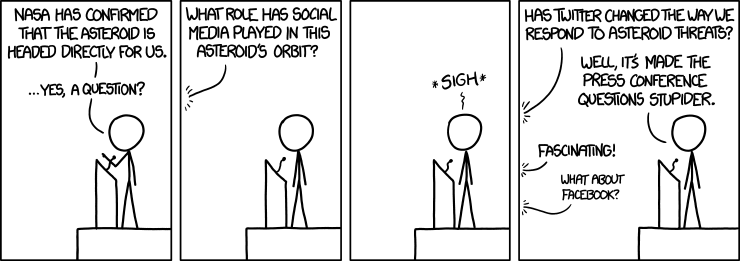
Fits of ill-tempered pique aside, you know that feeling when you hear of a celebrity’s death, and you’re surprised because you’d been under the assumption they’d already been dead for years? Well, it’s surprising to me that it took until now for this comic to exist. You see it, you laugh, and then you think, wait, no one else thought of this yet? You kind of assume this joke has always existed, perhaps in Platonic ideal form. I’m certainly no early adopter, but I was yearning for an end to the meta-fascination last year. Oh, I was so cute when I was young and naïve…
One of the initial promises of social media was that it might help ideas succeed on their own — removing the old gatekeepers, whether Roman aristocrats or publishers, and democratizing how information circulates. But this isn’t quite how it has turned out.
…Social media is in fact not especially democratic. The most powerful people and institutions have the most Facebook fans and Twitter followers which means that content that serves their interests is much more likely to show up in your newsfeed. In the case of the Gatsby post, the scholars were mostly positive about the movie — and it’s hard to imagine that the post would have had nearly the same readership if they’d hated it and thus the movie studio had ignored it. For people in the media, this kind of power sets up a dilemma that’s not altogether different from the one authors faced in Cicero’s time: the bigger the interests you please, the more likely you are to be read.
If I’m going to be slightly caustic about it, and why not, that supposed promise of social media provides a frisson of rags-to-riches fantasy to people who might otherwise consider themselves too savvy to waste money playing the lottery. The dream of a pure meritocracy dies hard, I suppose. But again: our eyes and ears tell us that most people are social animals who care more about fitting in and feeling comfortable than tormenting themselves with nuanced thinking for the sake of abstract ideals. Human nature isn’t merely a frustrated urge toward disinterested inquiry awaiting the proper tool or organizational system to set it straight. New technologies will, ploosa shawnje, be used in service to the same old pursuits of glad-handing, status-seeking, ego-stroking and score-settling.
The rise of the social web may be perceived as a re-villaging, where the permanence of one’s digital footprint behaves as a deterrent, making it seem to some like an ideal time to reintroduce public shaming to reinforce norms. But considered through a historical lens, public shaming begins to look like a tool designed not to humanely punish the perp but rather to satisfy the crowd.
This explains its resurgence. When has the crowd ever been bigger, or more thirsty for vengeance? The faceless Internet, with its shadowy cyberbullies and infinite display of every social ill is scary. And when it slithers its tentacles in a person’s life, we become desperate for some way to fight back—to shine light into the darkness and counterattack those who would victimize behind the veil of anonymity. But doxing, even just naming publicly-available names to channel outrage (or worse) at someone who has violated your norms, is not only an ineffective way to deal, it risks causing more harm than the initial offense. Last year’s trendy rise of media-sponsored shaming is self-righteousness masquerading as social justice. In many cases the targets deserve to be exposed and more, but public shaming does not drive social progress. It might make us feel better, but let’s not delude ourselves into thinking we’ve made a positive difference.