While Pangram is accumulating the power to end reputations and careers, the tool does make mistakes, perhaps to a greater extent than is currently understood. In turn, AI accusations could very quickly spiral into a witch hunt.
…Pangram, to be clear, is not useless. But this is exactly the problem: It’s too easy to twist and contest Pangram’s conclusions, especially when nobody really agrees on which uses of AI are or aren’t ethical. Just like chatbots, AI-detection tools have become effective enough for widespread use, but not reliable enough to fully trust. In this way, Pangram and other detectors are mirror images of the AI products they are hunting for.
I admire Wong’s attempt to bring facts and perspective to a moral panic, but I fear it’s largely beside the point. The mob does not primarily want accuracy. It wants authorization. I’ve already seen several articles and posts which indicate to me that the narrative has congealed around Pangram being the authority that can tell AI from non-AI. It has become one of those things that “everyone” knows.
“Is Pangram good at detecting AI?”
“That’s what ‘they’ say!”
In fairness, most of what we “know” is like this. We do not personally verify food safety standards, bridge engineering, drug trials, crime statistics, economic data, historical dates, or medical advice. We live by delegated trust. The problem is that delegated trust and herd belief feel similar from the inside.
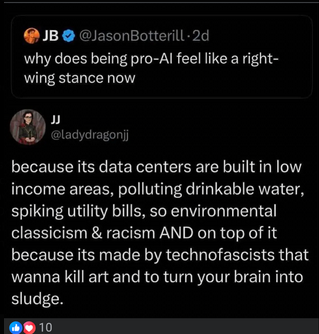
Who is “they”? What do “they” know, and how do we know that they know it? The next person you see repeating the claims of Pangram’s accuracy doesn’t know how it works, or how reliable it is. They just know that an article or spokesperson told them what they wanted to hear. They just know that “studies have shown.” They just know the sweet relief of doubt and insecurity being assuaged. Pirate Wires published an excellent debunking of the panic around data centers and water usage last year, and I still hear friends repeating the conventional wisdom that “AI is using up all the water.” (Strangely, the “misinformation” sniffers are nowhere to be seen on this issue.)
Studies and corrections have limited power for now. A study can answer, “How much water does this consume?” or “How accurate is this detector?” But the panic is asking different questions: “Are we being replaced?” “Are people cheating at being human?” “Is civilization being hollowed out?” “Can I still trust any text I read?” “Are my own skills suddenly worth less?” Those are existential anxieties, not spreadsheet questions. Once anxiety has moralized itself, the facts become subordinate. People do not say, “I am afraid and disoriented.” They say, “This is theft.” “This is fraud.” “This is environmental destruction.” “This is soulless slop.” “This is the end of human creativity.” Some of those claims may contain truth in particular cases, but their social function is often emotional laundering. Fear enters the machine and comes out as righteousness.
In a panic, people do not merely want facts. They want reassurance that the walls still hold. They want an authority to step forward, raise his hands, gesture for calm, and say that the malefactors have been identified and the contamination contained. In earlier ages, that authority might have been priest, magistrate, censor, expert, committee, or cop. In ours, with perfect comic symmetry, it may be software. The crowd terrified that judgment has been outsourced to machines now asks a machine to tell it whom to punish.
The harsh truth is that this probably has to burn itself out socially before facts matter much. People will need to see enough absurd accusations, enough friendly fire, enough ruined trust, enough obviously human prose dragged before the tribunal. Until then, skepticism will sound to the panicked like apologetics for the devil.